|
|
|
|
|
|
|
|
|
The 2027 annual IAFI Membership Meeting will be a 'Pardee Party' on June 11-12, 2027, in Butte and Philipsburg Montana, hosted by the Glacial Lake Missoula Chapter.
|
What we know now:
Day 1 - Butte, MT, Membership Meeting
Day 2 - Philipsburg, MT
|
|
|
|
|
Planning has just begun, stay tuned at IAFI.org for more details as they develop.
|
|
|
|
|
|
|
|

|
We've completed 3 free K–12 Educators Workshops at 1) the Columbia Gorge Discovery Center in The Dalles, 2) The Reach in Richland, and 3) Shadle Park Library in Spokane . Rick Reynolds, from Engaging Every Student, led over 160 educators through the new Ice Age Floods Detectives phenomena-based curriculum with information and classroom exercises to help students experience the incredible science story of the megafloods that shaped our landscape and history. The workshops were great successes with glowing evaluations from 91 participants, thanks to facility and materials support from the hosting venues and the Ice Age Floods Institute, and with financial support from the Avista Foundation.
|
Workshops Featured engaging classroom and field-based activities included exciting ways to model Floods phenomena and stories of the megafloods that transformed the Northwest 18,000–12,000 years ago at the end of the Last Glacial Period
Up to 7 Washington STEM Clock Hours and/or PDUs for license renewal in Oregon and other states were appreciated, and we've distributed IAFI K-12 Education Mini-Grants to attendees to defray the costs for classroom materials and field trips when implementing the curricula. We are also applying for outside grant funding to plan and conduct several more workshops. For questions, comments, or ideas on where we might offer additional training, please contact Rick Reynolds, M.S.Ed., at rick@engagingeverystudent.com.
|
|
Many thanks to the sponsors of the workshops
|
|
|
|
|
|
|
|
|
|
|
Were pleased to announce that we've distributed our first IAFI K-12 Educaiton Mini-Grants for classroom and field trip teaching support. And we've received over $1600 in additional donations to support the grant program.
|
|
IAFI and our 11 chapters are committing $5,000 annually to launch this effort,
|
|
With member support, we can reach even more students, classrooms, and communities. Your donations will directly fund real-world education — one classroom, one science fair, one budding geologist at a time.
|
Help us make the Ice Age Floods story come alive
|
|
|
|
|
IAFI Leadership Losses
|
|
In a rough year so far, we're devastated to report the passing of two more key members of the IAFI Team, IAFI President Dr. Gary Ford and artist Stev Ominski.
|
|
|
|
|
|
|
|

|
|
Gary's family will scatter his ashes in a place that held a special, enduring meaning to him. Read more
|
|
|
Dr. Gary Ford, Ice Age Floods Institute President, passed away peacefully at his home on June 4, 2026 after living a full life of service, curiosity, and dedication. With a Ph.D. in Soil Conservation he spent a career at Yellowstone National Park and with the U.S. Forest Service.
|
|
When Gary "retired," he brought his leadership, extraordinary openness, thoughtfulness, and exceptional people management skills to the Ice Age Floods Institute. Eager to entertain fresh ideas, support grassroots chapters, and spark a shared sense of wonder, he wasn't rigid or about titles; but it was about fostering an open, collaborative community united by curiosity, He is already sorely missed.
|
|
|
|
|
|
|
Stev Harvey Ominski, 74, passed on Sunday, May 24, 2026, from stroke complications. Stev rendered visual images of the Ice Age Floods that have been widely shared. Primarily self-taught, to Stev. painting was natural as breathing. Just something he did daily.
|
|
his generosity and artistic ability to bring the immensity of the Ice Age Floods to life is something we're ever grateful and appreciative of.
|
|
|
|
|
The IAFI Store has a limited stock of Stev's Ice Age Floods images available for purchase. When our stock is sold out they cannot be reordered.
|
|
|
|
|
|
|
We are looking for new, younger leaders with fresh ideas, skills and enthusiasm.
|
|
We are also looking for a new IAFI Store Manager
|
|
Please contact Patty Hurd for details about the position
|
|
|
|
|
|
|
|
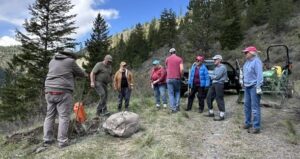
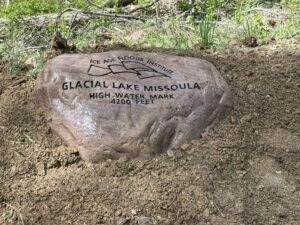
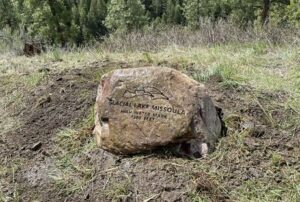
Members of the Glacial Lake Missoula Chapter recently placed two more rock markers on recreation trails located on Missoula hillsides. Both rocks were placed at 4200 feet elevation, the highest fill level of the Lake. The inscription contains IAFI’s name, logo, Glacial Lake Missoula, and the high-water elevation of 4200 feet.
|
|
|
|
|
The rocks (known as #6 and #7) continue the “Route of the Rocks” project of previously placed rocks throughout the Missoula area. Most of the rocks are situated at 4200 feet. Missoula’s elevation is about 3200 feet, so trail users can imagine the valley completely submerged with only the highest surrounding hill tops sticking out.
|
|
|
|
|
|
Rock #6 - Number 6 is located on the Miller Trail which begins at the Little Park Creek Trailhead and parking lot, accessed via upper Miller Creek Road. Hiking distance is approximately 1.5 miles.
|
|
|
|
Rock #7 - Number 7 sits at 4200 feet on Marshall Mountain, a former ski area but now a park, in East Missoula. From the parking lot take the Easy Up Trail .6 mile to the rock.
|
|
|
|
|
|

|
|
Even though the Dry Falls Visitor Center is under construction/renovations, the Ice Age Floods Fest is happening again this year on Saturday, July 25th,10 AM–3 PM
|
|
The event has been moved for this year to the Amphitheater, Sun Lakes Dry Falls State Park. It will be a nice casual gathering of “ologist” types, who enjoy sharing their knowledge, history, and expertise. Cold drinks and snacks will be available!
|
|

|
|
Dale Lehman, Ice Age Floods Institute Puget Lobe Chapter President, and an EXCELLENT Earth Science teacher, is leading a hike from the Umatilla Rock trailhead to Green Lake. The hike is an easy 3 miles that will highlight the amazing features of Ice Age Flood geology, geomorphology, and Shrub Steppe ecosystems.
|
|
|
|
|
There will be booths manned by IAFI and local agencies, maybe a stream table, as well as information related to the floods story. Each participating group will have their own picnic table, folding table, and canopy. We are setting up on the lawn directly behind the Mobile Office in the Amphitheater parking lot.
|
|
|
|
|
|
Ice Age Floods National Geologic Trail News
|
|
We're also sad to report that Justin Radford has resigned from his position as Ice Age Floods National Geologic Trail Coordinator and from the National Park Service. Denise Bausch, working at Lake Roosevelt National Recreation Area, has been assigned as temporary coordinator. She anticipates that a full-time coordinator will be assigned and up to speed by year's end.
|
|
|
|
|
|
|
17,000 years ago, a massive Ice Age lake – now called Lake Bonneville - filled a large portion of present-day Utah. As temperatures changed, the influx of ice melt caused the lake level to rise. In addition, the Bear River, once a tributary of the Snake, was diverted by volcanic activity back into Lake Bonneville. These factors ultimately led to the breaching of a sedimentary rock dam at Red Rocks Pass, Idaho. There was only one ice-age Bonneville Flood because Lake Bonneville broke through a rock dam, unlike the Missoula Floods whose glacial ice dam repeatedly dammed Glacial Lake Missoula, then broke and rebuilt.
|
|
1,100 cubic miles of Lake Bonneville water rushed through the Snake River Canyon, and it took only six weeks for Lake Bonneville to empty the equivalent volume of modern-day Lake Michigan. The Great Salt Lake we know today is a remnant of Lake Bonneville, but at one tenth the size, it is a mere puddle compared to what the lake used to be.
|
|
|
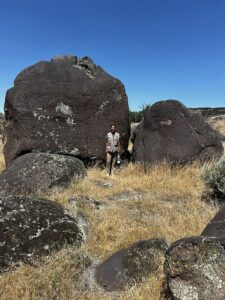
The power of this catastrophic flood widened canyons as the force of the water pulled huge chunks of basalt off the cliffs and tumbled them around, smoothing their jagged edges along the way. As the canyon width narrowed, the force and velocity of the flood increased. Wherever the canyons widened, the flood lost force and velocity, the waters slowed and began dropping its bedload - in this case, giant tumbled basalt boulders instead of your typical river gravel.
|
|
|
|
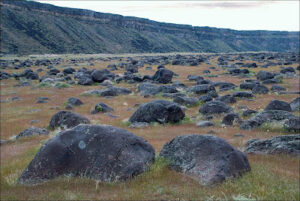
These flood-rounded boulders, named melon gravel due to their distinct shape, are scattered over vast areas of land. The rocks’ unique outlines and smooth surfaces caught the eye of Native American tribes in the area, who have used them as canvases for petroglyphs for thousands of years. Visitors can see the medium sized flood deposits just outside the visitor center, or hike upriver to see gigantic melon gravel the size of heavy-duty trucks.
|
Celebration Park is located in the Snake River Canyon, approximately 23 miles south of Nampa, Idaho. It is home to an enormous melon gravel field deposited by the Bonneville Flood.
|
|
|
|
|
|
Science in the News
|
To feed our members' interest in life-long learning, we share information about the Floods and other science topics. Use our online form to submit an article or question that others might appreciate.
|
|
|
|
|
|
|
|
|
|
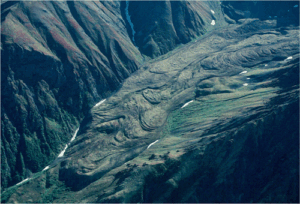
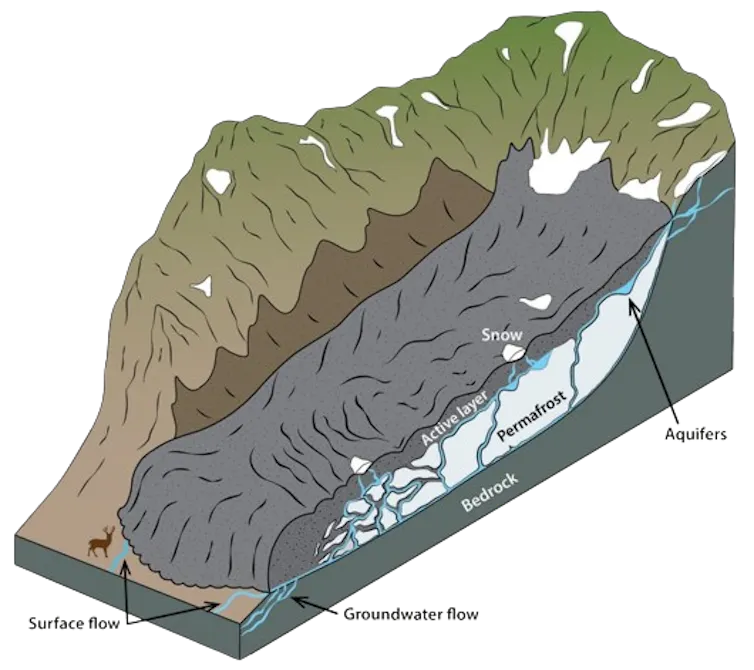
Glaciers you've never heard of could be most important climate havens. They're called rock glaciers, and they might not look like much, but they'll continue to provide meltwater after the world's iconic white glaciers are gone. Rock glaciers are slow-moving masses of rock debris and ice that flow downhill the same way that glaciers do, but they are covered by a thick layer of rock and boulders that can easily be mistaken for stable ground.
|
There are at least 1,500 active rock glaciers across the western U.S., and they’re important. That’s because while the icy white glaciers people typically picture have been shrinking and even disappearing, but a new study shows that rock glaciers and their frozen water are remaining mostly stable despite rising temperatures. The thick debris mantle shades the ice, keeping it colder. The result is that rock glaciers continue to provide meltwater for streams in summer as they always have, but they aren’t disappearing.
|
Every year, mountain glaciers partially melt and then rebuild again as snow falls in winter. But as temperature rise, glaciers are losing more ice than they gain. The vast majority of glaciers in temperate mountain ranges like the Tetons are projected to melt away completely by the end of the century, meaning a critical source of water for mountain streams and lakes will disappear. However, where rock glaciers are present, their protected ice will continue to release meltwater into the streams below, buffering the streams against warming temperatures and drying.
|
|
Understanding how much ice is contained in rock glaciers and how fast they are likely to melt is vital to help plan for the landscapes that will be managed later this century. Researchers have found that some icy glaciers thinned by 2.75 feet per year (0.84 meters per year) between 2014 and 2022, about seven times faster than in the previous half-century. Rock glaciers, on the other hand, were close to stable, losing only about 0.16 feet (0.05 meters) per year in 2014-2022, with no change relative to the 1967-2014 period.
|
|
|
Having a major ice source feeding a stream has also limited the warming of that stream over the past decade. Streams fed by rock glaciers warmed slowly, by about 1.1 degrees Fahrenheit (0.6 degrees Celsius) over the decade, while icy glaciers warmed by about 1 F (0.9 C). Streams that were fed by seasonal snowpack, small patches of ice and groundwater warmed more rapidly, by 6.1 F (3.4 C) over the same period. In one instance, the small snowfields feeding one of our long-term study sites largely disappeared, causing the stream below it to stop flowing by late summer.
|
|
|
A cross section of a rock glacier shows the thick permafrost layer that stores frozen water. Utah Geological Survey
|
|
Because of this, streams fed by rock glaciers have emerged as potentially critical climate refugia – places likely to stay cooler while everything around them warms – for cold-water wildlife in high-mountain ecosystems. A wide array of species already live in the cold meltwater that emerges from rock glaciers, from stoneflies to the bull trout that eat them. As glaciers fade, the ties between cold-water animals and rock glaciers will likely only become tighter.
|
So, the next time you’re out in the mountains, staring off into the distance, look carefully for these large fields of rock that appear to be flowing down the mountainside. And pay attention to that small trickle of meltwater emerging from the toe of the rock glacier. While meltwater from rock glaciers alone certainly won’t make up for the glaciers lost, it could help mitigate the most severe impacts where rock glaciers persist.
|
|
|
|
|
|
|
|
|
|
|
IAFI Store's Inventory Reduction Sale Continues - still a chance to save while you dive deeper into the story of the spectacular Ice Age Floods.
|
We're making room for exciting new items, which means steep discounts of 10% to over 40% on a selection of Ice Age Floods merchandise. Whether you're shopping for the Floods enthusiast in your life, a curious student, or treating yourself to something extraordinary, now's the perfect time to explore the fascinating world of the cataclysmic floods that carved the Pacific Northwest.
|
What Makes This Sale Special?
From educational materials that bring ancient catastrophes to life, to unique gifts that celebrate the power of water and ice, our collection offers something for every curious mind. These aren't just presents – they're gateways to understanding the massive forces that shaped our landscape thousands of years ago.
|
As an added gift for you, every order comes with a free IAFI window decal – your badge of honor showing you're passionate about the incredible science behind the Ice Age Floods story. It's more than just merchandise; it's a conversation starter about one of the world's most dramatic chapters.
|
Limited stock. Shop now while inventory lasts and discover why the Ice Age Floods continue to captivate scientists and nature lovers alike.
|
|
Ready to explore the catastrophic world of the Ice Age Floods? Visit the IAFI Store.
|
|
|
|
|
|
Ice Age Floods Institute (IAFI) is a 501(c)(3) tax-exempt, non-profit educational organization (EIN 91-1658221), founded in 1995 and recognized as an official authority on the Ice Age Floods, providing accurate, scientific-based advice to members and the public. We were instrumental in 2009 Federal legislation authorizing National Park Service designation of the
Ice Age Floods National Geologic Trail (IAFNGT).
|
|
|
|
|
|
|