
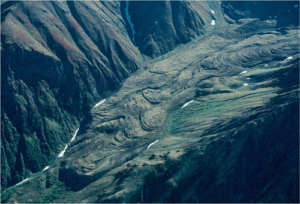
Glaciers you’ve never heard of could be the most important climate havens. They’re called rock glaciers, and they might not look like much, but they’ll continue to provide meltwater after the world’s iconic white glaciers are gone. Rock glaciers are slow-moving masses of rock debris and ice that flow downhill the same way that glaciers do, but they are covered by a thick layer of rock and boulders that can easily be mistaken for stable ground.
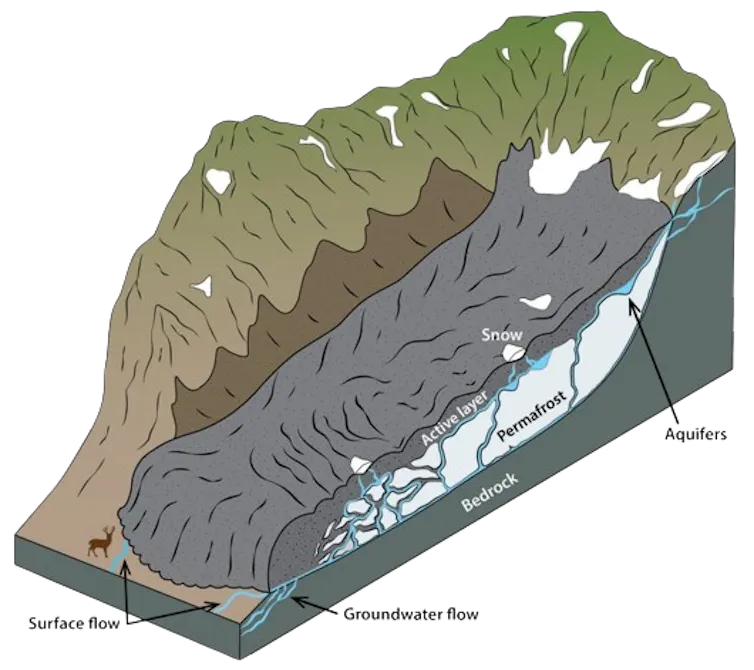
There are at least 1,500 active rock glaciers across the western U.S., and they’re important. That’s because while the icy white glaciers people typically picture have been shrinking and even disappearing, but a new study shows that rock glaciers and their frozen water are remaining mostly stable despite rising temperatures. The thick debris mantle shades the ice, keeping it colder. The result is that rock glaciers continue to provide meltwater for streams in summer as they always have, but they aren’t disappearing.
Every year, mountain glaciers partially melt and then rebuild again as snow falls in winter. But as temperature rise, glaciers are losing more ice than they gain. The vast majority of glaciers in temperate mountain ranges like the Tetons are projected to melt away completely by the end of the century, meaning a critical source of water for mountain streams and lakes will disappear. However, where rock glaciers are present, their protected ice will continue to release meltwater into the streams below, buffering the streams against warming temperatures and drying.
Understanding how much ice is contained in rock glaciers and how fast they are likely to melt is vital to help natural resource and land managers plan for the landscapes they will be managing later this century. Researchers have found that some icy glaciers thinned by 2.75 feet per year (0.84 meters per year) between 2014 and 2022, about seven times faster than in the previous half-century. Rock glaciers, on the other hand, were close to stable, losing only about 0.16 feet (0.05 meters) per year in 2014-2022, with no change relative to the 1967-2014 period.
Having a major ice source feeding a stream has also limited the warming of that stream over the past decade. Streams fed by rock glaciers warmed slowly, by about 1.1 degrees Fahrenheit (0.6 degrees Celsius) over the decade, while icy glaciers warmed by about 1 F (0.9 C). Streams that were fed by seasonal snowpack, small patches of ice and groundwater warmed more rapidly, by 6.1 F (3.4 C) over the same period. In one instance, the small snowfields feeding one of our long-term study sites largely disappeared, causing the stream below it to stop flowing by late summer.
Because of this, streams fed by rock glaciers have emerged as potentially critical climate refugia – places likely to stay cooler while everything around them warms – for cold-water wildlife in high-mountain ecosystems. A wide array of species already live in the cold meltwater that emerges from rock glaciers, from stoneflies to the bull trout that eat them. As glaciers fade, the ties between cold-water animals and rock glaciers will likely only become tighter.
So, the next time you’re out in the mountains, staring off into the distance, look carefully for these large fields of rock that appear to be flowing down the mountainside. And pay attention to that small trickle of meltwater emerging from the toe of the rock glacier. While meltwater from rock glaciers alone certainly won’t make up for the glaciers lost, it could help mitigate the most severe impacts where rock glaciers persist.
Excerpted from an article in The Conversation by Dan McGrath and Ashlesha Khatiwada