
IAFICS Palisades Hike Registration
IAFICS Escure Ranch / Towell Falls Hike Registration
IAFI 2023 YEAR-IN-REVIEW

A summary for our members and other interested people By Gary Ford, IAFI President, January 12, 2024 This is our 7th year preparing a Year-in-Review report for you, our members. We appreciate your continued support, friendship and membership. INSTITUTE MEMBERSHIP Our members provide most of our support and much of the reason for the various materials, activities and events we provide. In 1996, we started with 11 members. At the end of 2023, as we continue to recover from the pandemic, we have 648 members (489 memberships) from 20 states, British Columbia, Canada and Germany. INSTITUTE BOARD PROJECTS IAFI work activities occur at both the Institute Board of Director level and at the Chapter level. Projects at the Institute board level generally benefit more than one chapter or do work that all chapters might not be able to do by themselves. Listed below are some of the recent projects the Institute Board of Directors has worked on. The Education Committee is working with a contractor to develop three 20-minute floods videos for a 4th grade audience The Membership Committee is developing a catalog of speakers for the chapters to use for their member programs. A new membership tracking system has been developed which makes it easier to take care of our members. The Trail Advocacy Committee works closely with the National Park Service (NPS) Program Manager for the Ice Age Floods National Geologic Trail. The intent is to help the Trail Manager with projects related to the development of the Trail. We assisted with three NPS Sponsored Teacher Workshops this year: two in the Tri-Cities area and one in Spokane. Website and Newsletter: Our webmaster keeps our website (iafi.org) fresh and stimulating. He also, with support from the chapters, issues the Pleistocene Post Newsletter four times a year. ANNUAL MEMBERSHIP MEETING This year we had our first annual membership meeting and field trip since the pandemic started back in 2020. It was sponsored by the Puget Lobe Chapter with major assistance from the Lower Grand Coulee Chapter and was held in the Sun Lakes State Park area. Click here for a summary. 2023 CHAPTER PROGRAMS Outreach to inform and educate the public about the Ice Age Floods and their long-lasting impact on our area is a key part of the IAFI mission. Our local chapter programs are possibly the most effective way we meet this challenge. Three of the more important ways we help people learn about the Ice Age Floods are with lectures, field trips and hikes. Lectures – As we have moved beyond the pandemic, we have been able to again offer more in-person lectures with some viewed Zoom presentations. We had 50 in-person lectures attended by over 1642 people. Many more people viewed these lectures when they were posted on YouTube. Field Trips – We conducted 21 field trips with 586 attendees. Hikes – Three chapters sponsored 13 hikes with 163 attendees. CHAPTER PRESENTATIONS TO SCHOOL GROUPS AND SCIENTIFIC ORGANIZATIONS Lake Lewis Chapter: A number of people from the Lake Lewis Chapter help with education programs at The Coyote Canyon Mammoth Site (MCBONES) near Kennewick. Between April and October 2023, McBones hosted school classes or home school groups on 58 days, participated in 12 STEM (Science/Technology/Engineering/Math) events at elementary, middle and high schools, conducted 40 group tours, hosted 12 public tours, and did 7 youth group tours. That means that 1853 adults and 2242 kids were exposed to the story of MCBONES’ Coyote Canyon Mammoth Site and the ice age floods in 2023. Each presentation included the story of the floods usually including the IAFI map of the floods region. The connections between the floods and the mammoth are that the mammoth was buried in several layers of floods sediment (Touchet beds). There are erratic pebbles buried among the bones and the elevation of the bone bed is just over 1000 feet above sea level (about 650 feet higher than the Columbia River at the Tri-Cities). The calibrated radiocarbon date of death of the mammoth is approximately 17,449 years before present. We are studying the death and burial of a Columbian mammoth. We can’t tell people about that without including the floods story. This is a “Who Done It” story, and we have a suspect. Cheney-Spokane Chapter gave a talk to 84 sixth graders at Jefferson Elementary School in Spokane, WA. Also, conducted a program at STEM in March with 367 students. Glacial Lake Missoula Chapter helped with a Bozeman Science Camp. Had a day of classroom activities that discussed glaciers, ice ages, landscapes, climate change. Field trip day featuring Lake Missoula impacts to modern landscapes. Palouse Falls Chapter hosted the Geological Society of Oregon Country for three lectures and three days of touring about 600 miles of the channeled scablands. Had an information booth at STEAM (Science/Technology/Engineering/Arts/Math) night at Colton School. Lower Grand Coulee Chapter assisted with a geology presentation at the Ice Age Floods Fest at Dry Falls aimed at educating children on the Ice Age Floods story (350+ attendees) CHAPTER PRESENTATIONS AT COMMUNITY EVENTS Cheney-Spokane Chapter talked with 102 people at Spokane Outdoor Expo. Talked with 128 people at the Blue Waters Bluegrass Festival, Medical Lake, WA. Glacial Lake Missoula Chapter presented program to Five Valleys Land Trust banquet. Took Wildlife Film Festival Film makers on eastern loop. Featured lake Missoula Story at all stops. Featured Glacial country scenery shots. Columbia River Gorge Chapter made presentations to visiting Polish and German Marshall Fund delegations and led donated field trips for Bingen-White Salmon Rotary and Skyline Health Foundation. Lower Grand Coulee Chapter had a booth at the Quincy Farmer Consumer Awareness Day with IAFI talks and tours, videos and information displays. 250+ attendees. Palouse Falls Chapter conducted a tour at the Sandhill Crane Festival, had a booth at both the Wheatland Fair and the Palouse Empire Fair. Wenatchee Chapter participated in FCAD Farmer Consumer Awareness days in Quincy; also made a presentation at a Master Gardener Conference, 89 attendees. CHAPTER MEMBERSHIP APPRECIATION EVENTS Our members
Test Elementor Post
Add Your Heading Text Here [auto-iframe link=”https://docs.google.com/document/d/e/2PACX-1vSFsSoQRGsaPifqMIFC9LgIY7lTKGeNHF0vzFnAryTvvsC9LPV7NX-BrJ5VjkuKXamUrhavtG2igR_l/pub” width=400 height=1000 autosize=yes] style=”height:1000px !important;”
IAFI Booth at WSTA-CSTA Conference in Wenatchee

Ken Lacy of the IAFI Wenatchee Chapter hosted an information booth at the 2022 Washington Science Teachers Association Conference on Oct. 14-15 in Wenatchee, WA. His was the first use of a new table-top display that we recently developed for conferences, meetings and conventions. Ken felt the display,with its impressive graphics, showing maps and images of Ice Age Floods features, attracted a lot of interest and attention and fostered great opportunities to further engage with the conference goers as they came in for a closer look. He felt there was a high level of interest in the Ice Age Floods topic and people were keen to learn more about the floods, which led to many good conversations. It also gave Ken and opportunity to talk to as many as 10 ESD Science Coordinators about our project to provide 4th Grade level education materials about the Ice Age Floods. Their response was uniformly that this idea would not be well received because there was no time available for additional non-formulary classes. One of these Science Coordinators suggested it might be possible to combine our Floods program with an existing program, such as Language Arts, by presenting Floods information and having the students “prove” the existence of the floods by listing facts that supported this hypothesis. In another discussion with a retired school administrator about the issue of available time for our 4th Grade Floods program, she cited two examples of havin had to turn down outside offers of valuable educational programs because there was just not enough class time available for those programs. However, when Science Coordinators and teachers were asked about the idea of having IAFI people either conduct classes themselves or help the teachers develop such a class, the response was quite positive. The different response to the idea of our 4th Grade Floods program and the proposal for individual classes is significant in terms of class-time and preparation required. A single class session can often be fit into the schedule, but a multi-class program may cut too deeply into the time needed for required cirricula. Still, there are several sections in the Washington State Fourth Grade Curriculum that can support the inclusion of our proposed Ice Age Floods program. It will therefore be necessary for IAFI to work with the ESD Science Coordinators in each school district to get their support for the inclusion of our project.
Oct. 2022 Update from the National Geologic Trail

I’d like to start by thanking the Ice Age Floods Institute for letting the National Park Service share regular updates on Ice Age Floods National Geologic Trail. I’m Justin Radford the Trail’s program manager and I look forward to sharing some of the work we are doing. This summer I had the chance to travel much of the “Trail” from Missoula to Cape Disappointment. Having the opportunity to engage firsthand with the visitor experiences offered by our many partners and the amazing landscapes was certainly the highlight of the summer. Photos and stories from these site visits will bring enhancements to both the NPS App and our website in the future. This summer we also had our second annual Teacher training in Spokane, WA. 43 K-12 Teachers earned credit towards their teaching certificates by learning how to instruct with the story of the Missoula Floods in mind. We are currently working on the calendar for next year with hopes that we will be able to bring our traveling Ice Age Floods NGT and Lake Roosevelt NRA visitor center trailer to more events. Coming up this fall we will engage with the National Park Service’s Service-Wide Comprehensive Call seeking funding and support for future project activities. We will also be working to grow our cultural connections with more groups across trail. Thank you for your support as we continue to grow Ice Age Floods National Geologic Trail. More good news to come as we work with the Ice Age Floods Institute and other partners to move the Trail programs forward. Justin P. Radford Program Manager Ice Age Floods National Geologic Trail Address: Lake Roosevelt National Recreation Area 1008 Crest Drive Coulee Dam WA 99116 Phone: 509-237-9722
Dean Ladd, 1921-2022, RIP

Dean Ladd, Lt. Col., USMCR Ret., and founding member of the Ice Age Floods Institute passed away on August 17, 2022 at the age of 101 at his home in Spokane, Washington. He was born in Spokane and enlisted at 18 in the Marine Corps. He saw intense WWII fighting during combat on Guadalcanal, Tarawa, Saipan, and Tinian. He served with the Second Marine Division as a platoon and company commander. His experiences led him to write his book, Faithful Warriors, to remember his fallen comrades. It was published in 2009 by the US Naval Institute Press. At the time of his death, he was the oldest retired marine. Ladd received a field commission and saw extensive WWII combat in the Pacific with the Second Marine Division at Guadalcanal, Tarawa, Saipan, and Tinian. He was wounded three times, the most seriously during the landing at Tarawa. He received a Purple Heart at Tarawa and a second one at Saipan as well as numerous other honors during his lifetime. Dean returned home after the war and earned a BS degree in Mechanical Engineering from Washington State College (now University) in 1947. His civilian occupation was in engineering and management with Kaiser Aluminum, North American Rockwell and Lockheed Missiles and Space. He was President of the Lockheed National Management Association. Dean and Vera built their dream home in the hills of Spokane Valley. They had three daughters, Kathleen and Michele (twins), and Janet. Dean stayed very active with the Marine Corps Reserve Association and the Ice Age Floods Institute during its creation in 1994. He also was a founding member of the Cheney-Spokane Chapter in 2003. He volunteered extensively with both organizations and was always present at events where he was a friendly greeter and story teller until his health caused him to stay at home and write. Over his lifetime, he wrote three books and 29 manuscripts while pursuing his hobbies of genealogy, Marine Corps reunions, history, and geology. He is greatly missed. Much more information about his life and works can be found at this link: web: http://theworksofdeanladd.yolasite.com Fond memories and expressions of sympathy may be shared at www.HazenJaegerValley.com Written by Melanie Bell, President, IAFI Cheney-Spokane Chapter
Rick Thompson Honored in Chapter President Retirement

Charles Hall, Board Member and Co-Founder of Lower Columbia Chapter Ice Age Flodds Institute presented his miniature of the Willamette Meteorite to Rick Thompson upon his resignation as Board President of the Chapter in preparation for his and Sylvia’s move from Oregon to join family members on the East Coast. Sylvia Thompson also resigned her Secretary Board position. Rick is well known for his many years of study of erratics carried by the mega floods of 15,000 years ago, often called the Missoula floods which had major impact on the landscapes of Montana, Idaho, Eastern Washington and Northern Oregon. Such erratics were carried in glacial icebergs late in the last Ice Age. Rick published his first book on the subject, “The Hunt for Iceberg Erratics.” His second book, “GigaFlood” is now in its second revised edition. The Willamette Meteorite is thought to have fallen to Earth many thousands of years ago onto the large ice sheet and glaciers covering Western Canada. There was an ice dam at the Purcell Trench which eventually collapsed sending icebergs throughout the flood path toward the sea. They carried erratics, among them the Willamette Meteorite. It drifted into Lake Allison (the Willamette Valley); beached and grounded on a bar 400’ above sea level where the iceberg melted and stranded the Meteorite. It was different from every other erratic as its composition is nickel-iron and it has a ring to it when struck. Native Americans called it “The Visitor From The Sky.” For all these reasons, the Willamette Meteorite is the most awesome erratic. I wanted Rick to have my copy of it for his enjoyment and to thank him for his nearly 10 years leadership as President of the Lower Columbia Chapter, Ice Age Floods Institute. Lower Columbia Chapter IAFI was founded in 2005 by Mark Buser and myself. In 2014, the Lower Columbia Chapter joined with the Tualatin Historical Society to meet monthly at the Tualatin Heritage Center. Charles Hall: Co-Founder, Chapter Board Member & Treasurer for Lower Columbia Chapter, Ice Age Floods Institute
Ephrata Erratic Fan

EPHRATA ERRATICS FAN Ice Age Floods National Geologic Trail The Ephrata Erratics Fan is a depositional area south of where water from the Missoula floods poured out of the lower Grand Coulee. It is called a fan because the deposit is spread out like a fan or delta. The basalt and granite boulders now littering the Ephrata Fan were carried there by torrents of water that gushed out of the Grand Coulee. Water and debris exploded from the mouth of the Lower Grand Coulee complex sending debris in a wide swath like pellets from the mouth of a shotgun. Velocity reduction at the coulee mouth and debris momentum carried large boulders a mile or more before they began to settle out of the slowing water stream. The largest of these, “Monster Rock”, is estimated to be about 8m (25 feet) in diameter and contains over 500 cubic yards of rock that weighs over 1,500 tons! “The Ephrata fan is an immense accumulation of gravel and sand that resulted when mega-flood waters from Crab Creek, Dry Coulee, the lower Grand Coulee (ending at Soap Lake), and smaller scabland channels entered the Quincy Basin. The deposit probably formed more in the manner of an immense expansion bar (Baker, 1973a), rather than a fluvial fan in which relatively small alluvial channels shift across the fan surface without ever inundating the entire surface at once. Local areas of surface scour occurred on the fan, the most prominent of which is Rocky Ford Creek. The scour probably developed during waning flood stages, when draining of the inundated Quincy Basin caused relatively steep water-surface gradients to occur over the depositional surfaces that had been constructional during the high stages of megaflooding (Baker, 1973a). The scour processes produced the lag concentration of boulders on the fan surface, many of which can be seen from this viewpoint. An alternative explanation for the morphology of the Ephrata fan is that it was progressively incised by a sequence of multiple floods of successively decreasing magnitudes (Waitt, 1994; Waitt et al., 2009). It may also be that a more complex combination of these mechanisms occurred.” Due to sudden expansion, the floodwaters decelerated and deposited about 130 feet of sediment onto the fan. At the head of the bar, east of Ephrata, are house-size boulders up to 60 feet in diameter. Sediment sizes in the fan decrease with distance south from the mouth of the Grand Coulee. Many of the large boulders that cover the fan are basalt that was likely ripped out of Grand Coulee and other scabland channels just upstream. There are also numerous granitic erratics that were likely carried in the floods from as far away as the Grand Coulee Dam area, over 6o miles north. Quick Facts Location:Hwy 17 south of Ephrata, WA at Hatchery Rd NE. OPEN TO PUBLIC:No MANAGED BY:Private Owner
Grand Coulee National Natural Landmark
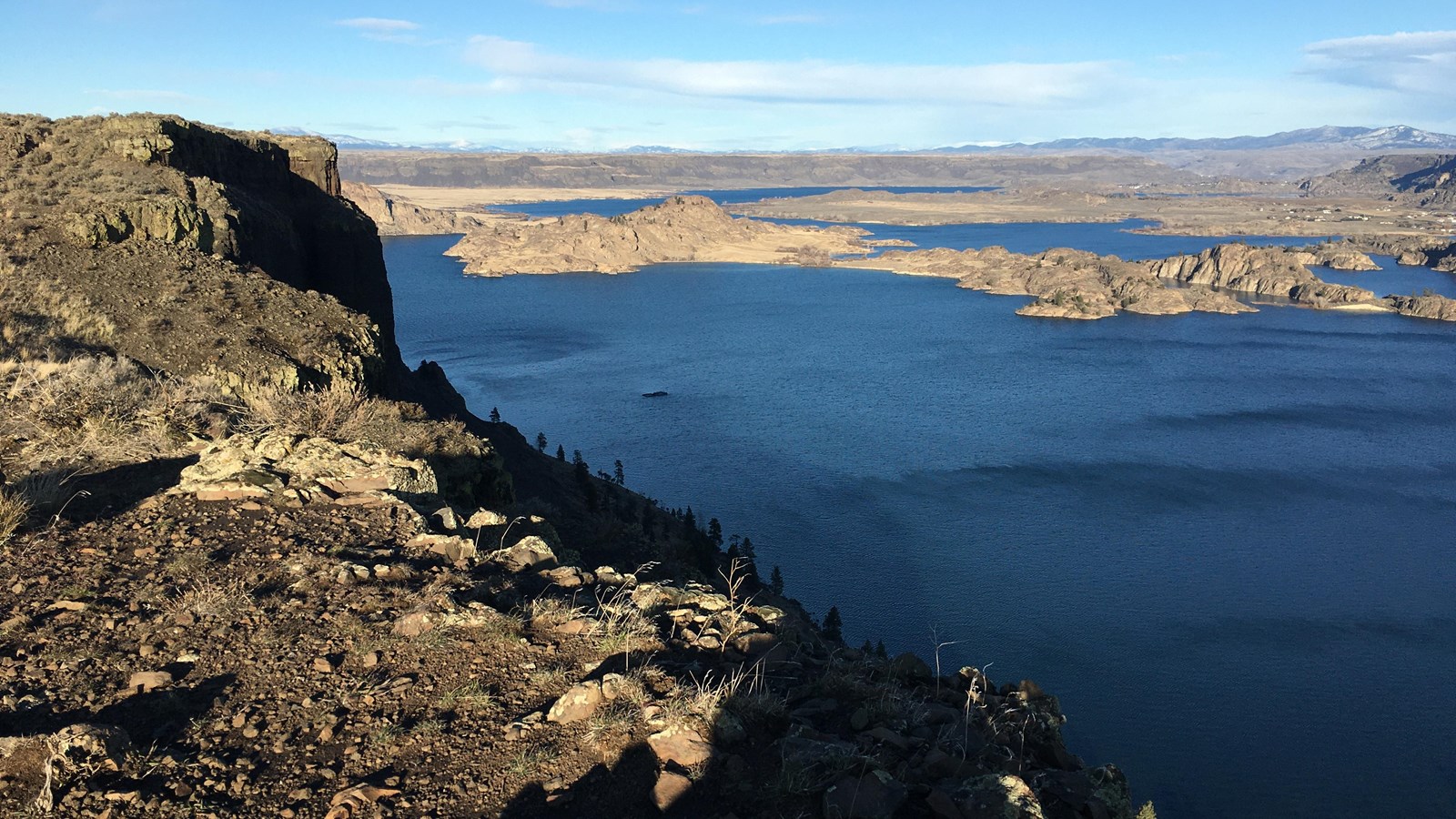
Place Grand Coulee National Natural Landmark Ice Age Floods National Geologic Trail This large geological feature is approximately 50 miles long and averages about 1 mile in width. Within the Coulee there are illustrations of a series of geological events beginning with a low range of granite mountains through which the ancestral Columbia River flowed. Outpourings of lava built up the Columbia Plateau, diverting the course of the river. There followed deformation of the lava beds, advance and recession of glacial ice, the cutting of a new river course, the formation and retreat of waterfalls, and the return of the Columbia River to its present channel, leaving the Coulee high and dry until man turned part of it into a huge reservoir by artificial damming. Much of the evidence from which this geological story is reconstructed may be seen from Dry Falls State Park; the park is located about 5 miles southwest of Coulee City. Quick Facts Designation:National Natural Landmark