IAFI K-12 Grant Program Donation Cancelled
Your donation to IAFI K-12 Grant Program was cancelled before being completed If this was unintentional, please try again Donate to IAFI K-12 Grant Program
Proposal for an IAFI K-12 Grant/Scholarship/Support Program
IAFICS recently instituted a Student Research Grant Program to encourage undergraduate and graduate-level research into Quaternary flood geology. This is an excellent effort to encourage research that fits extremely well and is consistent with the IAFI Articles of Incorporation and Bylaws. Recognizing the vision and leadership of the IAFICS program and its consistency with our stated goals, I propose that the larger IAFI organization adopt an expanded program to additionally encourage education, scholarship and research throughout our larger four state area of interest. There are numerous advantages to the organization that can result from this program, such as: Providing much needed support to K-12 teachers for Floods-related curriculum supplies and materials. Encouraging interest and dedication in students and researchers to advance the Ice Age Floods story, and to become an integral part of our organization itself. Providing tangible programs and results that encourage and recognize contributions from our donors while garnering pride and admiration for our organization and our entire membership. Providing a pipeline of speakers, presentations and field trips led by grant recipients. As a practical guide to doing this I contacted the board of the (presumed smaller) Central Oregon Geoscience Society, which has an existing program of educational, scholarship and research grants. Their response: Most of our funds for our educational outreach come from members that make donations. Members can donate to our general fund, or specifically to either our K-12 educational program, or to the student research program. Our members have been quite generous to the K-12 program and student research program and we have received a few $1000 each year in donations. The specified donation funds are then restricted to the specified program. In addition, our general fund budget (that is funded by dues and some unrestricted donations) includes: A) $400 to the K-12 program – presentations, field trips, demonstrations, materials, as requested from schools, and other organizations in the area that support K-12 events. We have 12 volunteers that assist. B) $200 scholarship (for K-12 teachers if they need some training money). We have not yet awarded any teaching scholarships. C) $1500 to the student research grant program Our student research program funds student projects focussed on Oregon, including undergraduate, masters, and phd. Typically sample analysis and field work expenses that is not already funded by other grants. In some cases, if justified, we will consider expenses for presentation of results. We encourage students to share results with our organization, with a talk, field trip, poster session. We send out notices to various organizations with a deadline to apply (March-Early April). This involves submitting a brief proposal (a couple of pages) project objectives with supporting citations and a budget with timeline, a resume, and they must have their advisor to send a letter of recommendation. We set up an ad hoc review committee of 4-5 people to review (typically Education committee and board members) and approve the grant. Sometimes we go back to the student with additional questions. Typically we make grants in the $500-$1000 but there is no set limit and it depends on the scope of the project and quality. We have been approving in the range of 3-6 projects each year. Some PhD projects have submitted and been funded for a second year. I firmly believe that our generous membership similarly can, and will, fully fund such a program completely through their donations. In addition, IAFI and some of our chapters have accumulated sufficient resources to independently contribute for specific grants and scholarships. I suggest we start by appointing 3 committed board members at the September board meeting to design the program, establish the application and review procedures, and offer their proposals to the board at our October meeting.That will give us time to create a website presence and make an announcement to the membership through our mid-October newsletter.. We can then recruit a 3-5 member committee familiar with research and/or teaching needs to review, evaluate and recommend proposals and recipients. I suggest we use our website, newsletter, email blasts, radio and press releases to introduce, advertise and accept proposal applications. If possible, we should try to offer our first assistance grants early in 2026. I suggest we launch with a first year pilot program of $3000-$5000 initially funded by IAFI, to establish our commitment to the program in the eyes of our members. If successful, we might allocate 10% (~$2000) of the IAFI portion of membership dues on an ongoing basis, and actively encourage grant-targeted donations to maintain a similar commitment level. We should review the commitment of funds each year to align with other IAFI expenses and with membership and donor income so we don’t risk bankrupting the organization. I suggest we offer assistance for K-12 education materials in the $100-$500 range, and high school, undergrad and graduate research grants in the $500-$2500 range. The assistance and grants should be spread as widely and equitably throughout our 4-state region as applications and projects warrant. I suggest we track the program effectiveness through measurable outcomes such as applications received, projects funded, donor participation rates, presentations and field trips given for at least two different chapters as part of the requirements for research grants. This program may also help recruit new research and field trip leaders into the organization and IAFI/Chapter boards. Proposed in August, 2025 by Lloyd DeKay, President – Columbia River Gorge Chapter
Volunteer Profile – Sue Billings
How would you like to have on your team a volunteer who embodies the following qualities: Enthusiasm – Support – Upbeat Attitude – Availability to help – Creative Ideas – Encouragement The Ellensburg chapter has such a member in Sue Billings. She has been involved in several meetings and projects over the last years. And she is almost always available to help out when called upon. She and her husband, Tom Ring, live in the town of Selah—reflecting the wide spread area from which our members come. And she is able to do all this in addition to having a rich lifestyle in which they travel and stay involved in other projects. Thanks so much for your involvement and contributions, Sue. We really appreciate it. Mike Doran, President Ellensburg Chapter Ice Age Floods Institute
Order Your Service Recognition Gift
International Old Rock Day – January 7
International “Old Rock Day” Celebrate Old Rock Day on January 7 every year. It’s a day to remember the Earth’s incredible history and to pay tribute to the amazing geologists who help us understand it. We’ve been dependent on rocks since we first walked the Earth, and today it’s no different, with rocks forming the foundation of our daily lives. History of “Old Rock Day” The study of rocks was first introduced by the Ancient Greek Theophrastus in his work, “Peri Lithon” (“On Stones”), and became the cornerstone of geology for other interested scientists. The study was advanced by Pliny the Elder, who recorded numerous minerals and metals in great detail, with a particular focus on their practical use. Although working without the tools we use today, Pliny was able to correctly identify the origin of amber as fossilized tree resin. It wasn’t until 1603 when the word ‘geology’ was used for the first time by Italian naturalist Ulisse Aldrovandi. It took a further 150 years for the first geological maps to be drawn by British geologist William Smith, whose work began the process of ordering rock layers by examining the fossils contained in them. Then, in 1785, James Hutton wrote and presented a paper to the Royal Society of Edinburgh called ‘Theory of the Earth’, which outlined his belief that the world was far older than previously thought. His breakthroughs make him widely considered the first modern geologist. In 1809 William Maclure produced the first geological map of the USA, a task he completed thanks to two painstaking years spent personally traversing the country. With the invention of radiometric dating in the early 20th century, scientists could finally provide an accurate figure for the age of the earth by tracing the radioactive impurities found in rocks. It helped scientists to see that the Earth is one very old rock indeed! Rocks have been essential for human development, which is why we celebrate Old Rock Day and the wonder of the geological world. Why We Love “Old Rock Day” Geology is cool Studying the natural world helps us protect, preserve, and predict it so that we can live in harmony with nature Rocks are useful From the sturdy bricks of our homes to the sidewalk beneath our feet, rocks are essential for human existence Rocks are precious Some of the most coveted things in the world today — gold, diamonds, and other gemstones — are old rocks (minerals) Reprinted from National Today – Old Rock Day
IAFI 2024 YEAR-IN-REVIEW

A summary of IAFI’s 2024 activities for our members and other interested people. This is our 8th year preparing a Year-in-Review report for you, our members. We appreciate your continued support, friendship and membership. Gary Ford – IAFI President, January 4, 2025 INSTITUTE MEMBERSHIP Our members provide most of our support and much of the reason for the various materials, activities and events we provide. In 1996, we started with 11 members. At the end of 2024, we have 587 members (451 memberships). In addition to the members in the IAFI states (WA, OR, ID, MT), we have members in 16 other states as well as BC Canada and Loerrach, Germany (which is in the very southwest of Germany near Basel and the Swiss Border). West of the Mississippi we have members in CA, NV, AZ, WY, TX, AK, NM and OK. East of the Mississippi there is love of ice age floods in MD, GA, IL, TN, MA, FL, VA and PA. INSTITUTE BOARD PROJECTS IAFI work activities occur at both the Institute Board of Director level and at the Chapter level. Projects at the Institute board level generally benefit more than one chapter or do work that all chapters might not be able to do by themselves. Listed below are some of the recent projects the Institute Board of Directors has worked on: The Education Committee is working on a curriculum for four 20-minute floods videos for a 4th grade audience The Membership Committee developed a catalog of speakers for the chapters to use for their member programs. The Board works closely with the National Park Service (NPS) Program Manager for the Ice Age Floods National Geologic Trail. The intent is to help the Trail Manager with projects related to the development of the Trail. The Board has completed IAFI and Chapter history summaries in preparation for next year’s 30th anniversary. Our webmaster keeps our website (iafi.org) fresh and stimulating. He also, with support from the chapters, issues the Pleistocene Post Newsletter four times a year. This year the Cheney-Spokane Chapter created a significant amount of new content for the website, including a page with geolocated maps of J Harlen Bretz’s and Joseph Pardee’s field notes. ANNUAL MEMBERSHIP MEETING This year the annual IAFI membership meeting and field trip was hosted by the Cheney-Spokane Chapter and was held in the Spokane Valley area. Approximately 100 people attended the event. Follow this link for a summary of that event. 2024 CHAPTER PROGRAMS Outreach to inform and educate the public about the Ice Age Floods and their long-lasting impact on our area is a key part of the IAFI mission. Our local chapter programs are possibly the most effective way we meet this challenge. Three of the more important ways we help people learn about the Ice Age Floods are with lectures, field trips and hikes. LECTURES, FIELD TRIPS AND HIKES In 2024 we had 37 in-person lectures attended by over 1425 people. Many more people viewed lectures when they were posted on YouTube. We conducted 22 field trips with 735 attendees and three chapters sponsored 7 hikes with 106 attendees. PRESENTATIONS TO K-12 STUDENTS A number of people from the Lake Lewis Chapter help with education programs at The Coyote Canyon Mammoth Site (MCBONES) near Kennewick. This was a record year for tourism at the site. Over 4300 visitors, most of them K-12 students, learned about the ice age floods and megafauna extinction. Palouse Falls Chapter: Had a booth at STEAM (Science/Technology/Engineering/Arts/Math) night at Colton School. Lower Grand Coulee Chapter: Assisted with a presentation at the Ice Age Floods Fest at Dry Falls aimed at educating children on the Ice Age Floods story (350+ attendees). INVOLVEMENT WITH PROFESSIONAL ORGANIZATIONS AND UNIVERSITYS Cheney-Spokane Chapter: Hosted a booth at the Geological Society of America meeting in Spokane during May which was attended by several thousand professionals. The Chapter vice president led a two-day trip which was attended by a dozen of the leading professionals on the ice age floods. Wenatchee Chapter: Assisted Dr. Vic Baker with his University of Arizona graduate student trip to the Scablands. Columbia Gorge Chapter – Co-led a number of field trips sponsored by the Oregon State University Extension Master Naturalist Program. Coeur Du Deluge Chapter – Led programs for the Idaho Native Plant Society. All chapters routinely recruit extremely knowledgeable speakers from universities or state/federal agencies so we are presenting the most current information to our members. PRESENTATIONS FOR COMMUNITY EVENTS Cheney-Spokane Chapter – In February, the chapter talked with over 100 people at Great Outdoors Expo Exhibit in Spokane. Presented four lectures at Spokane County Library units. All four talks had standing room only. The library district asked the chapter to do four more talks in 2025 which have been scheduled. Columbia River Gorge Chapter – Completed work on the Cherry Orchard Trail Recording and Dedication. Ellensburg Chapter: had information booths at three Ellensburg Farmers Markets. Spoke with about 300 people. Lower Grand Coulee Chapter: Had a booth at the Quincy Farmer Consumer Awareness Day with IAFI talks and tours, videos and information displays. 200+ attendees. Developed a 3-D topographic model with lights of the floods area for use at community events. Palouse Falls Chapter: Presented lecture on the floods and conducted a tour at the Sandhill Crane Festival. Wenatchee Chapter: Co-led a tour at the Sandhill Crane Festival and participated in FCAD Farmer Consumer Awareness days in Quincy. PARTNERSHIPS AND COLLABORATION WITH OTHER ORGANIZATIONS We are always looking for other organizations to work with. This is a great way to share resources and knowledge. Listed below are some of the organizations we have worked with: Wenatchee – Wenatchee Valley Museum and Cultural Center, Port of Quincy, Othello Sandhill Crane Festival Coeur Du Deluge – Idaho Master Naturalist Program, Idaho Native Plant Society Lake Lewis– MCBONES Mammoth Site, Friends of Badger Mountain, Benton County Parks, The Hanford Reach Interpretative Center, Visit Tri-Cities, East Benton County Historical Museum, Franklin County Historical Museum Cheney-Spokane – Spokane Riverfront Park board,
The Advance and Retreat of the Cordilleran Ice Sheet Revealed in the Bluffs at Discovery Park, Seattle

During his time teaching in Seattle, J Harlen Bretz noted the extensive array of glacial features present in the Puget Sound area. The Puget Lowland is an extensive glacial outwash plain of highly elongated drumlin topography adorned with kames, eskers, kettle lakes, glacial erratics, and other glacial features indicative of continental glaciation. The Seattle Basin is filled with a layer cake of distinctive sedimentary layers that reveal the advance and retreat of the Cordilleran Ice Sheet during the most recent (Wisconsin) glacial advance. South Beach at Discovery Park in Seattle offers visitors an easily accessible exposure of the stratigraphic layers which tell this story. Magnolia Bluff at Discovery Park ranks as one of the most interesting and important geologic sites in the central Puget Sound Lowland. In its near-vertical cliffs, there is a record of the advance and retreat of the last great Ice Age glacier to enter western Washington from the extensive ice fields that covered southwestern Canada. At no other place near Seattle are the geologic relationships of this record so clearly displayed and so accessible to study. The exposure of sediment at Discovery Park is unique in that several distinct layers can be seen in the bluffs during a short walk along the beach. To the inexperienced, the cliff appears to merely consist of a large pile of sand and clay; however, the different layers each tell a story of strongly contrasting environmental conditions over the past 25,000 years. Each of the major beds represents a depositional episode. Their depositional environments can be deciphered by close examination of the composition and texture of each layer of sediment. Sediments comparable to those exposed at Discovery Park are found across Puget Sound, along Hood Canal to the south, and near Tacoma. The large regional extent of these deposits indicates that conditions throughout the central and southern Puget Sound Lowland were similar throughout the time period represented by the deposition of these sediments. A half century of field investigations in the southern Puget Lowland (Armstrong et al., 1965; Crandell et al., 1958; Mullineaux et al., 1965; Noble & Wallace, 1966; Waldron et al., 1962) and in the northern Puget Lowland (Clague, 1981; Easterbrook, 1986, 1994; Troost & Booth, 2008) show that ice sheets have advanced south into the lowlands of western Washington. Evidence for the latest glacial advance can be seen by examining the layer cake of sediments exposed at Discovery Park as the Cordilleran Ice Sheet advanced and retreated over the Seattle area. This recent advance is called the Vashon Stade of the Fraser glaciation. Timeline Prior to 100,000 years ago, the climate in Seattle must have been similar to the climate today. Evidence shows that a river system drained north through the Puget trough. ~100,000 years ago, Earth’s climate began to cool and became more moist. The Cordilleran Ice Sheet began to form in SE Alaska and in British Columbia. ~19,000 years ago, the Cordilleran Ice Sheet advanced to the Canada/US border, sliding at a rate of 135 meters/year. The ice sheet split into two lobes as it passed Victoria B.C. The Juan de Fuca Lobe extended out the Strait of Juan de Fuca, the Puget Lobe extended south over the Puget Sound region. When the ice reached Port Townsend, it blocked the north-flowing river that occupied the Puget Trough, forming a proglacial lake. ~18,000 years ago, ice overrode the lake and covered Seattle. Water was forced to drain to the south through the Chehalis river system. ~16,900 years ago, glacial maximum. The ice sheet extended to just south of Olympia, with ice thickness of ~3,000 feet over Seattle and 6,000 feet over Port Townsend. Sediments visible at Discovery Park Olympia Formation. This is the oldest formation on the exposed bluff wall. The Olympia Fm contains layers of sand, clay, and silt. These beds indicate a fluvial (river) non–glacial environment which existed in the Puget Sound region before the Vashon Stade glacial advance. The sand layers suggest stream deposition, the clay layers suggest ponding, and the silt layers suggest backwaters. There are shallow, broad ripple marks in some of the layers. Radiocarbon dates for wood in the layers at the base of the fm range from 22,000 to 20,000 years BP. A yellowish-gray silt layer 8 m above the bottom of the fm; this 2-m-thick layer contains wood fragments that are 18,000 years old. Pollen in the layers between the base of the Olympia Formation and the base of the overlying Lawton Formation are dominantly spruce and pine, representing a cooler climate than at present. These deposits reflect the climatic conditions in the area before the most recent arrival of ice in Puget Sound. Lawton Formation. The Lawton Fm includes relatively dark clays above the brownish-gray non-glacial sediments. The clays represent deposition in the bottom of a lake which formed in ice margin lakes. The Lawton has striking laminations, which look like varves. The lower portion, which is older, is very fine-grained, which suggests that it was deposited in deep, calm water. The upper part grades into coarser materials and contains ripple marks. The oldest beds of the Lawton Fm are approx, 18,000 years old. Esperance Formation. As the ice front of the Cordilleran Ice Sheet approached Seattle, the size of the deposited particles increased, grading from the clays of the Lawton Formation into the sand layer that we call the Esperance Fm. There are several different layers in this sand deposit, some of which are inclined. The sands are finer at the bottom and coarser on the top. The sands are well sorted, suggesting deposition from glacial meltwater, rather than by ice. The Esperance also contains lenses of gravel within the sand layers. Such lenticular bedding suggests a high energy environment of deposition. Geologically, layers or horizons in a deposit are referred to as “beds”. The orientation of the beds provides clues about the environment when these beds were deposited. The beds in the Esperance Fm show cross bedding. Cross bedding reveals flow direction. Vashon
Unearthing the Secrets of Spokane Valley: A Recap of the IAFI June Jamboree
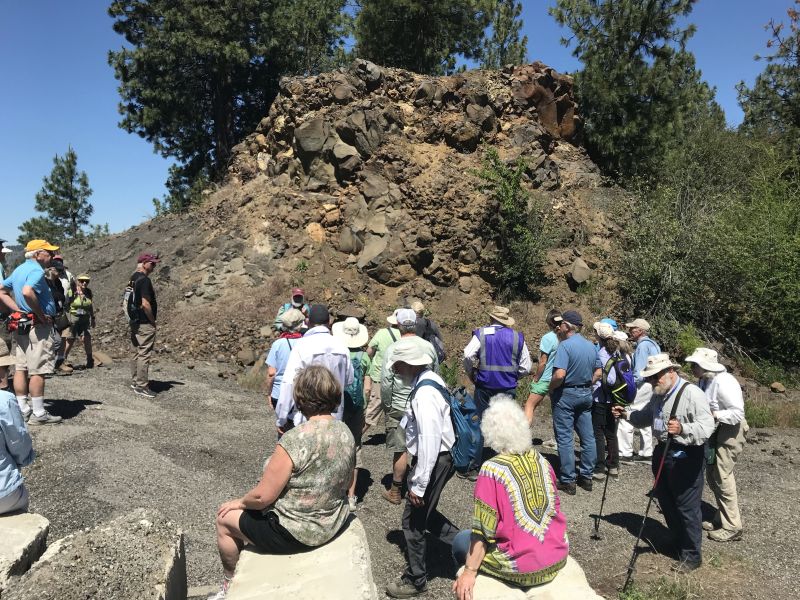
This year’s IAFI June Jamboree delved into the fascinating geological history of Spokane Valley, contrasting it with the iconic Grand Coulee and Dry Falls, explored during last year’s Jubilee. Challenging the Landscape: Unlike the open spaces of Dry Falls, Spokane Valley presented a unique challenge – showcasing evidence of Ice Age Floods within an urban environment. Our chapter tackled this brilliantly, organizing hikes and car caravans departing from convenient public parks and commercial areas. Evening Explorations: The program’s highlights included captivating lectures. Professor Emeritus Dean Kiefer shed light on J Harlen Bretz’s Spokane associates, while renowned naturalist Jack Nesbit brought the story of the first Columbian Mammoth discovered near Latah Creek in the 1800s to life. Celebrating Success: The Jamboree culminated in a relaxed gathering at Mirabeau Meadows. Registrants, leaders, and participants exchanged insights and experiences, with a resounding appreciation for the chapter’s efforts. Comparisons were drawn, highlighting how our Spokane Valley exploration continued the excellence of the Puget Lobe’s outing at Dry Falls last year. A Delicious Finale: The grand finale was a catered Longhorn Barbecue overflowing with delicious food. Everyone left satisfied, with many even taking home doggie bags to savor the flavors afterward. Check out more images from the event in this Google Photo Album. Meet the Masterminds: Linda & Mike McCollum: This dynamic professor emerita and a research geologist duo co-led tours and car caravans, sharing their latest research on the Spokane area’s Ice Age Floods, and shaping the Jamboree’s theme. Michael Hamilton: A gifted geologist, Michael led hikes and the bus trip, encouraging questions and offering honest answers. Don Chadbourne & Chris Sheeran: Don, the chapter treasurer, managed logistics with expertise, while Chris, our media and registration guru, ensured a smooth experience. Melanie Bell Gibbs: A past president and national board member, Melanie oversaw participant check-in and badge distribution. Dick Jensen: Dick handled bus transportation and provided crucial support throughout the Jamboree. Jim Fox: The chapter vice president secured speakers and offered his assistance wherever needed. We also owe a great deal to the participant volunteers who proved invaluable in assisting us in all our efforts. Through the combined efforts of many the IAFI June Jamboree was a resounding success, fostering exploration, education, and a deeper appreciation for the Spokane Valley’s unique geological heritage. Being present with so much information and conversation among such extensive expertise was to witness the scientific process in action. Meeting people from other chapters was particularly nice, putting faces with names we know. We all learned a lot.
Thank You from Ice Age Floods Institute
Thank you for your Ice Age Floods Institute membership registration and or donation. Your membership dues are used to support public education, research, and public policy advocacy about Ice Age Floods related subjects and issues. Donations are used to support public education, research, and public policy advocacy about Ice Age Floods related subjects and issues unless you have specified a specific purpose for its use. NOTE: Ice Age Floods Institute is a registered 501(c)(3) non-profit organization (EIN 91-1658221), and as such 100% of your membership fees and donations may be tax deductible. This notice confirms that your registration/donation has been submitted, but the transaction is NOT complete until you’ve completed the payment process and you receive a payment confirmation. Please keep confirmation notices as needed for your records.