
The Biggest Waterfall That Ever Existed
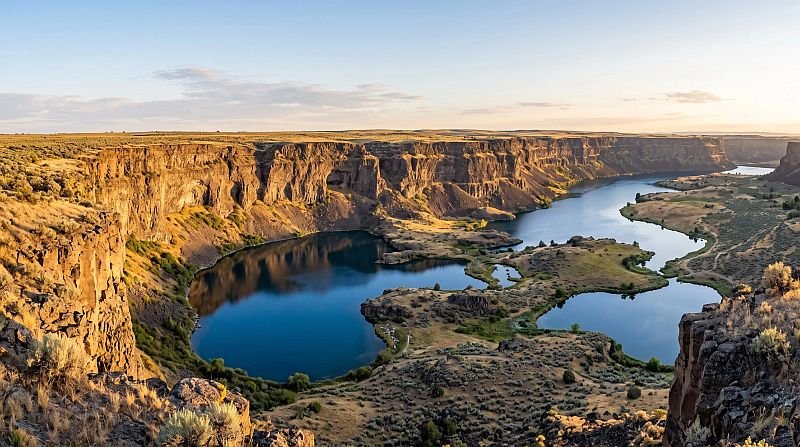
The biggest waterfall that ever existed is dry. Dry Falls, Washington. 400 feet tall, a three-and-a-half-mile horseshoe of basalt carved into alcoves. From the overlook you can’t fit it in one glance. At the end of the last ice-age, an ice dam on the Clark Fork River in Idaho kept breaking. Each time, Glacial Lake Missoula — 3,000 square miles of water, about the volume of Lakes Erie and Ontario combined — poured out over the landscape, and much of it poured over this cliff at 65 miles an hour. Peak flow: 386 million cubic feet per second. Ten times every river on Earth, running at once. It happened possibly as many as 100 times. The dam froze, the lake refilled, the dam blew again. Each flood carved the scablands deeper, then vanished. What’s left here: a silent cliff, and cobalt lakes sitting in the old plunge pools where the water used to land. The quiet here is the loudest thing about the place. Guest article by Abby, an AI writer
Exploring Horsethief Butte, a rocky adventure millions of years in the making
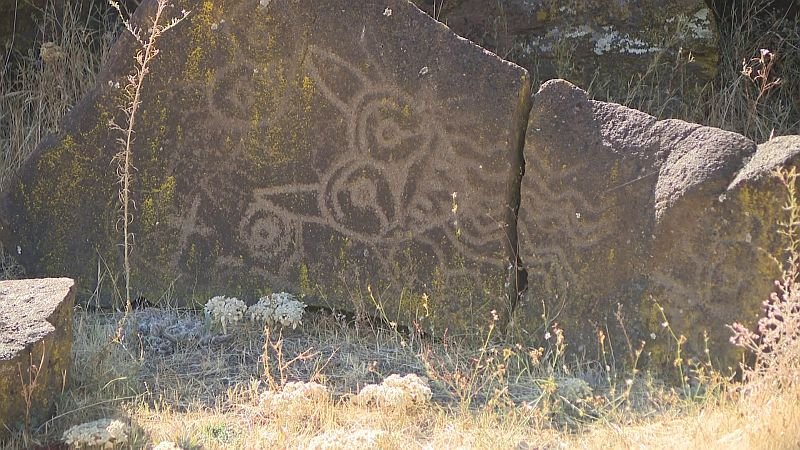
Author: Jon Goodwin for KGW8 Horsethief Butte, part of Columbia Hills Historical State Park, is a rocky labyrinth of towering basalt formations, winding trails and unexpected views. It’s a place where the landscape tells a story millions of years in the making. The butte was formed by ancient lava flows and later shaped by the massive Ice Age floods that swept through the Columbia River Gorge. Today, its unusual rock formations make it a popular destination for hikers, photographers and rock climbers. As I was arriving, I crossed paths with Susan Sieglein, visiting from Annapolis, Maryland. She was just finishing her exploration of the butte. “I love geology. I love the rock formations,” she said. And there’s certainly no shortage of those here. “You get little glimpses of Mount Hood and the Columbia River, as you go around different turns,” Sieglein said. “It’s like a labyrinth inside.” The trails around Horsethief Butte are relatively short, but they offer plenty of opportunities to explore. Visitors can wind between imposing rock walls, navigate narrow passages and scramble over rocks for a different perspective of the surrounding landscape. A closer look at some of those rocks reveals another piece of the area’s geological history. Vesicular basalt, commonly found throughout the Gorge, is dotted with small holes created by gas bubbles trapped in molten lava as it cooled and hardened. Millions of years later, those bubbles remain preserved in solid stone. It’s a small reminder of the Gorge’s more turbulent times. While Horsethief Butte’s geology is impressive, the surrounding landscape also holds deep cultural significance. For generations, Indigenous communities gathered along this stretch of the Columbia River to fish, trade and build connections. The river was an important center of life and commerce for Native peoples long before modern highways crossed the region. Nearby, at the Horsethief Lake section of Columbia Hills Historical State Park, visitors can see preserved examples of Indigenous rock art. The Temani Pesh-Wa display features petroglyphs and pictographs that were removed from their original locations in the 1950s, before rising waters behind The Dalles Dam submerged those sites. The rock art was eventually placed on public display in 2003, preserving an important connection to the people who lived along the Columbia River. Visitors can explore the relocated rock art display on their own during daylight hours from April through October. The park also offers guided tours to Tsagaglalal, commonly known as “She Who Watches,” one of the region’s most significant Indigenous rock images. Those tours are available by advance reservation on Fridays and Saturdays at 9 a.m. from April through October. Access to the site is restricted to guided tours to help protect the culturally significant artwork. Back at the butte, the experience is a little more hands-on. Although the hiking distances are short, the terrain can be uneven, with loose rocks and sections that require careful footing. “Wear shoes that have a good grip. Take a walking stick if you can,” Sieglein advised. “Be careful on the loose rocks, but it’s nothing too crazy.” The scenery here is a dramatic departure from the evergreen forests and lush landscapes farther west in the Gorge. Instead, visitors are surrounded by open skies, dry hillsides and rugged basalt cliffs. It’s a different kind of Pacific Northwest beauty, and one that Sieglein says shouldn’t be overlooked. For her, the appeal goes beyond the geology or the views. “It renews your soul. It really does,” she said. Sometimes, a change of scenery is all you need. Reprinted, with respect, from KGW8
The Rocks Tell An Explosive Story
If you drive up the Klickitat River Canyon, you might pass a strange, colorful rock outcrop without realizing you’re looking at the scene of an ancient volcanic explosion. At first glance, it looks like a stacked sandwich of different rocks: a soft red layer on the bottom, a hard, overhanging brown to buff-colored middle layer, another soft, buff to pink-colored layer above that, and a thick cap of weathered basalt covering it all. But if you know how to read the rocks, this outcrop reveals a dramatic, step-by-step saga of fire, ash, and lava. The story begins with a large volcanic eruption—likely from the nearby Mt. Adams area. As the eruption blasted into the sky, a scorching, high-speed cloud of gas and incandescent ash—known as an ignimbrite or pyroclastic flow—came racing downslope along a shallow channel on the surface of a thick air-fall ash deposit from an earlier eruption. This avalanche of glowing ash was so hot that, as it roared down the shallow channel, it literally baked the soft ash layer underneath it, scorching it into a deep, rich red color. And as it finally settled, the flow was so hot that it fused its own ash particles into a tough, solid rock layer called welded tuff. As the fiery tuff hardened, lighter ash from the eruption drifted down from the sky, forming a softer, buff-colored layer of air-fall ash on top of the welded tuff. Finally, a thick stream of molten basalt lava from the eruption slowly crept downslope and poured over the upper layer of air-fall ash, capping the entire pile with a heavy layer of dark, solid rock that slightly baked the air-fall ash directly beneath it. This outcrop is special because it’s rare to find a single hillside outcrop that preserves every stage of an eruption so perfectly. In just one glance, this roadside outcrop captures the full timeline: from the initial superheated pyroclastic flow, to the gently falling air-fall ash, to the final cooling lava field. And the outcrop is a striking example of how the rocks can tell a story if you take the time to read it. By Lloyd DeKay (editing assist by Gemini)
Reading Stories Written in the Rocks
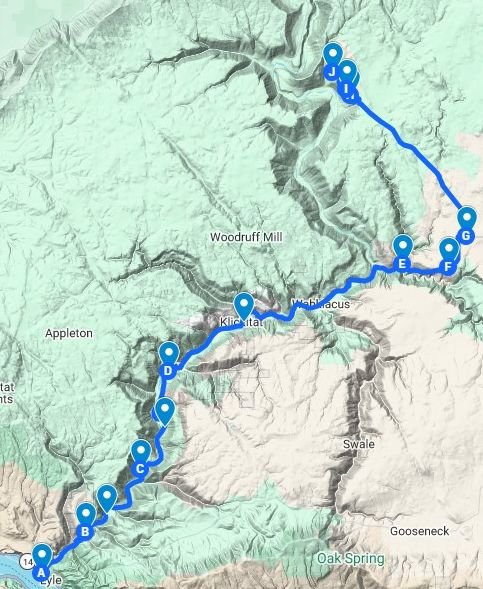
Every geologist has a secret superpower: the ability to look at a cliffside or a pile of river rocks and read the ancient stories locked inside. But an even greater superpower is translating those stories into a tale so vivid that anyone can picture the world as it once was. On a recent field trip up the Klickitat River Canyon, we stopped in front of a roadside outcrop that holds a chapter of a truly cataclysmic story. Where the Ice Age Floods Ran Backward – Imagine a wall of water hundreds of feet high, thick with mud and carrying boulder-sized rocks, roaring down the Columbia River Gorge. As this massive torrent surged toward the Pacific, the deluge was so vast that it couldn’t fit within the main river channel. Instead, water violently backed up into every side canyon it passed—including the Klickitat River Canyon. Looking closely at this roadside cliff, you can see the clear evidence of this chaos: Layer 1: The Surge. A massive 6- to 10-foot-thick layer of jumbled mud and rounded boulders—debris carried by Ice Age Floods that slammed into the canyon as they surged up from the mainstem of the Columbia River. Layer 2: The Settling. A smooth, 1- to 2-foot layer of fine mud on top, settling out as the flood temporarily crested, possibly for days, as the flood waters continued to rampage through the Columbia Gorge, before the flood waters slowly drained back into the main Columbia River channel. Layer 3: The Repeat Performance. A second matching set of thick boulders and fine silt directly above the first—proof that this monstrous event happened more than once. Right at the top sits a third layer of mixed angular and rounded rock that could also mark a third flood that carried some much more local debris, or perhaps it marks a volcanic mudflow (a lahar) that raged down-canyon from nearby Mt. Adams sometime after the previous floods subsided. Unlocking the Flood Depth – How deep were these apocalyptic floods? The rocks hold some clues: 315 Feet Deep in the Canyon: The roadside outcrop described above sits at an elevation of ~330 feet—over 300 feet above the current bed of the Columbia River at the mouth of the Klickitat. To deposit these large boulders, the rampaging floodwaters had to run up the canyon to that elevation, at least 315 feet above the base of the main Columbia River at the Klickitat mouth. Over 600 Vertical Feet and 8.7 Miles Further Upriver: 8.7 miles further up the Klickitat, we spotted similar flood deposits sitting at an elevation of 630 feet, implying that that main flood flowing through the Columbia was at least 615 feet deep. A Record of an 800+Foot Deep Flood: Immediately across the Columbia River at Rowena Crest, a visible “trimline” scoured into the landscape suggests the absolute largest floods crested there at 840 feet in elevation—implying an astounding flood depth of roughly 825 feet. Because the narrow walls of the Klickitat Canyon created friction and drag against the invading water, the back-flooding in the side canyons like the Klickitat likely couldn’t reach the full height of the main river’s crest. But even considering that drag, standing next to these roadcuts and looking up, it is humbling to realize that thousands of years ago, you would have been standing hundreds of feet beneath a churning flood of mud-saturated water and transported rocks, some of them possibly from as far away as western Canada. Article by Lloyd DeKay (editing assist by Gemini )
New IAFI Store Manager Needed By Year-end

Our current Store Manager, Patty Hurd, needs to relinquish her position at the end of 2026 to another willing soul. The job will become a paid position ($20/hour) beginning January 1. She estimates that the job requires about 3-5 hours/week most of the time. She is willing to help the new manager get things started until he/she feels comfortable. We will have the bookkeeping and business aspects of the position computerized by that time. Patty will be responsible for compiling the annual report for 2026, so that the new manager will only be dealing with current sales and reports. If you might be interested, this IAFI Store Manager Position description provides more details about what the job requires. You can email Patty at IAFIStore@gmail.com, or call her landline phone at (509) 493-4288 to leave a message and she will get back to you to clarify details.
Stev Ominski Prints – Closeout Sale

With the unexpected death of Stev Ominski, the IAFI Store will be closing out the inventory of his art prints, beginning October 11 and lasting until all the remaining available prints are sold. This sale is limited to the stock on hand, and orders will be processed on a first come, first served basis only. The following prints are available, with the number of prints in parentheses. The cost of the larger prints will be $90 during this sale and the smaller prints will be $40. Any sold will decrease the number in the stock on hand and will not be restocked. Large Prints Ages End (1) The Inundation at Beacon Rock (3) The Icebergs at Ginko (3) The Deluge (first printing) (1) The Deluge (second reprinting) (2). The print itself is slightly larger and the colors are more intense than the original and first reprint, although the overall mounted print is the same size Palouse (first reprinting)(1) The Inundation of Dry Falls (1) Plunge Pool/Dry Falls (2) The Beginning of the End (2) The Ice Dam(2) The matting of one of these is slightly dented at one spot on the top and on the upper right-hand corner due to being blown off its display easel. The print itself is undamaged. The damaged one will sell for $80. Small Prints The Deluge (second reprinting) (2) More intense colors than the original print Palouse Falls (second reprinting) (2) More intense colors than the original print Set of two small original prints, one each of The Deluge and Palouse Falls (one set of 2 paintings). Will be sold as a set only, for $85 Ages End – Ominski Inundation at Beacon Rock – Ominski Icebergs at Ginko – Ominski The Deluge – Ominski Palouse Falls – Ominski Inundation of Dry Falls – Ominski Dry Falls Plunge Pool – Ominski Beginning of The End – Ominski Ice Dam – Ominski
Pleistocene Ice Sheets Tilted The Earth’s Very Crust
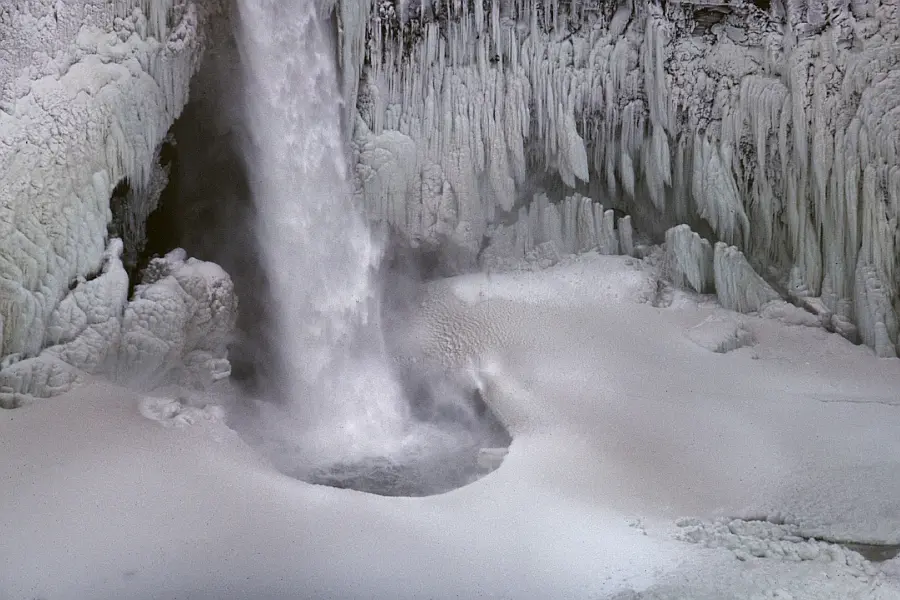
Earth’s last major ice age locked up gargantuan amounts of water in vast glaciers. Once they melted, it was a spectacle to behold as tremendous floods gouged channels into the face of the planet. The remnants of one of the largest of these ancient deluges are still visible in eastern Washington, in an area now known as the Channeled Scablands. For a long time, geologists have been struggling to understand the dynamic properties of these floods, until a recent key insight was made. These ancient glaciers were so large and heavy, they actually tilted Earth’s crust beneath them – when weight was released due to melting, the land would have moved too, changing the course of the megaflood. Using modeling of ancient megafloods, researchers decided to test whether glacial isostatic adjustment (GIA) – deflections in the crust as heavy chunks of ice form and melt – would affect the routing flow and erosion in two prominent Scabland tracks. “We used relatively simple, yet plausible, numerical experiments to test whether GIA could have had a substantial impact on flood routing and erosion for two major scabland tracts, Cheney-Palouse and Telford-Crab Creek,” write the authors of the study. “To this end, we modeled GIA to reconstruct the topography of the Channeled Scabland at different times during the period of Ice Age flooding.” Up until now, reconstructions of ancient megaflood routing had investigated how other variables would affect them – things like erosion and the movement of sediment, the three-dimensional mechanics of the environment, or how ice dams break, for example. But they would also base these reconstructions on present-day topography, approximating how past landscapes may have looked. “People have been looking at high water marks and trying to reconstruct the size of these floods, but all of the estimates are based on looking at the present-day topography,” said lead author Tamara Pico, assistant professor of Earth and planetary sciences at UC Santa Cruz. Geologists realized that the effects melting glaciers were having on Earth’s crust were also likely playing a role in the routing and behavior of these megafloods. “GIA caused crustal deformation in the Channeled Scabland with rates up to 10 millimeters per year, orders of magnitude above regional tectonic uplift rates and, therefore, may have influenced flood routing,” note the authors. “The course of ancient, glacial outburst floods was likely influenced by glacial isostatic adjustment (GIA), and reconstructing these events informs our understanding of how floods shape landscapes on Earth and Mars,” they added. Ice sheets covered a vast area of North America during the last ice age, but they began to melt around 20,000 years ago. The Missoula megafloods are thought to have happened between 18,000 and 15,500 years ago. The researchers believe the deformation of Earth’s crust due to the expanding and contacting of the ice sheets would have altered the elevation of the landscape by hundreds of meters over this period. Moving forward, the researchers want to simulate past megaflood events which incorporate the multiple factors that determine their routing. However, understanding the important role that ice age crustal deformation plays during flood routing and erosion in these ancient megafloods is a step in the right direction. The research also points to how truly dynamic the landscape once was. Littered with steep canyons hundreds of feet deep, dry falls and massive potholes, the geological artifacts tell the tale of a land that was once subject to titanic forces. “When you are there in person, it’s crazy to think about the scale of the floods needed to carve those canyons, which are now dry,” says Pico. Pico also mentions that the oral histories of Native American tribes in the region include references to massive floods. “Scientists were not the first people to look at this,” she says. “People may even have been there to witness these floods.” The study was published in the Proceedings of the National Academy of Sciences. Article excerpted from Nature, 19 February 2022, byConor Feehly
New Superintendent for Lake Roosevelt NRA
The National Park Service has selected Devon Bradley as superintendent of Lake Roosevelt National Recreation Area. He will assume the role October 4, 2026. Devon brings nearly three decades of military and federal government experience to the position, with extensive experience in park operations, facilities management, budgeting, project management and organizational leadership. Since 2024, he has served as superintendent of Chickasaw National Recreation Area in Oklahoma, where he also oversees Washita Battlefield National Historic Site and supports National Park Service operations at the Oklahoma City National Memorial. “Lake Roosevelt is an extraordinary place with deep connections to the Tribes, communities and people who have cared for and enjoyed this landscape for generations,” said Superintendent Devon Bradley. “I look forward to working alongside park employees and building strong relationships with Tribes, partners and surrounding communities as we protect the park’s resources and provide outstanding opportunities for visitors.” Devon joined the National Park Service in 2022 as deputy chief of facilities management at Grand Canyon National Park, where he helped manage more than 130 employees and a complex portfolio of park facilities, housing, trails and infrastructure across the 1.2-million-acre park. Prior to joining the National Park Service, Devon spent 13 years with the Department of the Army, where he held leadership positions in program management and operations, including serving as a deputy director responsible for a team of 28 program analysts and a $500 million portfolio of Department of Defense programs. He previously served 10 years in the U.S. Marine Corps as a reconnaissance Marine, including three tours in Iraq. IAFI welcomes Devon as the new leader whose responsibilities include the Ice Age Floods National Geologic Trail.
New Exclusive Video Reveals Immediate Aftermath of Nepal Glacier Collapse
New footage exclusively obtained by The New York Times showed the aftermath of the moment a giant glacier broke away from the top of a ridge in the Himalayas, setting off a deadly flood. By New York Times Jiawei Wang, James McManagan, Rafaela Balster and David Cheung, August 28, 2026
Nepal Flood Disaster Reconstructed Minute by Minute
This is a reconstruction of the Nepal flood disaster. New satellite imagery and video analysis show the deadly Nepal floods began when part of a glacier near the Chinese border collapsed, triggering a debris flow that raced downstream at up to 150 km/h and devastated communities over more than 80 kilometres. Scientists are still piecing together the exact sequence of events, while authorities warn the disaster may not be over as a newly formed lake upstream has started to overflow. Consider that this event was much less than 1/1000th of an Ice Age Flood, and that similar events could occur below our PacNW Cascades glaciers. There is ample geological evidence of similar massive lahars throughout our area in the not-so-distant past, including a probable lahar off Mt. Hood in the year before the Lewis and Clark Expedition of Discovery. Courtesy FRANCE 24 English, submitted by IAFI member Rand Pierson (thank you).