
 New research suggests that the Yellowstone supervolcano may not be fueled by a deep “mantle plume” as previously believed. Instead, a study published in Science suggests that the volcano’s activity is driven primarily by tectonic shifts within Earth’s crust.
The New “Plumbing” Model
For years, scientists debated whether Yellowstone was heated by a deep column of hot rock rising from the Earth’s core. However, researchers using 3D modeling discovered that the magma system is actually controlled by two competing tectonic forces:
- Crustal Stretching: The lithosphere (outer crust) is being pulled toward the U.S. West Coast.
- Sinking Plates: An ancient tectonic plate, the Farallon slab, is sinking beneath North America, dragging the lower crust downward.
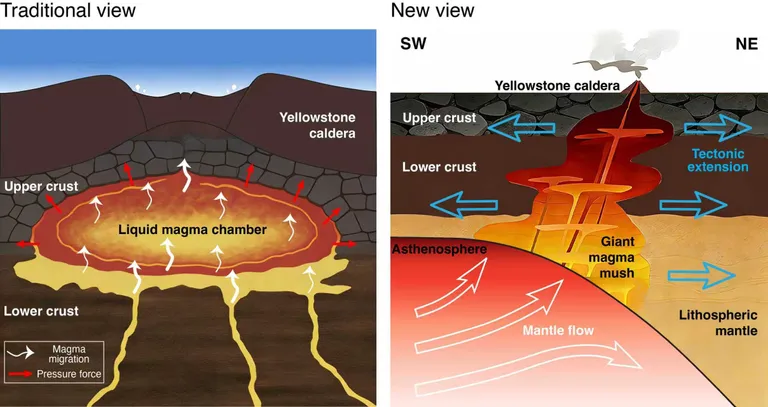
This “tug-of-war” pulls the lithosphere open, allowing magma to migrate from the southwest to the northeast and rise toward the surface.
This discovery is a game-changer for volcanic forecasting. By understanding that tectonics—rather than a deep plume—fuel the system, scientists can better predict how the volcano will behave as it moves toward the thicker, colder crust to the east.
“Our work changes the understanding of how the magma plumbing system works, so future eruption models have to take this into account.” — Lijun Liu, Geologist at the Chinese Academy of Sciences.
This tectonic modeling isn’t just for Yellowstone. It could help researchers better understand other high-hazard systems, such as Toba in Southeast Asia and Taupo in New Zealand, potentially improving volcanic safety worldwide.
From an article in LIve Science by Sarah Wild