
DOGAMI Launches New LIDAR Data Viewer
The Oregon Department of Geology and Mineral Industries has launched the LIDAR Data Viewer interactive map, which offers additional data and new features that make exploring and downloading LIDAR easier than ever before. Visit the viewer: https://gis.dogami.oregon.gov/lidarviewer/ Since the Oregon LIDAR Consortium (OLC) was formed in 2007, DOGAMI has collaborated on collection of LIDAR data with more than 80 partners. The viewer offers OLC data for free download, and now includes data from 18 recent OLC projects. The newly available data includes: Lane County: 3,226 square miles. Covers portion of Douglas, Lane, Deschutes, Benton, Linn, Jefferson, Lincoln and Marion County. Consortium members include Lane County, City of Eugene and Springfield, Emerald People’s Utility District, Lane Council of Governments, Weyerhaeuser as well as Bureau of Land Management and the USGS. Metro: 1,240 square miles. The Metro project was a lidar and imagery collection that brought together over 30 different regional, local and state agencies that needed new elevation data covering the Portland Metro region. The project covers a small portion of Clatsop, Columbia, Hood River, Yamhill and Marion County as well as large portions of Washington, Multnomah and Clackamas County. Clackamol: 709 square miles. Covers portions of Clackamas and Marion County. The project was funded by USGS, National Resource Conservation Service (NRCS), Bureau of Land Management, Weyerhaeuser and Portland General Electric. Ochoco West: 474 square miles. Covers portion of Crook County. The data was supported by contributions from USDA Forest Service. And data from OLC projects: Green Peter, Big Windy 2013 and Big Windy 2015, Crooked Ochoco, Scappoose, Umatilla YST, Lower Malheur, Panther Creek 2015, Wasco, Four Rivers, Harney Basin, Wallowa 3DEP, Upper Rogue 3DEP, and Upper Umpqua 3DEP. For more information about the LIDAR Data Viewer or the Oregon LIDAR Consortium, contact: Jake Edwards Oregon Lidar Consortium Coordinator [sf_email]jacob.edwards@oregon.gov[/sf_email] 971-673-1557
The Columbia River Gorge Eagle Creek Fire – Ruin or Renewal?
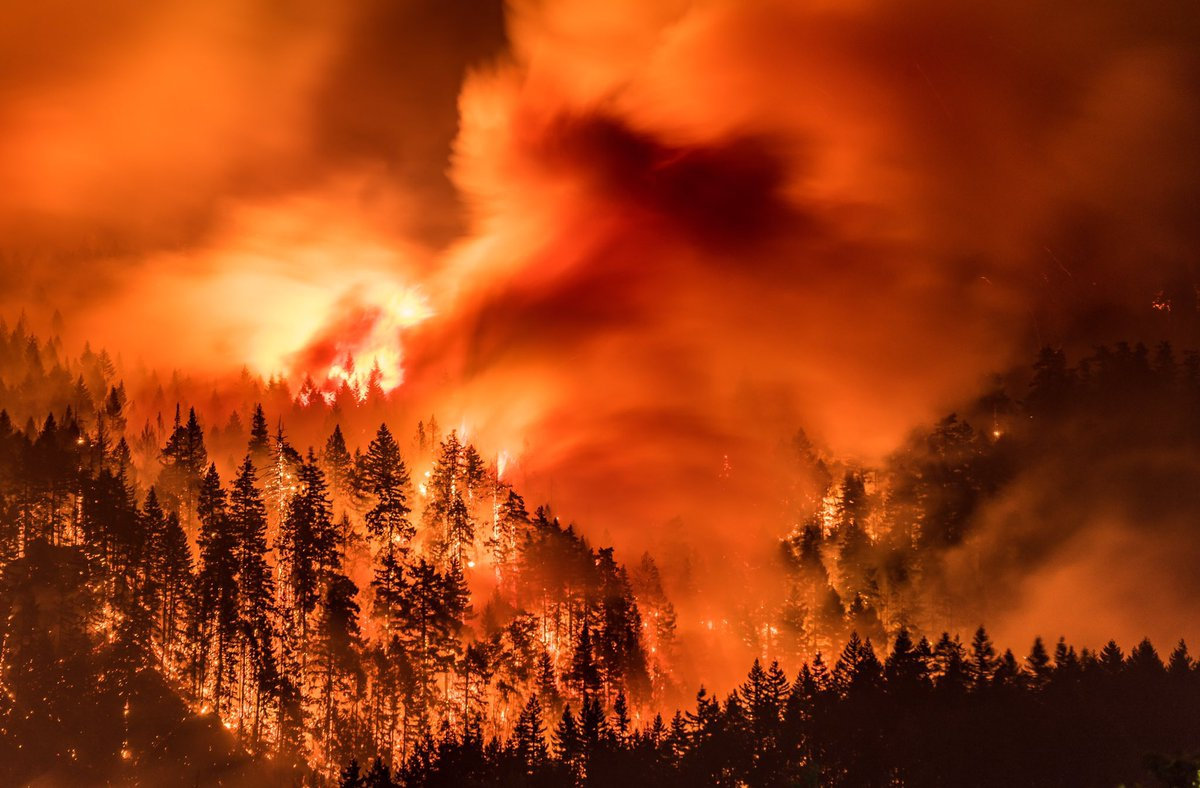
I’ve found there is huge public interest and concern about the catastrophic effects of the Eagle Creek Fire on the Columbia River Gorge. Pictures of ridgeline after ridgeline enveloped in bright orange fire, trees bursting into towering flames, and the choking smoke that filled valleys throughout the Pacific Northwest are truly a hellish image of Armageddon visited on the entire area. But, while the temporary loss of recreational trails and green forest aesthetics, and the increased potential for landslides and falling snags are inconvenient and even somewhat dangerous, the truth is that the recent fires have not ruined the natural areas of the West and the Gorge in particular, but instead have refreshed and renewed them. This past summer I’ve been interpreting geology for a new Columbia Gorge Master Naturalist Program, working beside forest ecology experts who are extremely optimistic regarding the effects of the Eagle Creek Fire. One of those experts, wildlife habitat expert Bill Weiler, writes, “Life will return to burned areas in short order. Fungi are already crawling around in the ashes of the fire, laying the foundation for soil that will support the plants that will constitute the early stage of the forest’s re-growth—a time when heat from the fire and sunlight newly reaching the ground in the absence of a canopy encourages a new crop of plants to firm up the soil structure that will allow gigantic trees to thrive. And ash is nature’s fertilizer. Plant blight, disease and insects are reduced or eliminated by burns. Mineral soil is the compost that Douglas fir seedling roots need to grow. “Dead trees” or snags are full of life.” In a typical forest fire a third of the trees will be scorched and dead, a third will be moderately to severely damaged, and a third will be essentially unscathed. Reports from the Eagle Creek Fire describe that fire as a discontinuous “mosaic burn” with much less devastation even than the typical forest fire burn. There is a broad consensus among scientists that we have considerably less fire of all intensities in our Western U.S. forests compared with natural, historical levels, when lightning-caused fires burned without humans trying to put them out. Early in the 20th century, before fire suppression became the norm, the average annual burn area in the western states was over 25 million acres, compared to a recent average of 4-6 million acres. According to Oregon State University Professor John Bailey, a century’s worth of suppressing wildfire in the United States has created conditions, especially in the West, that will ensure longer fire seasons because of longer, drier and hotter summers. Those conditions point to the need for “actively managed” forests which could include more deliberately set and managed prescribed fires. “Easily two-thirds or more of the Gorge fire is really good ecological fire,” Professor Bailey said, “the fire does some of the fuel management for us.” There is an equally strong consensus among scientists that fire is essential to maintain ecologically healthy forests and native biodiversity. This includes large fires and patches of intense fire, which create an abundance of biologically essential standing snags and naturally stimulate regeneration of vigorous new stands of forest. These areas of “snag forest habitat” are ecological treasures, not catastrophes, and many native wildlife species depend on this habitat to survive. More than 260 scientists wrote to Congress in 2015 noting that snag forests are “quite simply some of the best wildlife habitat in forests. ” Much of the Eagle Creek Fire burn area is closed to civilian activities due to the danger from flare-ups, rock slides and falling snags. The fire is less than 50% contained due to the ruggedness and inaccessibility of much of the area. Though it is still burning it is not expected to flare-up again until Winter rains and snow completely douse the embers.
New Ellensburg Chapter Webpage
The Ellensburg Chapter of the Ice Age Floods Institute has a new webpage with presentation videos and field trip guides. The Ellensburg Chapter was created in 2007 by Tom Foster, Karl Lillquist, & Nick Zentner. The chapter has offered free events for a solid decade and counting! Optional membership has supported the lectures and field trips. Thank you to our supporters! Our old field trip guides can now be viewed/downloaded from the webpage! Karl & Nick alternate leading 4 field trips per year. Note the contrasting styles of trip guides by Karl Lillquist (CWU Geography) and Nick Zentner (CWU Geology). Email Nick if you’d like to be added to the Ellensburg Chapter email list! nick@geology.cwu.edu [weaver_iframe src=’http://www.nickzentner.com/#/ellensburg-chapter-iafi/’ height=600 percent=100]
Ice Age Floods Story Map Wins ESRI Grand Prize!
The Washington Geological Survery (WGS) story map highlighting the ice-age floods that shaped the landscape of Montana, Idaho, Oregon, and Washington won the grand prize for scientific/technical story maps at the ESRI User Conference in San Diego last week. Woo-hoo! The Washington Ice Age Floods Story Map tells the story of cataclysmic outburst floods that shaped the landscape of the Pacific Northwest during the last ice age. With imagery, maps and video, this story map follows the devastating deluge of the Missoula floods as it tore across the landscape, from its origins in western Montana to its terminus at the Pacific Ocean. Our Award-Winning GIS Cartographer The mastermind behind this story map is WGS’s own very talented cartographer, Dan Coe. Dan also does all of the cartography for their geologic and hazard maps, maintains their website, and creates their interpretive lidar posters. On ESRI award day, Dan also won the second prize for his story map submission of “Native Trees of the Pacific Northwest“, which he created in his spare time. He’s quite the overachiever and they’re extremely lucky to have him with them. Reprinted from Washington State Geology News
Castle Lake Basin
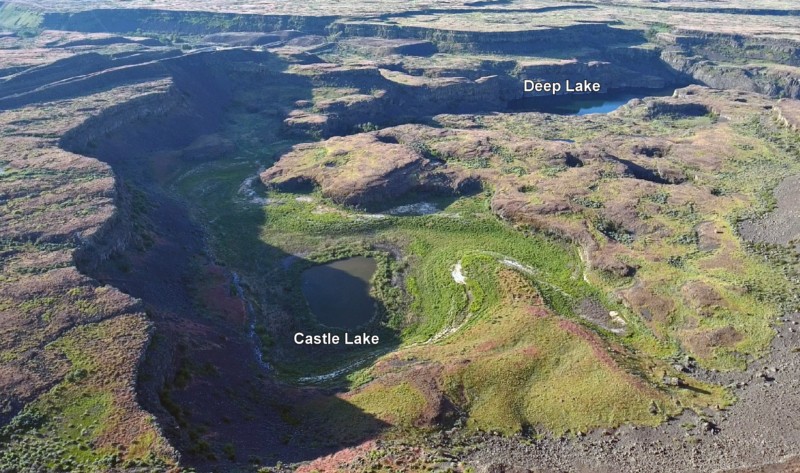
Castle Lake fills a plunge-pool at the base of a 300-ft tall cataract at the opposite (east) end of the Great Cataract Group from Dry Falls, above the east end of Deep Lake. A set of steel ladders put in place during the construction of the Columbia Basin Irrigation Project allow for a safe descent into the basin. In the basin are great views of giant potholes, the flood-sheared face of Castle Rock, as well idyllic Deep Lake. The Castle Lake Basin lies along the east end of the Great Cataract Group. At the base of the cataract is lovely blue-green Castle Lake plunge pool nestled into the rock bench below. Castle Lake lies within a single recessional cataract canyon eroded down to a flood-swept, pothole-studded rock bench that stands 100 feet above Deep Lake. This is the same rock bench of Grande Ronde Basalt where dozens of potholes occur at the opposite (western) end of Deep Lake. Castle Rock itself is an isolated butte along the west side of the Castle Lake basin. It is a faceted butte escarpment nearly sheared off by monstrous flood forces moving across the cataract.
Ice Age Floods National Geologic Trail NPS Brochure
The next big project for the Ice Age Floods National Geologic Trail is to develop the official National Park Service (NPS) brochure. The standard park brochure that people receive when they visit most national parks has a map of the park or trail on one side and informational text and pictures on the other side about the park significance, visitor safety, and other information. Developing a brochure is usually done by the NPS Harpers Ferry Center, but because the Ice Age Floods National Geologic Trail is an affiliate, it is up to Lake Roosevelt, with the help of the its partners, to make it happen. Developing a brochure has three major components: 1) developing the map, 2) writing the accompanying text, 3) laying out the brochure. We’re working on creating a map that follows Harpers Ferry Center guidelines for readability and disability accessibility. Limiting the map to key locations and fine-tuning the route names are critical to creating a visually pleasing and usable map. At the Ice Age Floods Institute (IAFI) Spring board meeting, IAFI board members and NPS Superintendent Dan Foster identified several significant locations along the trail, then narrowed the list down to about 13 key sites. Institute members have been working on brief descriptions of each of these locations and a clear, yet concise overall flood story. They’ve also been gathering images to be included in the brochure. Once the map is completed and the informational text and pictures are in hand, we can start laying out the brochure. When we have a good draft of the layout we will send it out to our partners for review. We hope to have the brochure printed and distributed before next travel season. Denise Bausch Chief, Interpretation and Education Lake Roosevelt National Recreation Area Ice Age Floods National Geologic Trail
Frenchman Coulee Drone Video
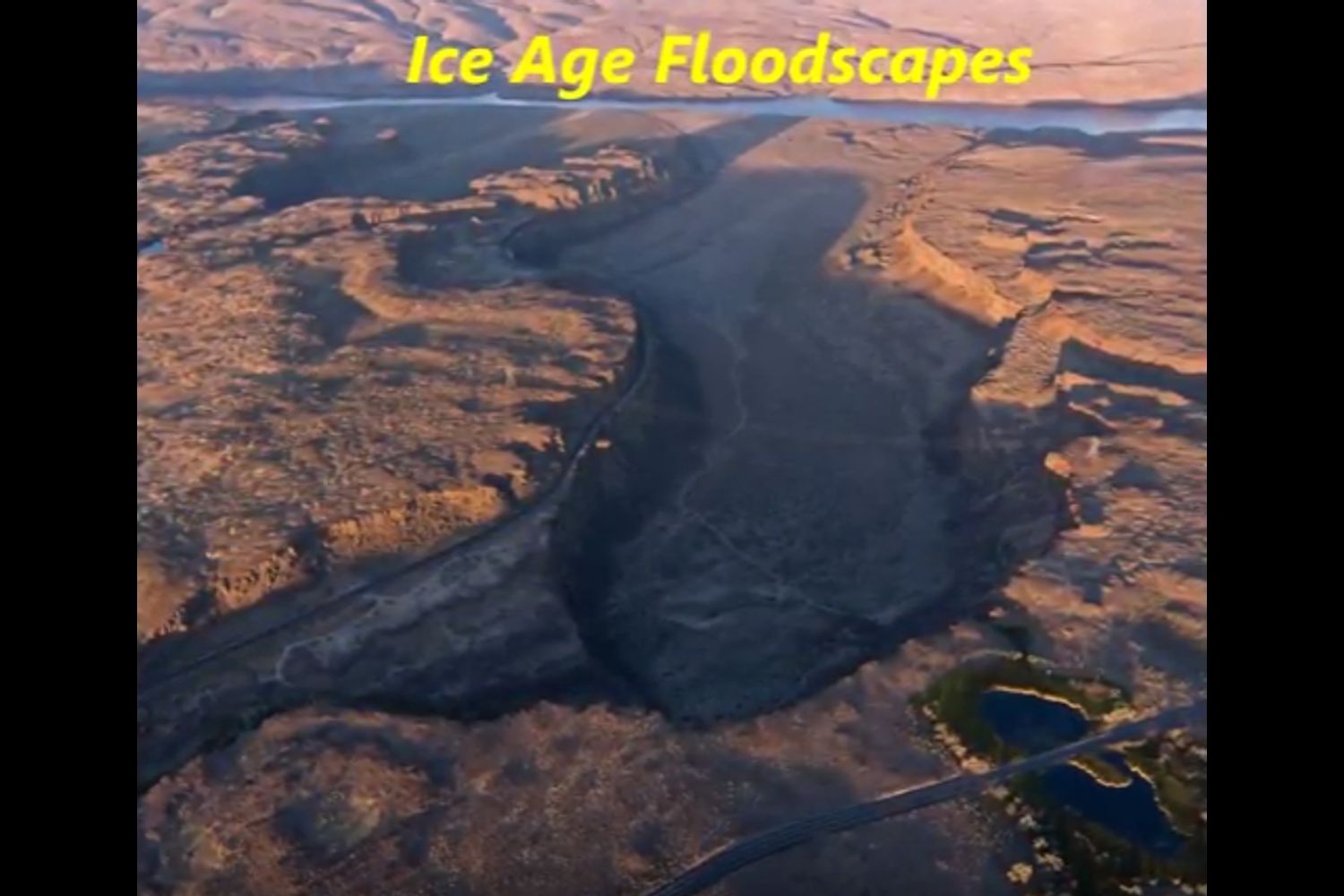
Bruce Bjornstad is at it again with his awesome Ice Age Floodscapes drone videos, this one from Frenchman Coulee. Watch it below and visit his Ice Age Floodscapes YouTube channel.for many more.
Bretz and His Floods Story – National Geographic
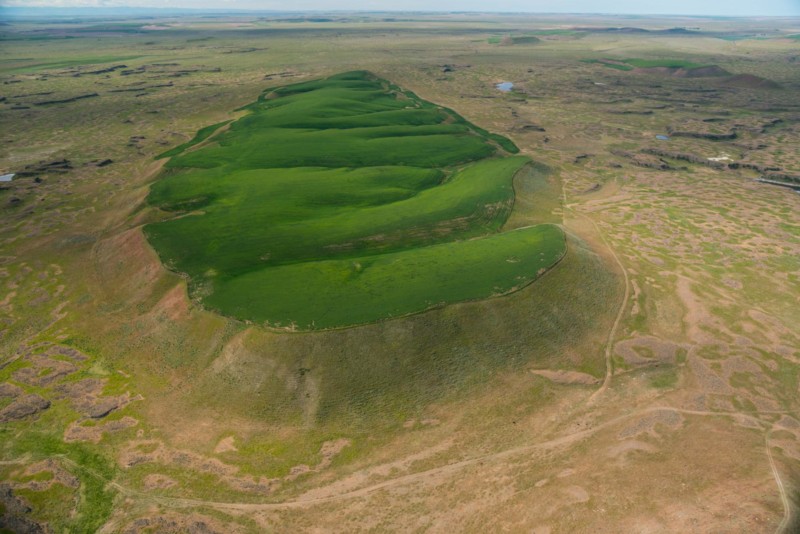
National Geographic has published an outstanding article, “Formed by Megafloods, This Place Fooled Scientists for Decades”, about J Harlan Bretz and his outrageous, fantastical theories of a landscape shaped by huge floods. Most Ice Age Floods aficionados are generally aware of the story, but this one is so detailed and well written it’s worth reading for the story-telling value alone. Please see: This National Geographic site:
Lake Lewis High Water Markers Installed
In April, 2017, Lake Lewis members George Last and Bruce Bjornstad worked with Friends of Badger volunteers Jim Langdon (Trail Master) and David Beach to install Markers showing the Lake Lewis high water marks on Badger and Candy Mountains near Richland, Washington. The Lake Lewis Chapter donated $300 to the Friends of Badger Mountain to purchase the two faux erratics engraved with “Lake Lewis Maximum Elevation 1250 Feet”. One of the markers was installed along the Sagebrush Trail on Badger Mountain, and the other along the Candy Mountain Trail. It was a glorious day!
Getting Our Palouse Falls “WOW” Story Out
A few of us met two years ago in August to decide if we should start our own chapter. We asked the question, “How do we get the word out to see how much interest there is?” We decided the best way to do this was to the attend the upcoming local fairs – Wheatland Communities Fair in Ritzville over Labor Day weekend, the Palouse Empire Fair outside of Colfax the following weekend and the Adams County Fair in Othello the weekend after that. We were fortunate to still be able to get booth space for the first two fairs and to share with the Coulee Corridor (at no cost) for the last one. We quickly rounded up pictures, maps, and books to fill our first booth. We talked to a lot of interested people and signed up new members for our chapter. This year we decided to do the three weeks of fairs again. The Coulee Corridor allowed us to use part of their booth again to help out our fledgling chapter – we will be able to go solo next year. There are a number of good reasons to take the time and expense to do these fairs. We recognize existing chapter members. We advertise our upcoming lectures. We promote our fall bus tour. We sign up new members. We share our flood story. This year we had time to create a more professional booth including local rock samples. This was a good draw for the young visitors as well as the adults. We also had samples of Mount St. Helens ash from the local area and Yakima. It was a great dialog starter – Why are the two samples different? Answer – the local ash is finer and the Yakima ash is coarser because the heavier material dropped out closer to the mountain. We also met with people who were visiting from outside the flood path or had just recently moved in from out of the area. I would ask them if they were familiar with the Missoula floods. Some knew nothing and others just a little. I would tell the story, pointing to the map showing Glacial Lake Missoula and the flood path. The one superlative I would hear over and over again was “WOW”. It reminded me of just how much of a “WOW” area we live in and how easy it is to forget that when you have lived in it all your life. Yes we do live in a “WOW” area and the local fairs have been a great venue to get our “WOW” story out to the public. Lloyd Stoess, President Palouse Falls Chapter, IAFI