
Earth in the Next Billion Years
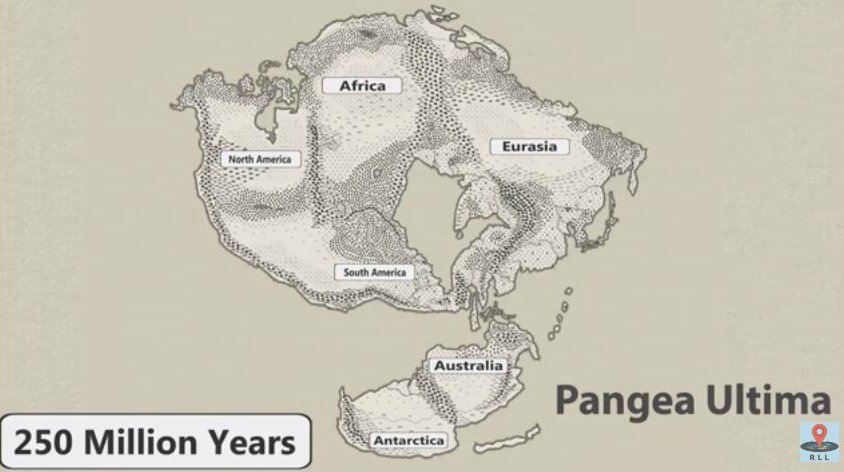
No one can ever say for sure what the future will bring, but this new video has summed up all the science-backed predictions that we can reasonably make about how Earth will change over the next 1 billion years. It’s highly unlikely that anyone will be around to see most of these changes come to pass, so consider this an exclusive front-row seat to a world where supercontinents reign supreme, Mount Everest is no longer the tallest mountain on our planet, Earth enters another glacial period regardless of current global warming trends. and then the Sun becomes a lot hotter. Just another reason we should be glad we live at the time we do. Reposted from Science Alert and RealLifeLore
Beryllium-10 dating of late Pleistocene megafloods and Cordilleran Ice Sheet retreat
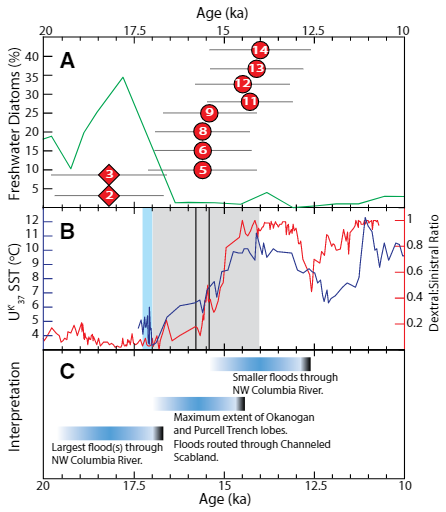
Balbas et. al. use cosmogenic beryllium-10 dating methods to further constrain the timing of ice sheet retreat, as well as the potential pathways for megafloods from both Lake Missoula and Lake Columbia. Read this fascinating Geology article summarizing their findings. Balbas2017 – Missoula Flood Chronology In summary, our new chronological information suggests the following: (1) Blockage of the Clark Fork river by the Purcell Trench lobe by ca. 18.2 ka, resulting in Missoula floods following the Columbia River valley. (2) Blockage of the Columbia River valley by the Okanogan lobe before 15.4 ± 1.4 ka, which shunted Missoula flood water south across the Channeled Scablands. (3) The final Missoula floods at ca. 14.7 ± 1.2 ka, signaling retreat of the Purcell Trench lobe from the Clark Fork valley, yet these floods entered a glacial Lake Columbia still impounded by the Okanogan lobe. (4) Down-Columbia floods at ca. 14 ka from breakouts of glacial Lake Columbia, signaling the retreat and final damming of the Columbia Valley by the Okanogan lobe
German Marshall Fund Fellows Visit Gorge Floods
On May 6th a group of 6 German Marshall Fund (GMF) Fellows from Europe and Russia got a taste of the Ice Age Floods story as they toured the Gorge, shepherded by Krystyna Wolniakowski, the Executive Director of the Columbia River Gorge Commission and a past-fellow herself. This was their last day to do some sightseeing before heading home after three weeks of intensive presentations and meetings with experienced business and political leaders. After being wowed by the scenic beauty and amazing wines of the Gorge they came to Rowena Crest for a brief discussion about the Ice Age Floods at this incredible vantage point. IAFI Gorge Chapter leader, Lloyd DeKay, used maps and illustrations and pointed out several local Floods features to help tell our story of the 1000′ deep floods that roared across the landscape and through Rowena Gap, crashing against and over this promontory on their devastating path to the sea. These Fellows came away awed by the many wonders of the Gorge, and feeling like they had the crowning experience of all the GMF groups touring the States and Europe. The GMF-funded Fellowship Program is a leadership development program intended to help build networks and develop effective transatlantic relationships and engagement for future world leaders. Each year 70+ GMF Fellows are stringently chosen from hundreds of up-and-coming business and political leaders from both sides of the Atlantic. Each small “class” is supported for 6 months of focused distance learning and 24 days of first-hand travel and experiences as they meet and learn from high-level business and political leaders. It was humbling for us to have played a small part in contributing to the experiences of this dynamic group of future world leaders.
Washington’s Ice Age Floods – ESRI Story Map
The Washington Geological Survey (formerly the Division of Geology and Earth Resources) has just released an ESRI story map about the Ice Age Floods in Washington. The story map: “tells the story of cataclysmic outburst floods that shaped the landscape of the Pacific Northwest during the last ice age. With imagery, maps and video, this story map follows the devastating deluge of the Missoula floods as it tore across the landscape, from its origins in western Montana to its terminus at the Pacific Ocean. Sites along the Ice Age Floods National Geologic Trail are featured, with an emphasis on flood features in Washington State.” Entitled Washington’s Ice Age Floods, it is best viewed on a desktop or laptop computer. Mobile devices will not show all of the content. It is navigated by scrolling your mouse through the slides. There are a few animated sections that may take a second or two to load. [weaver_iframe src=’https://wadnr.maps.arcgis.com/apps/Cascade/index.html?appid=84ea4016ce124bd9a546c5cbc58f9e29′ height=600 percent=100]
WA-DNR Website Features Phenomenal LIDAR Images
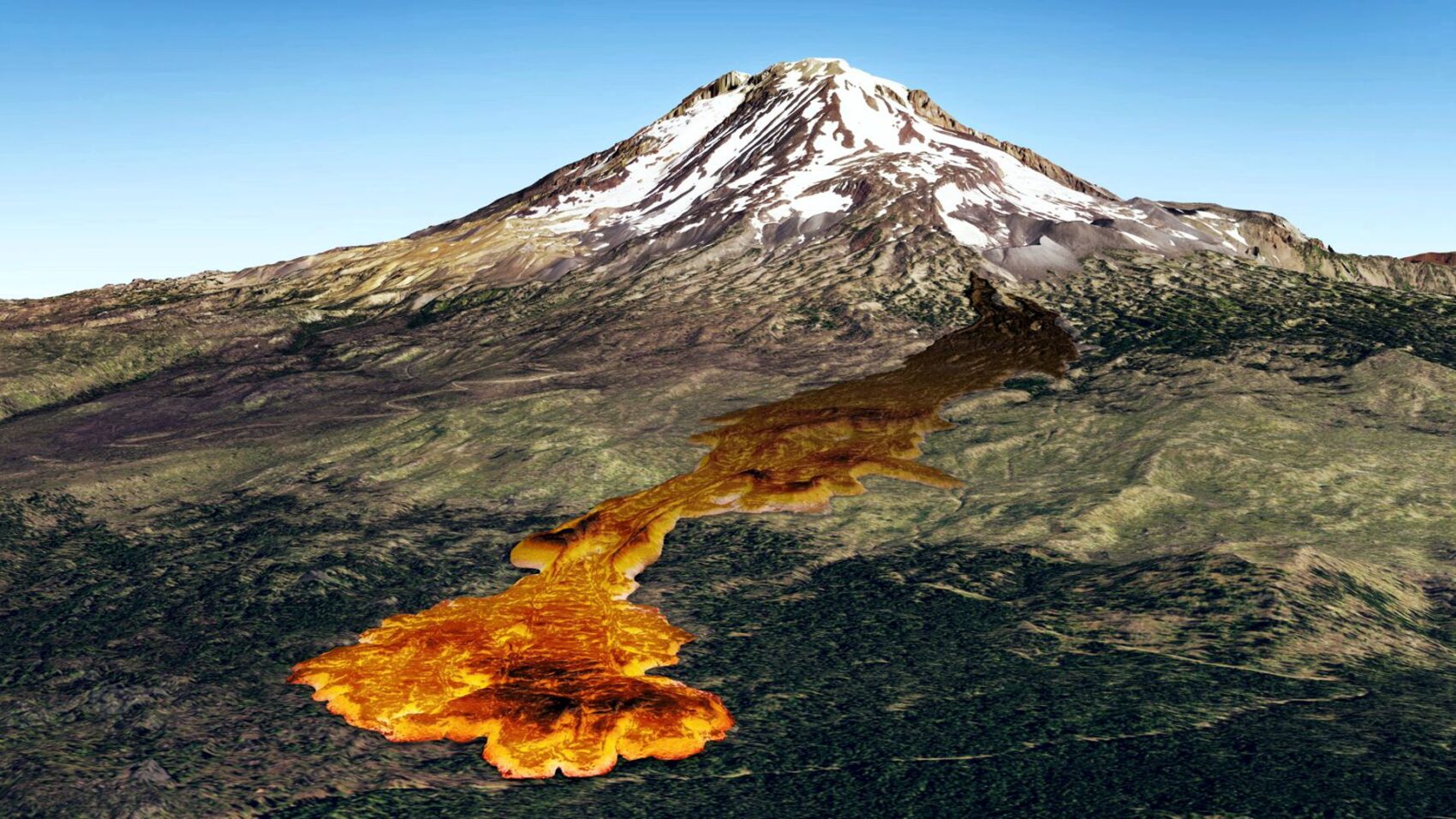
Washington State Geological Survey is collecting, analyzing, and publicly distributing detailed information about our state’s geology using the best available technology – LIDAR – an acronym for Light Detection And Ranging. The main focus of this new push for LIDAR collection is to map landslides, but there are innumerable additional benefits and applications of this data both inside and outside of the field of geology. A number of amazingly beautiful and revealing images are featured on the WA-DNR Flickr website, along with a trove of information about the technology and it’s applications. LIDAR is a surveying method that measures very precise distance to a target by illuminating that target with a pulsed laser light and measuring the reflected pulses with a sensor. Differences in laser return times and wavelengths can then be used to make digital representations of the target. LIDAR is expensive, but it can easily remove vegetation/grass/trees as it uses an emitting source and interferometry criteria to find the “last echo return” that is assumed as the ground, even in very dense scenarios (forests, corn fields, etc). LIDAR uses ultraviolet, visible, or near infrared light to image objects. It can target a wide range of materials, including non-metallic objects, rocks, rain, chemical compounds, aerosols, clouds and even single molecules. LIDAR is widely used for many different applications. Some (but by no means all) of those uses include: Geology and Hazards, Forestry, Graphics, Navigation, Meteorology and Fir,e Land-use planning, Archaeology and Agriculture. In geology, bare earth models allow closer study of geomorphology, which is the study of the origin of the topography of the earth. Floods, faults, landslides, erosion, and glaciers leave their mark on the landscape, and while these marks can be hidden by dense vegetation, they can’t hide from LIDAR. LIDAR can be used in the field of archaeology to find things hidden by the forest canopy. Large features that would be indistinguishable on the ground are readily apparent in a LIDAR survey, leading archaeologists to sites they might not have otherwise found. For example, intensity returns can be used to detect features just below the surface that affect plant growth.
Ice Age Floods National Geologic Trail Logo
After several years of coordination…Dan Foster, Ice Age Floods National Geologic Trail (IAF-NGT) Superintendent, announced we have a finalized version logo for the IAF-NGT that has been accepted and that will be displayed prominently throughout the floods area. WA-DNR’s graphic designer came up with the design that the Logo Committee believes best captures the essence of the meaning behind this national trail. During this process they faced a difficult task to capture something that was abstract, expressed itself visually in many different ways to represent the flood area, and reflected a story that is generally not well known to the public…now comes the work to sign the 4-state trail. Dan plans on sending out guidance to all the Trail partners on the proper use of the logo. Work is currently underway to develop a “Signing the Trail Plan”. This plan will give us a fairly accurate number for how many logo signs will be needed throughout the floods area. Until now we have only had a very rough guess. Having a more accurate figure for the number of logo signs that will be needed will give us a more accurate cost for making the signs and posts. It will also help the State DOT’s determine what it will cost them to install the logo signs and posts. Dan Foster has started people working on this and hopes to have the plan done this spring. They still have lots of unanswered questions about this process (i.e. how to pay for manufacturing and installing the logo posts) but to finally have a logo was the necessary first step. We started with several conceptual drawings from members of the logo committee and colleagues, but ended up using the services of a number of talented designers whose time was donated by their agency. During this process, a vast number of logos were drafted, but not chosen. Through this we learned the logic, recognition and cognitive association of a logo with its object. We appreciate all who worked on this and couldn’t have done it without them. Because of the difficulty in portraying the scientific nature of the trail, we spent considerable time focusing on designing a literal geologic translation of Ice Age Floods. However, what seemed to work in one place didn’t in another. What worked for instantaneous public recognition didn’t reflect the geologic accuracy this approach demanded. It took time for us to shift our point of view, but we were convinced when graphics designer Dan Coe with Washington Department of Natural Resources tried something different and it resonated with us. The adopted design is a contemporary scene that reflects the primary public purpose of the Trail as stated in its establishing legislation, to enable “the public to view, experience, and learn about the features and story of the Ice Age floods…” I think this approach communicates that there is something incredible to see and experience as one travels along the route, something that is consistent with the overall interpretive goal and approach of the Trail. While there may not be 100% concurrence for the logo from everyone, we think the logo to be distinctive enough that the public will be able to easily distinguish it from the many other trail logos in our Region. More importantly, we believe the logo captures the essence of the landscape that J. Harlan Bretz saw and used as the basis for first recognizing the former Ice Age Floods. The effort on the logo is symbolic of the entire trail partnership. We have an immense story with lots of players and opinions to disseminate it. Tasks ahead of us will also take time to reach consensus, but that consensus will be the strength of the trail moving forward over the coming years, even as we all come and go in our various roles.
Ice Age Flood Animation
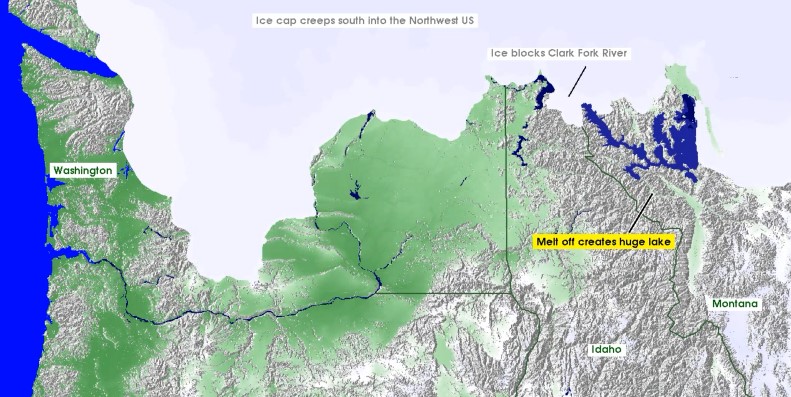
This 3:50 minute animation, presented by the Crown Point Country Historical Society, illustrates the growth of the Cordilleran Ice Sheet, the damming and back-up of Glacial Lake Missoula, and the progress of an Ice Age Flood through WA and OR after an ice dam collapse.
Ice Age Floods National Geologic Trail (IAF-NGT) News
Dan Foster, Superintendent of Lake Roosevelt National Recreation Area (IAF-NGT administrative center for the National Parks Service (NPS)) admits that there’s little on the ground to show for the trail, but there’s still been quite a bit of organizational progress on the trail lately: Despite there being NO direct NPS funding for the trail, administrative funding squeezed out of the Lake Roosevelt National Recreation Area budget has kept things moving forward, Two required documents, the Foundation Statement and Long Range Interpretive Plan, are both complete, NPS.gov/IAFL, the official website for the trail, has been launched (note the last letter is an ‘L’), The critical step of deciding on a logo continues to be a sticking point for various reasons, predominantly related to design complexity, but the end of this year has been targeted to have it completed. When the logo is finalized a next big step is to begin signage to identify the large number of major and minor routes and features included within the IAF-NGT. With no NPS funds allocated for this, Dan estimates a need for $300,000 in matching funds to pay for the initial round of route signage. There will also be need for interpretive signage at key locations along the trail. There will be huge opportunities for individuals, businesses and agencies to contribute substantially to the development of the IAF-NGT. We encourage all of you to begin thinking and working now to identify and educate funding sources about these opportunities to encourage education and tourism throughout the IAF-NGT region. Do you have contacts with resources that could contribute to a project for the IAF-NGT? Would you be willing to work on a project to help develop the trail? These projects could be through the NPS, the IAFI, state and local organizations, or even our local chapter, to help develop and promote the IAF-NGT, such as: Roadside signage all along the IAF-NGT route, Interpretive displays at selected locations, Interpretive brochures, podcasts, videos, etc. “Fam Tours” for travel professionals, Other ideas you may have. If you want to help with the development of the IAF-NGT please contact us at IAFInstitute@gmail.com.
Williams Lake Cataract Video
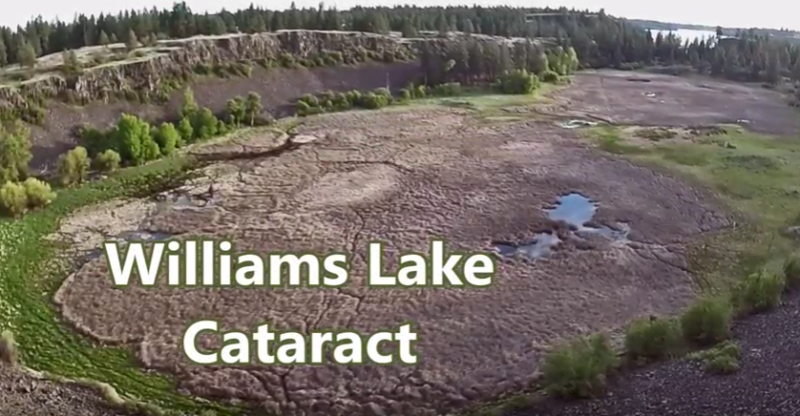
Williams Lake Cataract is an ancient, dry waterfall left behind along the Cheney-Palouse Scabland Tract in eastern Washington after Ice Age flooding recessionally ripped out underlying basalt to produce this massive cataract. Video produced by Bruce Bjornstad, Ice Age Floodscapes
Stev Ominski Prints Now Available in IAFI Store
Can you imagine the catastrophic scenes along the path of the Ice Age Floods? Stev Ominski is a very talented artist who has produced an exciting collection of works depicting what the Ice Age Floods might have looked like at several key locations along the paths of the floods. Prints of several of these artworks, signed by Stev himself, are now available through the IAFI Store. “Beginning of the End” – The artist describes this as “a study of several ways in which the ice dam may have begun to fail.” The scene overlooks the terminus of the ice dam, and depicts two small streams of water beginning to flow from the dam, shortly before the cataclysmic failure of the entire structure. “The Rowena Incident” – “An imaginary event based on two facts; one: that the approaching waters in the scene backed up behind Rowena Gap (another narrowing), and two: numerous Columbia Mammoth dig sites have been found nearby (within a mile or so of the present day site of the Columbia Gorge Discovery Center in The Dalles.” The Ice Age Floods Institute chose this print as the frontispiece of its last general brochure. In the scene, the viewer sees a small family of panicked mammoths flee from the rising floodwaters continuing to gush downstream from Wallula Gap at the same time as they were being backed up by the constriction of the gorge at Rowena Gap. This print measures 10 1/4 inches wide and 9 1/2 inches high, is mounted on a white backer and encased in a clear sleeve, with finished measurements of 16 1/4 inches wide and 12 1/4 inches high. “Inundation at Beacon Rock” – “The approaching flood waters slam into the side of Beacon Rock, in the central Columbia River Gorge. As this is a wide section of the gorge. The waters never topped Beacon Rock.” The view depicts the scene looking north across the Columbia River from its south bank. The print itself measures 17 inches wide and 11 inches high, is mounted on a white backer and protected by a clear sleeve, with total measurements of 22 1/4 inches wide and 15 1/4 inches high. “Age’s End” – The artist’s rendition of one of the Ice Age Floods crashing through the Columbia River Gorge. The view is looking east from the Women’s Forum, east of Portland, with Crown Point in the foreground and Beacon Rock barely visible in the background. The print itself measures 17 inches wide and 11 inches high, and is mounted on a white backer and protected in a clear sleeve, with finished dimensions of 22 1/4 inches wide and 15 1/4 inches high. “The Bellevue Erratic” – This erratic (a van-sized piece of Belt Rock/Schist) sits today as the largest found in the Willamette Valley. The print itself measures 17 inches wide and 11 inches high, is mounted on a white backer and encased in a clear protective sleeve, with finished measurements of 22 1/4 wide and 15 1/4 high. “The Deluge” – Depicts Palouse Falls as it looked with diminishing floodwaters rushing down the Palouse River Canyon. This print measures 11 inches wide and 17 inches high, is mounted on a white backer and encased in a clear sleeve, giving final measurements of 15 1/4 inches wide and 22 1/4 inches high. This picture, though beautiful by itself, is a natural companion to another available art print “Palouse” which depicts Palouse Falls today. “Palouse” – Although immersing himself in flood studies, Stev couldn’t resist painting beautiful Palouse Falls as they appear today and making the print available to the public. This print is sold by itself, but makes a lovely companion to “Deluge”, which depicts the same site as it might have appeared with torrents of water raging down the Palouse Canyon to the Snake River. “Palouse” measures 11 inches wide and 17 inches tall, is mounted on a white backer, encased in a clear sleeve, and has finished measurements of 15 1/4 inches wide and 22 1/4. inches high.