
The Earth – A Brief Overview
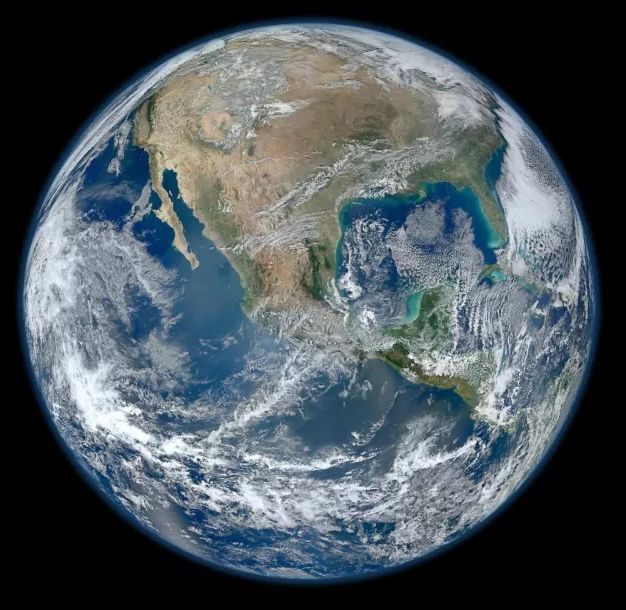
Background The 4.5 billion-year-old Earth is the only known astronomical object to harbor life, giving rise to billions of species of stunning diversity, including ours, Homo sapiens. It has formed the backdrop of an estimated 110 billion human lives. At 13.1 septillion pounds and 25,000 miles in circumference, the third planet from the sun long formed the horizon of all human experience and knowledge (watch overview). Recent discoveries have revealed our home planet’s relative size and location in the universe: a pale blue dot within the Orion Spur, located 26,000 light-years from the center of the Milky Way Galaxy, one of 100,000 galaxies within the Laniakea Supercluster. Formation Early Earth is theorized to have formed alongside the other planets within a solar nebula, where a massive cloud of spinning, interstellar gas and dust contracted under its own gravity and flattened into a hot disk (watch visualization). The core of the disk became dense with lighter elements like hydrogen, eventually heating up and triggering nuclear fusion, forming the sun. Solar wind pushed lighter elements farther out into the system, while heavier metals like iron gathered into increasingly larger masses known as planetismals in a process called accretion to form the Earth and other inner rocky planets. As the protoplanet grew, heat from the colliding material and radioactive decay differentiated Earth’s heavier iron-rich core from its lighter rocky mantle, giving rise to Earth’s magnetic field and long-term stability. Various models suggest Earth’s formation took tens of millions of years. Two billion years later, Earth changed dramatically when cyanobacteria, a microbe, evolved to generate energy from sunlight (i.e., photosynthesis) and release oxygen as a byproduct into the atmosphere during the Great Oxidation Event. Structure and Composition Earth is the densest planet in the solar system and the most massive of the four rocky terrestrials. Shaped into a sphere by gravity, Earth is flattened at its poles and bulges at its equator due to its roughly 1,000-mile-per-hour eastward spin (Jupiter spins 28 times faster). By analyzing seismic waves, researchers theorize that a solid, 9,800-degree Fahrenheit inner core is surrounded by an outer core of liquid iron and nickel—common elements that consolidate into solids at high pressures. Above the core, a slow-moving rocky mantle moves the crust’s tectonic plates, causing volcanoes and earthquakes (see overview). Earth’s spin combines with the core’s electrical conductivity and extreme heat to produce a magnetic field that protects its surface from damaging solar winds, cosmic rays, and deep space radiation. This so-called geodynamo process is expected to last for billions of years. Surface and Climate Situated within the solar system’s “Goldilocks zone,” Earth is the only planet with conditions able to sustain liquid surface water, key to the formation of life. Roughly 71% of its surface is water; the rest is land. An estimated 300 million planets in our galaxy are located in similar zones. The Earth’s five-layer atmosphere traps solar energy and maintains an average global surface temperature of 59 degrees Fahrenheit. Roughly 21% is oxygen, crucial for respiration but highly flammable. Nitrogen (78%) dilutes the oxygen and prevents rapid combustion. Seasons result from the Earth’s 23.4-degree tilt in relation to the orbital plane. Ice ages last millions of years and result from shifting climatic conditions—like ocean currents and the position of tectonic plates—that drop average temperatures by double digits. We live amid the fifth major ice age, though we are in the middle of a warmer interglacial period that began 11,000 years ago.
Video – How Earth Has Changed in 1.8 Billion Years
Among the planets in the Solar System, Earth is unique for having plate tectonics. Mapping our planet through its long history creates a beautiful continental dance — mesmerizing in itself and a work of natural art. This is the first time Earth’s geological record has been used to look so far back in time in an attempt to map the planet over the last 40% of its history. The work, led by Xianzhi Cao from the Ocean University in China, is now published in the open-access journal Geoscience Frontiers. Our planets rocky surface is split into fragments (plates) that grind into each other and create mountains, or split away and form chasms that are then filled with oceans. There are 4.6 billion years of plate motion to investigate, and the rocks we walk over contain the evidence for how Earth has changed over this time. This is a first attempt at mapping the last 1.8 billion years of Earth’s history – a leap forward in the scientific grand challenge to map our world. Modelling our planet’s past is essential if we’re to understand how nutrients became available to power evolution. Apart from causing earthquakes and volcanoes, plate tectonics also pushes up rocks from the deep earth into the heights of mountain ranges. This way, elements which were far underground can erode from the rocks and end up washing into rivers and oceans. From there, living things can make use of these elements. A number of critical metals – like copper and cobalt – are more soluble in oxygen-rich water. In certain conditions, these metals are then precipitated out of the solution: in short, they form ore deposits. Many metals form in the roots of volcanoes that occur along plate margins. By reconstructing where ancient plate boundaries lay through time, we can better understand the tectonic geography of the world and assist mineral explorers in finding ancient metal-rich rocks now buried under much younger mountains. Such a model will allow us to test hypotheses about Earth’s past. For example, why Earth’s climate has gone through extreme “Snowball Earth” fluctuations, or why oxygen built up in the atmosphere when it did. Indeed, it will allow us to much better understand the feedback between the deep planet and the surface systems of Earth that support life as we know it. Excerpted from a Science Alert article by Alan Collins, Professor of Geology, University of Adelaide
A New Class of Plate Tectonics – Lithospheric Dripping
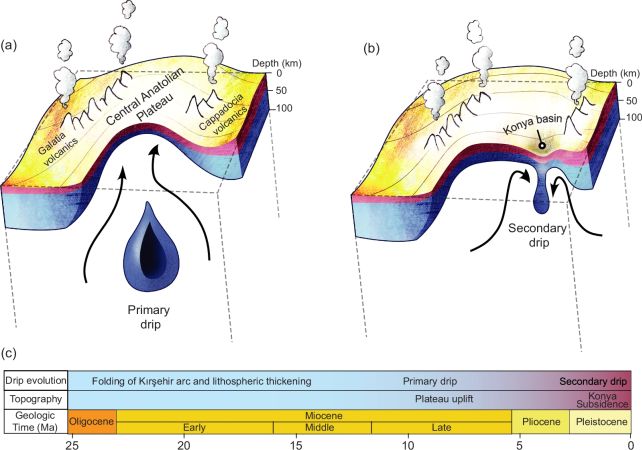
Crinkles and divots in the surface of Earth on Türkiye’s Central Anatolian Plateau are the smoking gun for a newly discovered class of plate tectonics. Beneath a depression called the Konya Basin, Earth’s crust is slowly dripping deeper into the planetary interior, a process that is gradually shaping the surface geology of not just the basin, but the plateau that surrounds it. It’s called lithospheric dripping, a phenomenon that has only recently been discovered here on Earth, and geologists are still figuring out the different ways it manifests. When the lower portion of Earth’s rocky crust is heated to a certain temperature, it starts to go a little gooey. Then, like honey or syrup, it slowly oozes downward – a bit like a pitch drop experiment, but much bigger and slower. As this drop descends, it pulls the planetary crust down with it. This creates a depression, or basin. Then, when the drop detaches into the mantle, the surface rebounds, bulging upwards, with a widespread effect. The Central Anatolian Plateau is known to be uplifting over time. Previous research suggests that it has gained around a kilometer (0.6 miles) in altitude over the past 10 million years thanks to the release of a crusty drip. But then there’s the Konya Basin, which is subsiding downwards at a rate of around 20 millimeters (0.8 inches) per year. That doesn’t sound like much, but a sinking patch of ground in a region that is rising upwards warrants further investigation. The broader region of the plateau is in the throes of the rebound phase of the lithospheric drip process, after having dropped its gooey molten load into the mantle. The Konya Basin? That’s a smaller, second drip forming. “As the lithosphere thickened and dripped below the region, it formed a basin at the surface that later sprang up when the weight below broke off and sank into the deeper depths of the mantle,” says Earth scientist Russell Pysklywec of the University of Toronto. “We now see the process is not a one-time tectonic event and that the initial drip seems to have spawned subsequent daughter events elsewhere in the region, resulting in the curious rapid subsidence of the Konya Basin within the continuously rising plateau of Türkiye.” Excerpt from a Science Alert article By Michelle Starr
Moses Coulee: Unveiling the Mystery of a Colossal Ice Age Scar
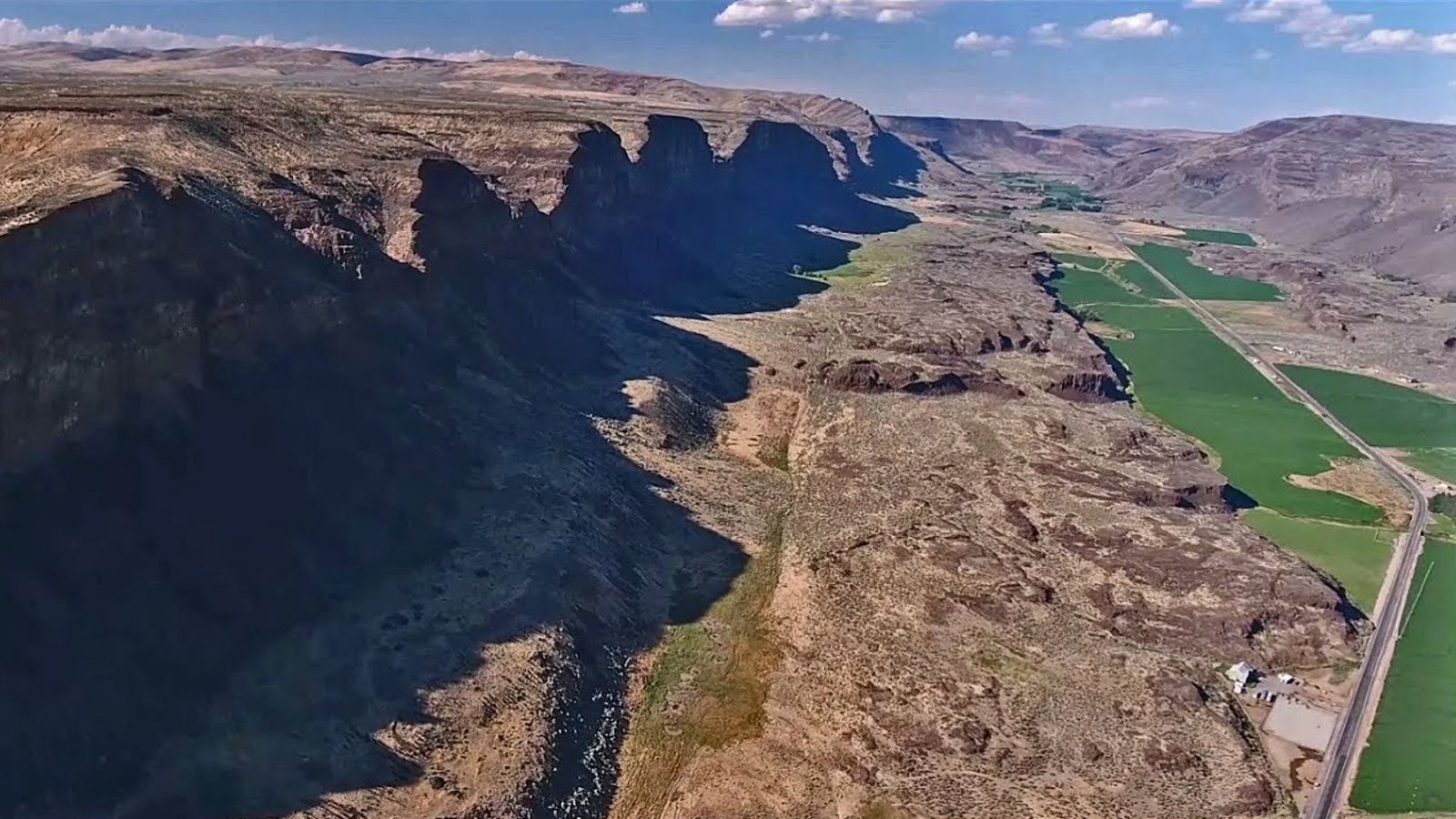
Moses Coulee, a Washington state wonder, has puzzled geologists for over a century. This massive canyon, carved into solid basalt, stands as a testament to some powerful force. The culprit? The Ice Age Floods, a series of catastrophic deluges that reshaped the landscape. If you’ve ever visited, or even just passed through Moses Coulee, you may not have been aware that this awe-inspiring coulee has been an Ice Age Floods conundrum since the time geologist J Harlen Bretz first noted it in 1922. The problem? Moses Coulee doesn’t quite fit the picture. As Bretz described it, “The head of Moses Coulee is just north of Grimes Lake. It is an abrupt termination, walled by 100 foot cliffs, identical with the features of channeled scabland which are called abandoned cataracts.” The head of the coulee ends abruptly, lacking any clear connection to the known flood paths. Theorists proposed a missing link, a path obliterated by the Okanagan Ice Lobe, but no evidence of such a grand passage has ever been found. The mystery has persisted and become more enigmatic as Ice Age Floods research has flourished over the years: what colossal force carved this immense coulee? A new study by Gombiner and Lesemann (Geology, 2024) offers a radical new hypothesis. They propose a surprising source for flood waters: meltwater trapped beneath the massive Okanagan Ice Lobe glacier. Imagine the giant Okanagan ice sheet pressing down on the Waterville Plateau. Meltwater pooled in valleys beneath the ice, trapped and pressurized. This water, according to the theory, found a surprising escape route. Flowing through a network of hidden channels, it carved its way across intervening ridges and valleys, eventually funneling into Moses Coulee. This “tunnel channel network,” as the researchers describe it, explains the unusual path of the water. The channels themselves, carved in basalt, climb slopes and defy normal drainage patterns. These features, along with glacial landforms like eskers, suggest a watery escape route beneath the ice sheet. The study doesn’t rule out the role of traditional Ice Age Floods. Water from massive glacial lakes might have also contributed to Moses Coulee’s formation by flowing along the eastern edge of the glacier. This new hypothesis could be a game-changer. It suggests a hidden world of pressurized meltwater sculpting the landscape beneath the ice. While the debate continues, one thing is certain: Moses Coulee remains a captivating enigma, a place where the power of water and ice continues to unfold its secrets.
Were Humans Present in the Area During the Ice Age Floods?

During the last ice age, humans ventured into two vast and completely unknown continents: North and South America. For nearly a century, researchers thought they knew how this wild journey occurred: The first people to cross the Bering Land Bridge, a massive swath of land that connected Asia with North America when sea levels were lower, were the Clovis, who made the journey shortly before 13,000 years ago. According to the Clovis First theory, every Indigenous person in the Americas could be traced to this single, inland migration, said Loren Davis, a professor of anthropology at Oregon State University. But in recent decades, several discoveries have revealed that humans first reached the so-called New World thousands of years before we initially thought and probably didn’t get there by an inland route. So who were the first Americans, and how and when did they arrive? Genetic studies suggest that the first people to arrive in the Americas descend from an ancestral group of Ancient North Siberians and East Asians that mingled around 20,000 to 23,000 years ago and crossed the Bering Land Bridge sometime between then and 15,500 years ago. Geneticists studying the first Americans tend to paint a more consistent picture than archaeologists do, mainly because they’re using the same human remains and genetic datasets. Genetic analyses have found that Ancient North Siberians and a group of East Asians paired up around 20,000 to 23,000 years ago. Soon after, the population split into two genetically distinct groups: one that stayed in Siberia, and another, the basal American branch, which emerged around 20,000 to 21,000 years ago. Genetic data suggest the descendants of this basal American branch crossed the Bering Land Bridge and became the first Americans. But some archaeological sites hint that people may have reached the Americas far earlier than that. There are fossilized human footprints in White Sands National Park in New Mexico that may date to 21,000 to 23,000 years ago. That would mean humans arrived in North America during the Last Glacial Maximum (LGM), which occurred between about 26,500 to 19,000 years ago, when ice sheets covered much of what is now Alaska, Canada and the northern U.S. Other, more equivocal data suggest the first people arrived in the Western Hemisphere by 25,000 or even 31,500, years ago. If these dates can be confirmed, they would paint a much more complex picture of how and when humans reached the Americas. Almost all scientists agree, however, that this incredible journey was made possible by the emergence of Beringia — a now-submerged, 1,100-mile-wide (1,800 kilometers) landmass that connected what is now Alaska and the Russian Far East. During the last ice age, much of Earth’s water was frozen in ice sheets, causing ocean levels to fall. Beringia surfaced once waters in the North Pacific dropped roughly 164 feet (50 meters) below today’s levels; it was passable by foot between 30,000 and 12,000 years ago. From there, the archaeological picture gets muddier. The older version of the story originated in the 1920s and 1930s, when Western archaeologists discovered sharp-edged, leaf-shaped stone spear points near Clovis, New Mexico. The people who made them, now dubbed the Clovis people, lived in North America between 13,000 and 12,700 years ago, based on a 2020 analysis of bone, charcoal and plant remains found at Clovis sites. At the time, it was thought that the Clovis traveled across Beringia and then moved through an ice-free corridor, or “a gap between the continental ice sheets,” in what is now part of Alaska and Canada. However, new discoveries have turned back the clock on the first Americans’ arrival. In 1976, researchers learned about the site of Monte Verde II in southern Chile, which radiocarbon dating showed was about 14,550 years old. It took decades for archaeologists to accept the dating of Monte Verde, but soon, other sites also pushed back the date of humans’ arrival in the Americas. The Paisley Caves in Oregon contain human coprolites, or fossilized poop, dating to about 14,500 years ago. Page-Ladson, a pre-Clovis site in Florida with stone tools and mastodon bones, dates to about 14,550 years ago. And Cooper’s Ferry — a site that includes stone tools, animal bones and charcoal — dates to around 16,000 years ago. Then, in 2021, scientists announced much more ancient traces of human occupation: fossilized footprints in White Sands, New Mexico dating to between 21,000 and 23,000 years ago. Sites such as White Sands and Cooper’s Ferry have big implications for how the first people arrived in the Americas. It’s thought that the ice-free corridor through North America didn’t fully open until about 13,800 years ago. So if humans were in the Americas long before then, they likely traveled there along the Pacific coast. That coastal journey could have been made by foot, by watercraft, or both. But no fossil or archaeological evidence of this journey has been unearthed. Ideally, archaeologists would like to find more sites from all of these branches, especially any remains that could explain the genetics behind the people at White Sands between 23,000 and 21,000 years ago. Evidence of these long-lost people can be found in the remains of the animals they butchered, the charcoal they burned, the tools they crafted and the loved ones they buried. Local Indigenous Peoples’ stories strongly suggest humans were in the area during the Ice Age Floods, but tangible scientific evidence is sparse and yet to be found in the area. Eedited from a Live Science article by Laura Geggel
Mima/Desert/Biscuit Mounds – An (Possible) Explanation

If you’ve visited the Rowena Crest Viewpoint at Tom McCall Preserve, west of The Dalles in the Columbia River Gorge, you may have noticed the many dome-shaped earthen mounds that cover the Rowena Plateau. These mounds are broadly circular and are surrounded by collections of basalt rock fragments. If you’ve visited the spring wildflower mecca of Catherine Creek on the Washington side of the Gorge, you may have also wondered at what caused the stripes of black rock extending down the slopes above the area. Tens of thousands of similar soil mounds cover large areas of the high desert lands of north-central Oregon, often in swarms that number in the hundreds. These mounds can be round or elongated, can range from a dozen feet to more than 60 feet in diameter atop the rocky Columbia River Basalt bedrock, and are typically surrounded and separated from each other by rings or stripes of basalt rock fragments. The mounds also appear similar to those at Mima Mounds Natural Area Preserve near Olympia, WA. There have been many suggested causes for the creation of these mounds, from burial mounds, to Pleistocene pocket gophers, to plants or glacial sun cups trapping wind-blown sediment, to sorting by earthquake vibrations, to turbulence at the base of ice-age floods flowing over the landscape. Research by two Oregon graduate students, Clark Nelson of Oregon State University and John Baine Pyrch of Portland State University, independently came up with what may be the most likely explanation for the origins of these enigmatic features. Their theses suggest desert mounds and their rock rings formed through a process of natural sorting, where fine soil material is pushed up into mounds and associated rocks are pushed out to the edges to form rings through countless cycles of wetting/drying and freeze/thaw during the wetter and colder period of the late Pleistocene. Clark Nelson cut a trench through a mound that exposed layers of soil and volcanic ash whose lack of mixing discounts the pocket gopher theory. Nelson also found that slope angle less than or greater than 10 degrees determined whether the features would form rounded mounds vs. elongated stripes. Pyrch showed the strips to be distinct from common talus slopes, because no obvious source of rock exists at the head of the talus stripe. He also observed that rocks within these stripes are sorted, unlike talus slopes, suggesting the same ice age freeze-thaw origins as soil mounds and rock rings. You can read more detailed articles about these enigmatic features in these articles: Mystery of the Desert Mounds Great Pyramids of the Gophers: Mima Mound Mystery Solved Similar processes are also thought to be responsible for the “patterned ground” found in periglacial environs. However these various types of features may have formed, we can be certain how the few mounds in the center of the parking circle at Rowena Crest Viewpoint came to be. They were man-made during the construction of the viewpoint and made to look like the mounds that cover the Rowena Plateau. At least one origin has a definitive answer.
Bone Pendants Suggest Humans in South America 25,000 Years Ago
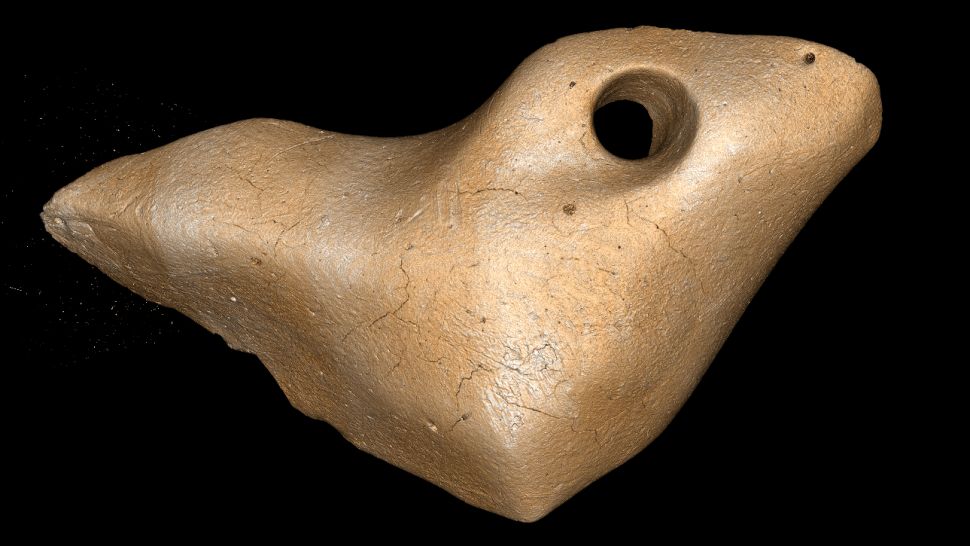
The date that humans arrived in South America has been pushed back to at least 25,000 years ago, based on an unlikely source: bones from an extinct giant ground sloth that were crafted into pendants by ancient people. The presence of human-modified sloth bones in association with stone tools from geological layers that date to 25,000 to 27,000 years ago is strong evidence that people arrived in South America far earlier than previously assumed. Discovered in the Santa Elina rock shelter in central Brazil, three sloth osteoderms — bony deposits that form a kind of protective armor over the skin of animals such as armadillos — found near stone tools sported tiny holes that only humans could have made. The finding is among the earliest evidence for humans in the Americas, according to a paper published July 12 in the journal Proceedings of the Royal Society B. The Santa Elina rock shelter, located in the Mato Grosso state in central Brazil, has been studied by archaeologists since 1985. Previous research at the site noted the presence of more than 1,000 individual figures and signs drawn on the walls, hundreds of stone tool artifacts, and thousands of sloth osteoderms, with three of the osteoderms showing evidence of human-created drill holes. The newly published study documents these sloth osteoderms in exquisite detail to show that it is extremely unlikely that the holes in the bones were made naturally, with the implication that these bones push back the date humans settled in Brazil to 25,000 to 27,000 years ago. These dates are significant because of the growing — but still controversial — evidence for very early human occupation in South America, such as a date of 22,000 years ago for the Toca da Tira Peia rock shelter in eastern Brazil. Using a combination of microscopic and macroscopic visualization techniques, the team discovered that the osteoderms, and even their tiny holes, had been polished, and noted traces of stone tool incisions and scraping marks on the artifacts. Animal-made bite marks on all three osteoderms led them to exclude rodents as the creators of the holes. “These observations show that these three osteoderms were modified by humans into artefacts, probably personal ornaments,” the researchers wrote in their paper. Edited from Live Science article by Kristina Killgrove
The Oldest Stone Tools Ever Found in the US

Indigenous people have been in the Americas longer than archaeologists once thought. Stone tools unearthed from a rock shelter in Southern Oregon were last used more than 18,000 years ago, radiocarbon dating suggests. That makes the site one of the oldest-known human living spaces in the Americas. Buried deep beneath a layer of volcanic ash, archaeologists excavating Rimrock Draw Rockshelter found two stone scraping tools, which ancient knappers had skillfully shaped from pieces of orange agate. A residue of dried bison blood still clung to the edges of one scraper, a remnant of the last bit of work some ancient person had done with the tool before discarding it. The layer of volcanic ash above the tools had blasted out of Mount St. Helens, a few hundred kilometers north of the rock shelter, 15,000 years ago, long after the fine agate scrapers, and the people who made and used them, had been forgotten. In a layer of dirt below the volcanic ash but above the stone tools, archaeologists found broken teeth from now-extinct relatives of modern camels and bison. Radiocarbon dating on a piece of bison tooth enamel (first in 2012, and confirmed recently by more testing) suggests the teeth belonged to animals that lived about 18,250 years ago. And because those teeth were buried in a layer of dirt above the stone tools, they must have ended up in Rimrock Draw sometime after the tools. That makes the agate scraper, complete with bloody evidence of its use, more than 18,000 years old—and one of the oldest traces of human presence in North America. But the people who lived in Oregon more than 18,000 years ago almost certainly weren’t the first to call the continent home. In Idaho, the Nimiipuu (Nez Perce) know the Cooper’s Ferry archaeological site as the ancient location of a village they call Nipehe. The oldest artifacts unearthed at the site date to at least 16,000 years ago, and it looks like people lived there, at least off and on, for several thousand years after those first arrivals. To have reached Cooper’s Ferry 16,000 years ago, the ancient inhabitants of Nipehe would have had to cross Beringia, a land mass that connected what’s now Russia with what’s now Canada during the last Ice Age, when sea levels were lower. They then had to move south along the Pacific Coast of North America, skirting along the western edge of the great ice sheet, until they reached the southern edge of the ice. The ice-free corridor wouldn’t open until about 15,000 to 14,000 years ago. By then, people were already living far, far south of the ice: Archaeologists found stone tools and butchered mastodon bones submerged in a Florida sinkhole that dated back to 14,500 years ago. And in Chile, someone left behind a single footprint 14,600 years ago. Thanks to footprints on an island off the coast of what’s now British Columbia, we know that at least some people did make their way along the coasts about 13,000 years ago. But some archaeologists, like Bournemouth University’s Matthew Bennett and his colleagues, say that those coastal migrants may have found their way into a continent already home to people who arrived at least 26,000 years ago—long before the ice sheets blocked the way into North America from Asia. In the mountains of north-central Mexico, archaeologists unearthed stone tools from Chiquihuite Cave, which dated back to around 30,000 years ago. And at White Sands National Monument in New Mexico, it appears that someone walked along the ancient shoreline of Lake Otero (now long since dry) between 23,000 and 21,000 years ago, leaving behind a trail of 61 footprints. Archaeologists dated the White Sands footprints thanks to grass seeds trapped in the layers of clay and silt above and below the tracks, which helped bracket their possible age. Some archaeologists are still skeptical, partly because there are so few sites this old south of the ice sheets, but there’s enough evidence to take the claims seriously. Taken from an article by KIONA N. SMITH published in arsTechnica
Modeling Time: Human, Geologic, Cosmologic

It’s difficult for most people to grasp the immensity of time as it’s viewed by archeologists, much less as it’s viewed by geologist or cosmologists. One way often used by those scientists to model time in terms that others can visualize is to compare time to distance along a path, with markers to denote specific events and periods. To Scale: TIME is a YouTube video about a group of friends who built a practical scale model of time: 13.8 billion years of cosmic evolution, and our place within it, on a dry lakebed in the Mojave.
Molten Mush Under Yellowstone Supervolcano

The mantle hotspot now under Yellowstone is thought to have been the source of the voluminous Columbia River Basalts that erupted from 17 to 6 million years ago as the North American continent passed over the hotspot, and that now underlie much of the path of the Ice Age Floods. During and since that time the hotspot cut a long and explosive path from the Oregon/Nevada/California border across the Snake River Plain, but ongoing research appears to show it to be fairly stable for at least our brief geologic time. A new study has found the amount of melted rock beneath Yellowstone’s supervolcano is far higher than previous estimates. Scientists have worked out the consistency of the magma under the Yellowstone caldera using seismic waves — and the reservoir is filled with “mush” that doesn’t pose an imminent eruption threat. While researchers say there is no sign of an imminent eruption, the discovery provides a more detailed view of what’s going on in the enormous magma chamber that sits beneath the national park. Far from a smooth blend of molten rock, magma reservoirs contain a large amount of solid rock, semi-liquid crystals, gasses and other volatile substances. This “magmatic mush” is highly dynamic but tends to burst out from deep underground when the proportion of liquid — or melt — crosses a certain threshold. Previous work suggests that eruptions typically occur when at least 50% of the space in the upper magma reservoir — a layer of flattened pockets of magma stacked on top of each other — is filled with melt. The magma reservoir beneath Yellowstone volcano consists of two chambers — a shallow reservoir near the surface that’s around 55 miles (90 kilometers) long and 25 miles (40 km) wide, and a deeper chamber that is about 4.5 times larger. While the deeper reservoir contains about 2% melt, the upper chamber contains far more: A study published in Science in December 2022 put the proportion of melt between 16% and 20%. Now, Sin-Mei Wu, a geophysicist and postdoctoral researcher with the Swiss Seismological Service at the Federal Institute of Technology (ETH) in Zurich, and colleagues have found the percentage is much higher. The team used seismic wave data to assess the texture and composition of the upper magma reservoir, which is about 3 miles (5 km) deep at Yellowstone. The results, published June 8 in the journal Earth and Planetary Science Letters, indicate the upper chamber consists of 28% melt — 8% to 12% more than the 2022 estimate, which was found with different methods, Wu said. “What we found is that the portion of liquid phase is not enough to have an imminent eruption,” Wu told Live Science. “Although we found a much higher portion of liquid than what was previously found, it’s still only up to 28%. So, to the best of our knowledge, Yellowstone will not have an imminent eruption.” Working out the proportion of liquid in magma reservoirs could help scientists evaluate the risk of volcanic eruptions elsewhere. “It’s important to understand the eruption potential, maybe not for Yellowstone so far, but you can apply the same methods to other magma systems that are more prone to eruption and to some that are already erupting,” Wu said. The methodology used for the study is “revolutionary in the detail and resolution it allowed for,” said Michael Poland, a research geophysicist and scientist-in-charge at the Yellowstone Volcano Observatory. The magma at Yellowstone and in other magmatic systems is like “mush,” Poland told Live Science in an email. “We often refer to ‘magmatic mush’ to convey a sense that it’s not a 100% molten ball, but also contains a lot of solid material — in the case of Yellowstone, way more solid than liquid material,” he added. “Maybe like a really thick lentil soup.” Despite recent breakthroughs, scientists can’t be sure what exactly lurks beneath the supervolcano, Wu said. “We are looking forward to some joint interpretation with other geophysical data to find out, for example, if we only have melt or if there is gas, volatiles, or something else that will help us understand the eruption dynamics.” From an article in Live Science by Sascha Pare