
How do we know how old Earth is?
By measuring radioactive elements in rocks from Earth and other parts of the solar system, scientists can develop a timeline of our planet’s early years. Earth is roughly 4.54 billion years old. In that time, it has seen continents form and disappear, ice caps expand and retreat, and life evolve from single-celled organisms into blue whales. But how do we know Earth’s age? We start by looking inside it. “When you’re an Earth scientist who looks at a rock, it’s not just a rock; it’s like that rock has a story that you can try to decipher,” said Becky Flowers, a geologist at the University of Colorado Boulder. When minerals form out of magma or lava, they often contain traces of radioactive material, such as uranium. Over time, those radioactive elements decay, meaning they spew radiation, eventually transforming them into new, more stable elements that remain trapped inside the mineral. Take radioactive uranium-238, a common form of uranium. Its atoms will release energy until they eventually turn into lead. That process occurs at a fixed rate known as a half-life, which corresponds to the amount of time it takes for half of the atoms to decay. The half-life of uranium-238 is more than 4 billion years, meaning it takes more than 4 billion years for half of the uranium-238 in a sample to become lead. This makes it perfect for dating objects that are very, very old. By knowing these half-lives, we can calculate how old a rock is based on the ratio of the “parent” radioactive element and the “daughter” stable element — a method called radiometric dating. The mineral zircon is commonly used for radiometric dating because it contains a relatively large amount of uranium, Flowers said. Uranium-lead dating is just one type of radiometric dating. Other types use different elements; for example, radiocarbon dating, one of the most common methods, uses a radioactive isotope of carbon that has a half-life of thousands of years and is useful for dating organic matter. Using these methods, geologists have found minerals on Earth that date as far back as 4.4 billion years, meaning the planet has been around at least that long. But if scientists say Earth is more than 4.5 billion years old, where did those extra 100 million years or so come from? Earth, as mentioned, has changed a lot over billions of years, especially through processes such as plate tectonics, which shift the crust, birthing new land out of magma and subducting old land back underground. As a result, rocks from the very beginning of the planet’s history are hard to find; they’ve long since eroded or melted back into raw material. But scientists can use radiometric dating to determine the age of rocks from other parts of the solar system, too. Some meteorites contain materials that are more than 4.56 billion years old, and rocks from the moon and Mars have also been dated to around 4.5 billion years ago. Those dates are pretty close to the time scientists think the solar system started to take shape out of the cloud of gas and dust surrounding the newborn sun. And by knowing all of these relative ages, we can start to piece together a timeline of how Earth, the moon, Mars and all of the other little rocks floating around in nearby space started to form. Yet the transition from primordial dust cloud to planet Earth didn’t happen all at once but rather over millions of years, Rebecca Fischer, an Earth and planetary scientist at Harvard University, told Live Science. That means our understanding of Earth’s age will always be less about a specific year when the planet formed and more about a general sense of the era when our home planet started to take shape. By Ethan Freedman (lifes-little-mysteries ) reprinted from LiveScience.com
Geology Experts Find Evidence of Dual Mass Extinctions 260 Million Years Ago

Long before dinosaurs, Earth was dominated by animals that were in many ways even more incredible. Carnivores such as Titanophoneus, or “titanic murderer,” stalked enormous armored reptiles the size of buffalo. Many of these animals died out in a mass extinction during the Capitanian Age approximately 260 million years ago. Now an international team of researchers says evidence suggests this mass extinction was not a single event but two, separated by nearly 3 million years. Both were caused by the same culprit: massive volcanic eruptions. By studying uranium isotope profiles of marine samples collected in the South China Sea, scientists identified two “pulses” in which the oceans became deprived of life-giving oxygen. In a study published in the journal Earth and Planetary Science Letters, researchers say their analysis provides evidence that the oxygen-deprived oceans precipitated two mass extinctions around 259 million and 262 million years ago during the Middle Permian Period. Looming climate disaster By studying these ancient extinctions, researchers can better predict how modern-day global warming could affect the ocean’s food chain. “We are studying the biocrisis in the Permian Period, but similar warming is happening today because of human events,” said Thomas Algeo, a study co-author and University of Cincinnati professor of geosciences. “Humans are mimicking the effects of volcanic eruptions as a consequence of the release of carbon into the atmosphere.” The study was led by researcher Huyue Song at the China University of Geosciences, a former postdoctoral researcher at UC. “Today, we are facing several global change issues, including global warming, ocean hypoxia, seawater acidification and biodiversity decline, which are similar to the environmental changes during the Middle Permian biological crisis interval,” Song said. Scientists have identified the five biggest mass extinctions, including the most cataclysmic of all 252 million years ago called “the great dying” that wiped out 90% of ocean life and 70% of land animals. This disaster, too, was caused by massive volcanic activity that turned the seas into dead zones, said Algeo. “The Capitanian extinctions are not among the Big Five, but they are significant,” Algeo said. How do volcanic eruptions lead to extinctions? Algeo said massive eruptions create a brief period of cooling from ash in the upper atmosphere reflecting sunlight, followed by much longer periods of global warming. The release of massive volumes of greenhouse gases warmed the oceans. The warm surface water did not allow dissolved oxygen to reach lower depths, eventually destroying the food chain. “The ocean is teetering on the edge of anoxia,” he said of this absence of oxygen. “Dissolved oxygen has to be taken up by the surface layer and supplied to the deep ocean. But warmer water is lower density. When you increase the density differential, you prevent any overturn and there’s no way to get dissolved oxygen into the deeper layers.” One way researchers identify these massive volcanic eruptions is by looking for mercury in the sedimentary layers. “Mercury has been shown to be a useful proxy for volcanic eruptions,” Algeo said. “Large volcanic eruptions spew mercury into the atmosphere that gets carried around Earth and deposited in marine sediments.” Scientists say the volcanic eruptions that caused the great dying originated in Siberia. The eruptions that caused the twin mass extinctions in the Permian took place in southwest China in a place known as the Emeishan Large Igneous Province. Algeo said he would like to see if any terrestrial evidence supports the conclusions derived from their study of ancient oceans. He is optimistic that geology will unlock more mysteries about prehistoric life on Earth. “Over the last 40 years we’ve made tremendous strides in understanding the Earth’s past,” Algeo said. “It’s partly because we have all these new tools we can apply. And we have many more people working in this field than we had a generation ago.” Researcher Song said the dual disasters in the Permian show the devastating effects that global warming can have. “We must pay attention to these environmental issues and prevent the sixth mass extinction,” he said. Reprinted from Phys.org, article by Michael Miller, University of Cincinnati
Bering Land Bridge Formed Surprisingly Late During Last Ice Age
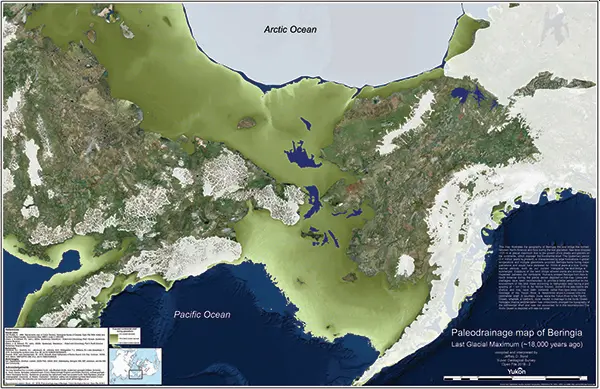
By reconstructing the sea level history of the Bering Strait, scientists found that the strait remained flooded and the Bering Land Bridge connecting Asia to North America did not emerge until around 35,700 years ago, less than 10,000 years before the height of the last ice age (known as the Last Glacial Maximum), and not long before humans are thought to have begun migrating into the Americas. The new findings indicate that the growth of the ice sheets—and the resulting drop in sea level—occurred surprisingly quickly and much later in the glacial cycle than previous studies had suggested. “It means that more than 50 percent of the global ice volume at the Last Glacial Maximum grew after 46,000 years ago,” said Tamara Pico, assistant professor of Earth and planetary sciences at UC Santa Cruz and a corresponding author of the paper. “This is important for understanding the feedbacks between climate and ice sheets, because it implies that there was a substantial delay in the development of ice sheets after global temperatures dropped.” Global sea levels drop during ice ages as more and more of Earth’s water gets locked up in massive ice sheets, but the timing of these processes has been hard to pin down. During the Last Glacial Maximum, which lasted from about 26,500 to 19,000 years ago, ice sheets covered large areas of North America. Dramatically lower sea levels uncovered a vast land area known as Beringia that extended from Siberia to Alaska and supported herds of horses, mammoths, and other Pleistocene fauna. As the ice sheets melted, the Bering Strait became flooded again around 13,000 to 11,000 years ago. The new findings are interesting in relation to human migration because they shorten the time between the opening of the land bridge and the arrival of humans in the Americas. The timing of human migration into North America remains unresolved, but some studies suggest people may have lived in Beringia throughout the height of the ice age. “People may have started going across as soon as the land bridge formed,” Pico said. The new study used an analysis of nitrogen isotopes in seafloor sediments to determine when the Bering Strait was flooded during the past 46,000 years, allowing Pacific Ocean water to flow into the Arctic Ocean. First author Jesse Farmer at Princeton University led the isotope analysis, measuring nitrogen isotope ratios in the remains of marine plankton preserved in sediment cores collected from the seafloor at three locations in the western Arctic Ocean. Because of differences in the nitrogen composition of Pacific and Arctic waters, Farmer was able to identify a nitrogen isotope signature indicating when Pacific water flowed into the Arctic. Pico, whose expertise is in sea level modeling, then compared Farmer’s results with sea level models based on different scenarios for the growth of the ice sheets. “The exciting thing to me is that this provides a completely independent constraint on global sea level during this time period,” Pico said. “Some of the ice sheet histories that have been proposed differ by quite a lot, and we were able to look at what the predicted sea level would be at the Bering Strait and see which ones are consistent with the nitrogen data.” The results support recent studies indicating that global sea levels were much higher prior to the Last Glacial Maximum than previous estimates had suggested, she said. Average global sea level during the Last Glacial Maximum was about 130 meters (425 feet) lower than today. The actual sea level at a particular site such as the Bering Strait, however, depends on factors such as the deformation of the Earth’s crust by the weight of the ice sheets. “It’s like punching down on bread dough—the crust sinks under the ice and rises up around the edges,” Pico said. “Also, the ice sheets are so massive they have gravitational effects on the water. I model those processes to see how sea level would vary around the world and, in this case, to look at the Bering Strait.” The findings imply a complicated relationship between climate and global ice volume and suggest new avenues for investigating the mechanisms underlying glacial cycles. In addition to Pico and Farmer, the coauthors include Ona Underwood and Daniel Sigman at Princeton University; Rebecca Cleveland-Stout at the University of Washington; Julie Granger at the University of Connecticut; Thomas Cronin at the U.S. Geological Survey; and François Fripiat, Alfredo Martinez-Garcia, and Gerald Haug at the Max Planck Institute for Chemistry in Germany. This work was supported by the National Science Foundation. Published in Proceedings of the National Academy of Sciences. Reprinted from UC Santa Cruz Newsletter, By Tim Stephens
OSU Archaeologists Find Oldest Known Projectile Points in the Americas

Oregon State University archaeologists have uncovered projectile points in Idaho that are thousands of years older than any previously found in the Americas, helping to fill in the history of how early humans crafted and used stone weapons. The 13 full and fragmentary projectile points, razor sharp and ranging from about half an inch to 2 inches long, are from roughly 15,700 years ago, according to carbon-14 dating. That’s about 3,000 years older than the Clovis fluted points found throughout North America, and 2,300 years older than the points previously found at the same Cooper’s Ferry site along the Salmon River in present-day Idaho. “From a scientific point of view, these discoveries add very important details about what the archaeologic al record of the earliest peoples of the Americas looks like,” said Loren Davis, an anthropology professor at OSU and head of the group that found the points. “It’s one thing to say, ‘We think that people were here in the Americas 16,000 years ago;’ it’s another thing to measure it by finding well-made artifacts they left behind.” Previously, Davis and other researchers working the Cooper’s Ferry site had found simple flakes and pieces of bone that indicated human presence about 16,000 years ago. But the discovery of projectile points reveals new insights into the way the first Americans expressed complex thoughts through technology at that time, Davis said. The Salmon River site where the points were found is on traditional Nez Perce land, known to the tribe as the ancient village of Nipéhe. The land is currently held in public ownership by the federal Bureau of Land Management. The points are revelatory not just in their age, but in their similarity to projectile points found in Hokkaido, Japan, dating to 16,000-20,000 years ago, Davis said. Their presence in Idaho adds more detail to the hypothesis that there are early genetic and cultural connections between the ice age peoples of Northeast Asia and North America. “The earliest peoples of North America possessed cultural knowledge that they used to survive and thrive over time. Some of this knowledge can be seen in the way people made stone tools, such as the projectile points found at the Cooper’s Ferry site,” Davis said. “By comparing these points with other sites of the same age and older, we can infer the spatial extents of social networks where this technological knowledge was shared between peoples.” These slender projectile points are characterized by two distinct ends, one sharpened and one stemmed, as well as a symmetrical beveled shape if looked at head-on. They were likely attached to darts, rather than arrows or spears, and despite the small size, they were deadly weapons, Davis said. “There’s an assumption that early projectile points had to be big to kill large game; however, smaller projectile points mounted on darts will penetrate deeply and cause tremendous internal damage,” he said. “You can hunt any animal we know about with weapons like these.” These discoveries add to the emerging picture of early human life in the Pacific Northwest, Davis said. “Finding a site where people made pits and stored complete and broken projectile points nearly 16,000 years ago gives us valuable details about the lives of our region’s earliest inhabitants.” The newly discovered pits are part of the larger Cooper’s Ferry record, where Davis and colleagues have previously reported a 14,200-year-old fire pit and a food-processing area containing the remains of an extinct horse. All told, they found and mapped more than 65,000 items, recording their locations to the millimeter for precise documentation. The projectile points were uncovered over multiple summers between 2012 and 2017, with work supported by a funding partnership held between OSU and the BLM. All excavation work has been completed and the site is now covered. The BLM installed interpretive panels and a kiosk at the site to describe the work. Davis has been studying the Cooper’s Ferry site since the 1990s when he was an archaeologist with the BLM. Now, he partners with the BLM to bring undergraduate and graduate students from OSU to work the site in the summer. The team also works closely with the Nez Perce tribe to provide field opportunities for tribal youth and to communicate all findings. The findings were published in the journal Science Advances. Reprinted from Oregon State University Newsroom, STORY BY: Molly Rosbach, SOURCE: Loren Davis
Ancient British Isles Ice Sheet Time-Lapse Animation

The rapid decline of the British-Irish Ice Sheet thousands of years ago may hold lessons for how melting ice sheets in Greenland and Antarctica will influence sea-level rise in the future. In an animation that spans tens of thousands of years, an ancient ice sheet grows to envelope land masses that would one day be known as Great Britain and Ireland. After thousands of years elapse, the ice then retreats to expose the land once more. Known as the British-Irish ice sheet, the frozen mass began its relentless march about 33,000 years ago. Around 10,000 years later, the land was covered in ice half a mile thick. But just 5,000 years after that, the glacier had melted away, vanishing in a mere blink of geological time. Human populations that had fled a millennia-long winter returned to settle the thawing land just as the last ice age drew to a close. Representing years of research, this animation highlights how quickly the British-Irish Ice Sheet declined. And the data driving the animation may help scientists to better understand how modern ice loss due to climate change contributes to sea-level rise.Scottish geologist Archibald Geikie first mapped the British-Irish Ice Sheet’s shape in 1894 and, over the past century, scientists have slowly carved out details of its formation and decline, publishing their findings in more than 1,000 scientific publications, according to the website of BRITICE-CHRONO(opens in new tab) a five-year, $4.2 million endeavor to map the British-Irish Ice Sheet. Ultimately it was the specter of human-caused climate change that drove one team of BRITICE-CHRONO researchers to bring together existing data and collect more; they published their findings Sept. 7 in the journal Boreas(opens in new tab). In creating the new animation, the scientists visualized the most complete picture to date of the ancient ice sheet’s rise and fall. The BRITICE-CHRONO team scoured prior studies and compiled data on more than 20,000 landforms that currently exist along the path of the ice sheet — from hill-like drumlins, or small ridges, to masses of soil and rock left behind by the moving glacier. The scientists then visited locations on land and sea, collecting data from 914 sites — some of which were only accessible via submarine, they reported in the study. They calculated the geometric contours of the ice sheet from features in the terrain, estimating the timing of the glacier’s retreat from carbon-dated sediment, including animal remains. Their efforts produced three times more data than any prior simulation of the British-Irish ice sheet; the team then fed the data into a computer model that assessed how the ice would have interacted with its environment over tens of thousands of years. Their animation presented the resulting maps as a time-lapse of the glacier’s expansion and eventual demise. Although this particular ice sheet melted thousands of years ago, the details of its growth and collapse may hold lessons for climate scientists studying the alarming decline of two modern ice sheets: one in Antarctica and the other in Greenland. Since 1901, these two ice sheets have lost 49,000 gigatonnes of ice — enough to coat the United States in 22 feet (6.7 meters) of ice, or enough to cover the entire surface of the moon in an ice sheet five feet (1.5 m) tall, according to NASA(opens in new tab). That melted ice ended up in the ocean, where it has been the single largest contributor to sea-level rise in the past few decades, according to the United Nations’ International Panel on Climate Change(opens in new tab). Even if humans were to cut all fossil fuel emissions tomorrow, a 2022 study in Nature Climate Change(opens in new tab) suggests that ice lost from the Greenland ice sheet would still cause a 10-inch (25-centimeter) sea level rise. Rising sea levels, in turn, will likely mean more punishing storms with worse flooding; the disruption of fragile ecosystems; and the mass displacement of millions of people who live along the coast. Projects such as BRITICE-CHRONO, which look back at the lifespans of long-gone ice sheets, may help scientists predict the decline of modern ice sheets and plan for the future, the researchers reported. Article by Joshua A. Krisch, taken from Live Science
How Galactic Rhythms Helped Form Earth’s Continental Crust

“To see a world in a grain of sand”, the opening sentence of the poem by William Blake, is an oft-used phrase that also captures some of what geologists do. We observe the composition of mineral grains, smaller than the width of a human hair. Then, we extrapolate the chemical processes they suggest to ponder the construction of our planet itself. Now, we’ve taken that minute attention to new heights, connecting tiny grains to Earth’s place in the galactic environment. Looking out to the universe At an even larger scale, astrophysicists seek to understand the universe and our place in it. They use laws of physics to develop models that describe the orbits of astronomical objects. Although we may think of the planet’s surface as something shaped by processes entirely within Earth itself, our planet has undoubtedly felt the effects of its cosmic environment. This includes periodic changes in Earth’s orbit, variations in the Sun’s output, gamma ray bursts, and of course meteorite impacts. Just looking at the Moon and its pockmarked surface should remind us of that, given Earth is more than 80 times more massive than its gray satellite. In fact, recent work has pointed to the importance of meteorite impacts in the production of continental crust on Earth, helping to form buoyant “seeds” that floated on the outermost layer of our planet in its youth. We and our international team of colleagues have now identified a rhythm in the production of this early continental crust, and the tempo points to a truly grand driving mechanism. This work has just been published in the journal Geology. The rhythm of crust production on Earth Many rocks on Earth form from molten or semi-molten magma. This magma is derived either directly from the mantle – the predominantly solid but slowly flowing layer below the planet’s crust – or from recooking even older bits of pre-existing crust. As liquid magma cools, it eventually freezes into solid rock. Through this cooling process of magma crystallization, mineral grains grow and can trap elements such as uranium that decay over time and produce a sort of stopwatch, recording their age. Not only that, but crystals can also trap other elements that track the composition of their parental magma, like how a surname might track a person’s family. With these two pieces of information – age and composition – we can then reconstruct a timeline of crust production. Then, we can decode its main frequencies, using the mathematical wizardry of the Fourier transform. This tool basically decodes the frequency of events, much like unscrambling ingredients that have gone into the blender for a cake. Our results from this approach suggest an approximate 200-million-year rhythm to crust production on the early Earth. Our place in the cosmos But there is another process with a similar rhythm. Our Solar System and the four spiral arms of the Milky Way are both spinning around the supermassive black hole at the galaxy’s center, yet they are moving at different speeds. The spiral arms orbit at 210 kilometers per second, while the Sun is speeding along at 240km per second, meaning our Solar System is surfing into and out of the galaxy’s arms. You can think of the spiral arms as dense regions that slow the passage of stars much like a traffic jam, which only clears further down the road (or through the arm). This model results in approximately 200 million years between each entry our Solar System makes into a spiral arm of the galaxy. So, there seems to be a possible connection between the timing of crust production on Earth and the length of time it takes to orbit the galactic spiral arms – but why? Strikes from the cloud In the distant reaches of our Solar System, a cloud of icy rocky debris named the Oort cloud is thought to orbit our Sun. As the Solar System periodically moves into a spiral arm, interaction between it and the Oort cloud is proposed to dislodge material from the cloud, sending it closer to the inner Solar System. Some of this material may even strike Earth. Earth experiences relatively frequent impacts from the rocky bodies of the asteroid belt, which on average arrive at speeds of 15km per second. But comets ejected from the Oort cloud arrive much faster, on average 52km per second. We argue it is these periodic high-energy impacts that are tracked by the record of crust production preserved in tiny mineral grains. Comet impacts excavate huge volumes of Earth’s surface, leading to decompression melting of the mantle, not too dissimilar from popping a cork on a bottle of fizz. This molten rock, enriched in light elements such as silicon, aluminum, sodium, and potassium, effectively floats on the denser mantle. While there are many other ways to generate continental crust, it’s likely that impacting on our early planet formed buoyant seeds of crust. Magma produced from later geological processes would adhere to those early seeds. Harbingers of doom, or gardeners for terrestrial life? Continental crust is vital in most of Earth’s natural cycles – it interacts with water and oxygen, forming new weathered products, hosting most metals and biological carbon. Large meteorite impacts are cataclysmic events that can obliterate life. Yet, impacts may very well have been key to the development of the continental crust we live on. With the recent passage of interstellar asteroids through the Solar System, some have even gone so far as to suggest they ferried life across the cosmos. However we came to be here, it is awe-inspiring on a clear night to look up at the sky and see the stars and the structure they trace, and then look down at your feet and feel the mineral grains, rock, and continental crust below – all linked through a very grand rhythm indeed. By Chris Kirkland and Phil Sutton, THE CONVERSATION – from Science Alert
Kummakivi, Finland’s Balancing Rock, Seems to Defy the Laws of Physics

Our brains are pretty good at physics. For instance, you can watch somebody kick a soccer ball in front of you, and you can run to the spot where you and that soccer ball will intersect, taking into consideration the speed of both you and the ball — so smart! Not only that, we can look at one object balancing on another and tell how sturdy it is without so much as touching it. But sometimes our brains make uneducated mathematical guesses, and one of these is Kummakivi, the balancing rock in Ruokolahti, Finland. If it was up to your brain, Kummakivi — which means “strange rock” in Finnish — wouldn’t exist. It’s a boulder resting on a lump of rock in a position that, to our monkey engineer brains, appears impossible, or at least dicey. Extremely slap-dash and temporary work, at best. And yet Kummakivi sits quietly in its Scandinavian forest, racking up the centuries. Millennia, even. Kummakivi is huge — about 23 feet (7 meters) long. It rests on the tiny, steeply pitched footprint of a smaller mound of rock that rises from the forest floor. The balancing boulder appears to be about to slide right off its perch, but it can’t be moved — at least by human muscles. The reason for this isn’t as mysterious as it might appear: Kummakivi is large, but large things aren’t necessarily more likely to be affected by gravity than small ones. Kummakivi is very rough, which helps it stick in place, and it’s not the same density throughout. The center of gravity looks off when you inspect the balancing rock with your eyes, but it’s actually doing exactly what physics would have it do. But the real question is, how did it get there? People have probably always wondered that, but we’ll never know because it has been there approximately 12,000 years — way before we started recording anything. However, Finnish folklore says that some giants or trolls carried the rock to the forest and balanced it on its plinth. These days geologists say it was deposited by a retreating glacier at the end of the last ice age — and as we know, a glacier is basically the only thing as strong as a giant or a troll. By: Jesslyn Shields | Aug 24, 2022 reprinted from How Stuff Works
Dinosaur-Killing Asteroid May Have Had a Companion

A newly discovered crater suggests a second impact that would have triggered underwater landslides and tsunamis On its own, the dinosaur-killing asteroid had a staggering impact: Wildfires raged across the continents, tsunamis pummeled coastlines and about three-quarters of Earth’s species went extinct. But now, new evidence suggests this massive chunk of rock may have had a partner: Scientists discovered what might be an impact crater off the coast of Guinea that they say dates to 66 million years ago—around the same time as the collision that wiped out the dinosaurs. This second asteroid may have broken off from the dinosaur-killer, known as Chicxulub, or it may have been part of a closely timed impact cluster, according to a new study published in Science Advances. “A lot of people have questioned: How could the Chicxulub impact—albeit a huge one—be so globally destructive?” Veronica Bray, a planetary scientist from the University of Arizona and paper co-author, tells National Geographic’s Maya Wei-Haas. “It might be that it had help.” Researchers discovered what they dubbed the Nadir crater—named after a nearby underwater volcano—in 2020, while examining seismic survey data. “We came across a highly unusual feature,” write Bray and co-authors Uisdean Nicholson and Sean Gulick for The Conversation. “Among the flat, layered sediments of the Guinea Plateau, west of Africa, was what appeared to be a large crater, a little under 10 km wide and several hundred meters deep, buried below several hundred meters of sediment.” Nicholson, a geoscientist from Heriot-Watt University in the United Kingdom, has been interpreting such surveys for about 20 years. But he has “never seen anything like this,” he tells BBC News’ Jonathan Amos. Though scientists haven’t confirmed it was caused by an asteroid, features of Nadir, including its scale, the ratio of height to width and the height of the crater rim, are consistent with an impact origin, write the authors in The Conversation. Additionally, deposits around Nadir look like materials ejected from a crater after a collision. Computer modeling showed that to cause this impact, an asteroid would likely have been about 0.25 miles across and hit an ocean that was more than 2,600 feet deep, per The Conversation. In comparison, the Chicxulub asteroid was likely around six miles wide. Still, this second impact would have been sizable. “The energy released would have been around 1,000 times greater than that from the January 2022 eruption and tsunami in Tonga,” Bray tells BBC News. The hit would have caused shock waves equivalent to a magnitude 6.5 or 7 earthquake, which would have triggered underwater landslides and a series of tsunamis, write the authors. “The discovery of a terrestrial impact crater is always significant, because they are very rare in the geologic record,” Mark Boslough, an earth and planetary scientist at the University of New Mexico, who was not involved in the research, tells CNN’s Katie Hunt. “There are fewer than 200 confirmed impact structures on Earth and quite a few likely candidates that haven’t yet been unequivocally confirmed.” To verify that Nadir was truly formed by an asteroid strike, as well as find a precise date for the collision and determine its connection to Chicxulub, scientists will need to drill into the formation and collect samples. The team has already applied for emergency funds for this additional research, per National Geographic. The drilling could also give scientists clues about how life on Earth responded to the impact. “Part of the Nadir drilling goal is to analyze the sediment that was deposited onto Nadir over time,” Bray tells Inverse’s Kiona Smith. “When did life recover? How?” Smithsonian Magazine article by Margaret Osborne
How Has Your Address Moved Over the Past 750 Million Years?

Some 240 million years ago, an enormous supercontinent known as Pangea encompassed nearly all of Earth’s extant land mass, Pangea bore little resemblance to our contemporary planet, but thanks to a recently released interactive map interested parties can now superimpose the political boundaries of today onto the geographic formations of yesteryear—at least dating back to 750 million years ago. Ancient Earth is an interactive Map tool that enables users to home in on a specific location and visualize how it has evolved between the Cryogenian Period and the present. The tool behind this millennia-spanning visualization, is the brainchild of Ian Webster, curator of the world’s largest digital dinosaur database. Webster drew on data from the PALEOMAP Project—spearheaded by paleogeographer Christopher Scotese, the initiative tracks the evolving “distribution of land and sea” over the past 1,100 million years—to build the map. Users can input a specific address or more generalized region, such as a state or country, and then choose a date ranging from zero to 750 million years ago. Currently, the map offers 26 timeline options, traveling back from the present to the Cryogenian Period at intervals of 15 to 150 million years. Ancient Earth includes an array of helpful navigational features, including toggle display options related to globe rotation, lighting and cloud coverage. Brief descriptions of chosen time periods pop up on the bottom left side of the screen, while a dropdown menu at the top right allows users to jump to specific milestones in history, from the arrival of Earth’s first multicellular organisms some 600 million years ago to early hominids’ relatively belated emergence around 20 million years ago. To switch from one time period to another, you can either manually choose from a dropdown menu or use your keyboard’s left and right arrow keys. Start at the very beginning of the map’s timeline and you’ll see the planet evolve from “unrecognizable blobs of land” to the massive supercontinent of Pangea and, finally, the seven continents we inhabit today. Edited from Smithsonian Magazine article by Meilan Solly, February 15, 2019
Continents Were Created on Ancient Earth by Giant Meteorite Impacts

To date, Earth is the only planet we know of that has continents. Exactly how they formed and evolved is unclear, but we do know – because the edges of continents thousands of miles apart match up – that, at one time long ago, Earth’s landmass was concentrated in one big supercontinent. Since that’s not what the planet looks like today, something must have triggered that supercontinent to break apart. Now, we have new evidence to suggest that giant meteorite impacts played a significant role. The smoking gun consists of crystals of the mineral zircon, excavated from a craton in Western Australia, a piece of Earth’s crust that has remained stable for over a billion years. Known as the Pilbara Craton, it is the best-preserved chunk of crust on the planet… and the zircon crystals within it contain evidence of ancient meteorite impacts before the continents broke apart. “Studying the composition of oxygen isotopes in these zircon crystals revealed a ‘top-down’ process starting with the melting of rocks near the surface and progressing deeper, consistent with the geological effect of giant meteorite impacts,” explained geologist Tim Johnson of Curtin University in Australia. Our research provides the first solid evidence that the processes that ultimately formed the continents began with giant meteorite impacts, similar to those responsible for the extinction of the dinosaurs, but which occurred billions of years earlier.” The work was conducted on 26 rock samples containing fragments of zircon, dating between 3.6 and 2.9 billion years old. The research team carefully analyzed isotopes of oxygen; specifically, the ratios of oxygen-18 and oxygen-16, which have 10 and 8 neutrons, respectively. These ratios are used in paleogeology to determine the formation temperature of the rock in which the isotopes are found. Based on these ratios, the team was able to distinguish three distinct and fundamental stages in the formation and evolution of the Pilbara Craton. The first stage is the formation of a large proportion of zircons consistent with partial melting of the crust. This partial melting, the researchers show, was likely the result of bombardment by meteorites, which heated the planetary crust on impact. The oldest cluster of these zircons, according to the team’s interpretation, was the result of a single giant impact that led to the formation of the craton. The second stage was a period of reworking and stabilization of the crustal nucleus, followed by the third stage – a period of melting and granite formation. This stabilized nucleus would then, much later, evolve to become today’s continents, as did the cratons found on other continents around the world. Many meteorites have pelted Earth in eons past, in numbers much higher than the number of continents. It’s only the largest impacts that could generate enough heat to create the cratons, which appear to be twice as thick as their surrounding lithosphere. These findings are consistent with previously proposed models for the formation of cratons around the world – but constitute, the researchers said, the strongest evidence yet for the theory. However, it’s just one craton, out of around 35 known. To make the evidence even stronger still, the team will need to compare their results with more samples from other cratons, to see if their model is consistent globally. “Data related to other areas of ancient continental crust on Earth appears to show patterns similar to those recognized in Western Australia,” Johnson said. “We would like to test our findings on these ancient rocks to see if, as we suspect, our model is more widely applicable.” Article by MICHELLE STARR, Science Alert,10 August 2022 – The research has been published in Nature.