
”Global Megaflood Science” Dr. Vic Baker
“Global Megaflood Science” – Dr. Victor R. Baker – Lower Columbia Chapter -Virtual Meeting Starting in the late 1960s, an accelerating pace of discovery has revealed that the last major de-glaciation of planet Earth involved a global pattern of huge outbursts of water from the margins of wasting continental ice sheets. Much of this water was delivered as relatively short-duration floods with peak flows comparable to those of ocean currents. The global inventory of these phenomena now includes about 4 dozen examples from Asia, Europe, North America, South America, and Iceland. Though there have been many advances in understanding the physical processes and geochronology of megaflooding, important controversies remain, including: the role of flooding on areas that are now under the oceans; the nature of subglacial megaflooding; and the details of the vast network of megaflood landscape features in Asia. Immense outburst floods likely induced very rapid, short-term effects on the global Earth environment. Recorded Thursday, July 16, 2020 at 7:00 PM
Glacial Lake Missoula – Inspired Classroom Videos

The Glacial Lake Missoula chapter has worked with Inspired Classroom LLC to produce a series of 9 short (3-7 minute) videos exploring different aspects of the Ice Age Floods in the Glacial Lake Missoula area. The entire set is posted to the Inspired Classroom LLC YouTube channel, including a full 31 minute version (below) that compiles the entire set.
Nick Zentner – More Geology Videos

Are you looking for new geology videos? Nick Zentner has done a long series live geology lectures from his home in Ellensburg and posted them online to his YouTube channel https://www.youtube.com/user/GeologyNick/videos He is now recording a series of “Nick on the Fly” virtual field trips and posting them on the same YouTube channel https://www.youtube.com/user/GeologyNick/videos Join Nick as he explores the geology of the Pacific NW and many other topics.
DECIPHERING THE CHANNELED SCABLANDS FIELD WORK CONTINUES
In August, Scott David, a postdoctoral researcher and Karin Lehnigk, a 2nd year PhD candidate from the University of Massachusetts visited the scablands for a week to do field studies. Karin was in search of granite erratics. Samples of these were taken to be processed for Beryllium-10 exposure dating, a robust geochemical technique which enables researchers to determine how long the object sampled has been sitting on the surface of the Earth. This information combined with computer simulations of a range of flood sizes is to test the hypothesis that the earliest floods through the Cheney-Palouse Scabland Tract were also the largest. Scott was in search of potholes. Measuring the geometry of potholes and the rocks that comprise them in a variety of locations, he is using these measurements in numerical and physical modeling experiments to explore what erosion mechanisms could generate these massive features. Were they produced by retreating waterfalls, rocks circulating at the base of the flow, large scale turbulence, or some combination of these mechanisms? The results of the study should provide insight into how the remarkable canyons that comprise the Channeled Scablands formed. On a Friday afternoon, I met up with them in Ritzville and proceeded to some granite erratics near Cow Creek southeast of town to take samples. They spent the night at our house in Washtucna and were thrilled to have hot showers, a home-cooked meal and soft beds. The days before they slept in tents on a gravel parking lot. The next morning, Chad Pritchard from EWU joined us as we took measurements from four pot-holes along the south side of Washtucna Coulee between Washtucna and Hooper. They also took granite samples from the Midcanyon Bar near Lyons Ferry before returning to the Grand Coulee area. The results of their studies were not available at time of printing. Article by Lloyd Stoess in The Scablander
Use Social Distancing Time to Explore the Floods with Our Interactive Online Map
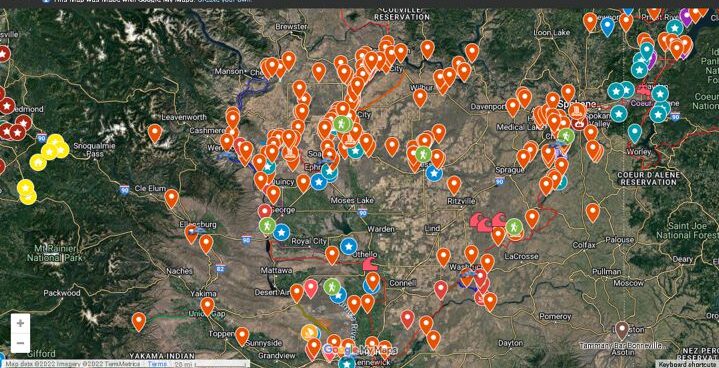
If you’ve ever tried to explore the Ice-Age Floods with a guidebook you’ll know how difficult and frustrating it can be to find and learn about the features in the area you’re visiting. Well, there’s now a solution to that problem; an interactive map that’s available wherever you have internet access. The map features over 300 points of interest throughout our 4-state area, with a description and images that slide out when you click on one of the markers. More features are being added all the time, and we’re planning to expand the map with features related to the Lake Bonneville Flood event that rampaged through the area during the time of the Ice-Age Floods. Since this is an internet-based map, it’s also easy to get driving directions to the site from wherever you are starting from. You can also easily build an informative field trip, exploring and learning about a number of other nearby features with just a few clicks of your mouse. We feel this may be the most useful field guide ever developed to explore ice-age Floods and glacial features throughout our 4-state region. AND it’s absolutely FREE! The only shortcomings we see are 1) the map requires internet access, which isn’t always available in far-flung areas of our region, and 2) we may not have every point-of-interest on the map (YET!). If we’re missing something you think is important we encourage you to submit your suggestion. We also appreciate any comments and/or corrections by email to Webmaster@IAFI.org. We sincerely hope you enjoy using this guide to poke around these fascinating ice-age features.
New Release – Glacial Geology Maps of North Idaho

IAFI Store is proud to offer a new, two-sided Glacial Geology of North Idaho map that includes a GLACIAL GEOLOGIC MAP OF NORTH IDAHO on one side and a SHADED RELIEF MAP OF NORTHERN IDAHO AND PARTS OF WESTERN MONTANA AND EASTERN WASHINGTON on the other side.The maps are 33.75” x 21.5” in size and are available as both flat and folded versions at a price of $9.95 + tax and shipping. The GLACIAL GEOLOGIC MAP OF NORTH IDAHO is a color map produced at the scale of approximately 1/175,000 that represents over 30 years of research and field work by Dr. Roy Breckenridge, former Idaho State Geologist and VP of the IAFI Coeur du Deluge Chapter. The second author of this map was Dean Garwood who, following Roy’s passing, organized Roy’s information and used his GIS skills to put together multiple information layers to produce the final map. The map is in commemoration of Roy and his dedication to the fields of geology and education and his commitment to our chapter and the Ice Age Floods Institute. The SHADED RELIEF MAP OF NORTHERN IDAHO AND PARTS OF WESTERN MONTANA AND EASTERN WASHINGTON is a shaded, colorized relief map generated by Dean Garwood, overlain with other important geographic information to make the map more useful. The shaded relief map was printed at a scale of approximately 1/198,000 and covers a larger area of the Inland Northwest. The Coeur du Deluge Chapter, a member of the non-profit Ice Age Floods Institute (IAFI), is a committed advocate, educator and marketer of the Ice Age Floods experience as a significant international natural and cultural heritage phenomenon. The production and distribution of this two-sided map is done in accordance with our Mission as an educational non-profit, more concerned with the map’s distribution than profits, which is the reason the map is priced less than $10. We plan to provide a set of maps free of charge to any local school and any local library in North Idaho, and to sell the maps through various outlets, primarily in Sandpoint and in Coeur d’Alene and Spokane, as well as through the Ice Age Floods Institute Store and Keokee Publishing.
Explore the Ice Age Floods with 12 New IAFI Brochures

IAFI has compiled 12 brand-new, full-color brochures into a packaged set to help guide you in visiting spectacular ice-age features across all of our 11 Ice Age Floods chapter areas. With these brochures as your guides you can explore the paths of the Ice Age Floods from Montana through Idaho, central Washington and northern Oregon, and even delve into the many glacial features of northwest Washington. Click on any of the brochure covers below to see a full size printable PDF version (note: you’ll need to scale down to print on 8.5×11 letter size paper). Packets of all 12 full-size brochures are NOW available through the IAFI Store and at participating local outlets. Click a cover to open a PDF of any of the brochures below
Ice Age Floods Playscape in Spokane Riverfront Park
By late summer or early fall of 2020, Riverfront Park will have an interactive playground that will be almost an acre in size. The great ice age floods that shaped the Inland Northwest also are shaping the new playground on the North Bank of Riverfront Park. The playground’s theme is Ice Age Floods, which will allow kids to both play and learn about Spokane’s history at the same time. Designers thought to add this theme since the Ice Age Floods had a significant impact on Spokane’s geology. “That parcel has always felt like an outlier,” says Dell Hatch, a landscape architect and principal in charge of the North Bank project for Bernardo|Wills Architects (BWA), “so it’s really cool to integrate that north side as another element of the park. Kids are going to be able to discover as they play, in the sand areas and as water moves through the playground, They’re going to be learning without even knowing they’re learning.” Soon the space will be home to a wheels park for skateboards, inline skates and scooters, new Hoopfest courts, parking served by improved access off Washington Street, and a new operations building to serve the park’s back-of-house needs. The North Bank will also connect with the soon-to-be-built Sportsplex, located on the basalt bluff above. But the centerpiece will be a 1-acre-plus destination playground themed around the Ice Age Floods that carved out the Spokane River Gorge some 15,000 years ago. “You are going to see some water play features, you’ll see some geology features too, some rocks in different elements the kids can climb around as they learn what the geology of eastern Washington is and why it is so special to our region,” said Fianna Dickson with Spokane Parks and Recreation. Some playground features will help children learn about nature and geology, like a stream that teaches about currents and damming. A climbing wall, rope suspension bridge, large rocks that children can climb, a splash pad, and a 30-foot tall climbing tower with tube slides, would be play elements in the park. “We’re working with Nigel Davies [a geologist from EWU], and we’ve held a workshop with the Ice Age Floods Institute,” says Bill LaRue, a landscape architect with BWA and project manager for the North Bank. “We’re working in like five or six different types of basalt, fossils of local flora and fauna — even a petrified forest.”
Model for a Missoula Flood
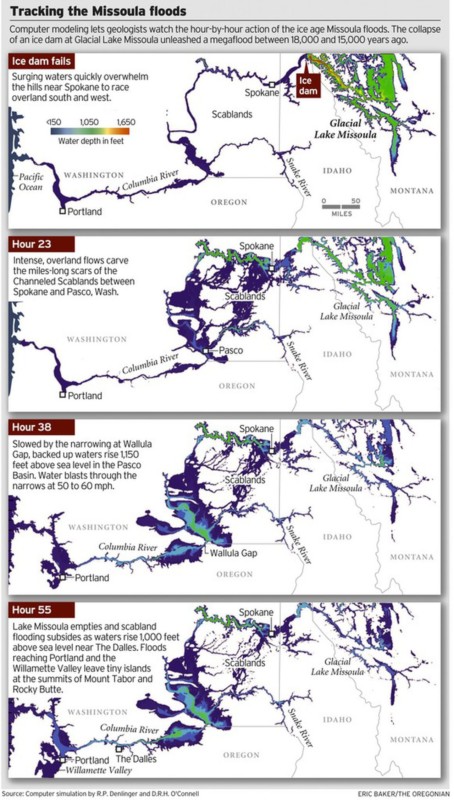
ICYMI (in case you missed it) — Floodwaters rise more than 1,000 feet as they slam into the Columbia River Gorge from the east. The torrent blasts through the narrows at 60 mph, carrying truck-size boulders and house-size icebergs. Reaching Portland, water loaded with gravel and dirt roils to a depth of 400 feet, leaving tiny islands at the summits of Mount Tabor and Rocky Butte. Geologists have spent decades piecing together evidence to tell the story of the great Missoula floods that reshaped much of Oregon and Washington between 18,000 and 15,000 years ago. Now scientists have found a way to travel back in time to watch the megafloods unfold, in a virtual bird’s eye view. Their computer simulation displays the likely timing and play-by-play action, starting with the collapse of an ice dam and outpouring of a lake 200 miles across and 2,100 feet deep. The computer model, developed by Roger Denlinger with the U.S. Geological Survey in Vancouver and Colorado-based geophysicist Daniel O’Connell, is filling gaps in scientific explanations of the floods and the baffling landforms they left, including the fabled Channeled Scablands — scars hundreds of miles long cut into the bedrock of eastern Washington and visible from outer space. The simulations also may help settle a lingering scientific controversy about what caused the repeating ice-age catastrophes. “It’s just really powerful visualization that gives a sense of the scale of the floods, how they came down through the channel system and backed up the big tributary valleys,” said Jim O’Connor, a hydrologist with the U.S. Geological Survey in Portland who has written extensively on the Missoula floods. He said the modeling work provides the first “really good information” on the timing of events. During the last ice age, a continent-spanning ice sheet built from massively expanded glaciers descended from the Canadian Rocky Mountains to reach deep into Washington, Idaho and Montana. Glacial Lake Missoula formed behind a miles-long dam of ice across what is now the valley of the Clark Fork and Pend Oreille rivers running from Montana to northeast Washington. The dam formed and collapsed dozens of times over a span of three thousand years. In the simulation of one of the largest possible floods, raging water quickly overwhelms the hills near Spokane and races overland to the south and west. The intense, overland flows carve the miles-long scars of the scablands between Spokane and Pasco, Wash. Thirty-eight hours later, swirling, mud-darkened waters converge at the narrowing of the Columbia at Wallula Gap, where the backed-up flow rises 850 feet above river level (1,150 feet above sea level). An immense volume of water blasts through the narrows at fire-hose velocity. Flow exceeds 1.3 billion gallons per second — a thousand times greater than the Columbia’s average flows today. Lake Missoula’s water, all 550 cubic miles of it, drains in 55 hours — less than three days — according to the model. At that time, the flood surge peaks in the Columbia Gorge at The Dalles, rising 950 feet above river level (1,000 feet above sea level), spilling over the gorge walls in places, and flooding the valleys of tributaries for miles upstream. Inundation of the Willamette Valley peaks on the seventh day after dam burst, in the simulation. Flooding reaches as far south as Eugene. Loaded with mud and gravel, the flood dumps sediment across the entire valley. Repeated floods build a layer 100 feet thick in Woodburn. Such a vast inundation, far greater than anything ever witnessed in historical time, seemed impossible to geologists in the 1920s, when J Harlen Bretz proposed that the scablands resulted from a catastrophic flood, not eons of gradual erosion. The idea didn’t gain mainstream acceptance until the 1960s. Since then, geologists have found evidence that Lake Missoula emptied catastrophically dozens of times during the last ice age. But controversy persists. A few scientists assert that the cataclysmic floods must have had multiple sources, not just an outburst from Lake Missoula. John Shaw of the University of Alberta in Edmonton, for instance, has proposed that an enormous reservoir beneath the ice sheet over much of central British Columbia boosted the flooding. The new simulation suggests that discharge from Lake Missoula alone would have been powerful enough. The simulated flood reaches peak stages all along its route that match the evidence visible today in sediment, with one big exception: At Wallula Gap, water levels in the simulation fell short by as much as 130 feet. “It’s pretty clear, if Lake Missoula is enough to hit all the other high water marks, you don’t need another source of water,” Denlinger said. Calculating the convoluted paths of such a massive flood requires an immense amount of number crunching. Simulating one flood requires more than 8 months of computer time, Denlinger said. But the computer simulation isn’t likely to end the debate. The fact that it can’t reproduce the maximum flooding at Wallula Gap leaves room for doubts. And some experts say there is direct evidence for an additional source of flood waters from beneath the ice sheet that covered the Okanagan Valley. “It is conceivable that other valleys in southern British Columbia contributed water to the scablands but the field evidence necessary to test these possibilities has not been fully documented,” said earth scientist Jerome-Etienne Lesemann at the University of Aarhus in Denmark. “There are a number of unanswered questions,” he said. “That makes the whole Channeled Scablands story a really interesting and intriguing geological puzzle.” Reprinted from The Oregonian, original article by Joe Rojas-Burke, 2010
PacNW Geology Videos – Nick Zentner

Do you want to learn about the fascinating general geology of the Pacific Northwest? Well, perhaps the easiest and one of the most ways to do that is to watch some of the many videos Nick Zentner and his film crews have made and posted on YouTube. Nick has been the host of a dizzying number of short (2 Minute Geology) to long (1+ hour free public lecture) videos covering everything PacNW geologic from 40+ million year old continental accretion to ice-age floods, flood basalts to our awesome volcanoes, huge landslides, and even earthquakes yet to happen. Nick is an award-winning professor of geology at Central Washington University in Ellensburg, WA. His is an ongoing crusade to bring the drama of Northwest geology to life for everyone – not just academics and die-hard rock hounds. Pacing and narrating with gee-whiz enthusiasm, Nick combines simplicity and scientific rigor, presenting his subject matter in a way that’s stimulating, fun and educational to students and the general public. Here are links to some of his YouTube channels and the topics you’ll find there: Huge Floods Channel – 2-Minute Geology Series – 13 videos including: Geology Video Blooper – Columnar Basalt – 0:54 Columnar Basalt – Geologist explains spectacular stone columns – 2:31 What is a Coulee? 2:36 Erratic Boulders – Rafted in Icebergs by the Ice Age Floods – 2:37 Giant Current Ripples Created by the Ice Age Floods – 2:51 Pillow Basalt (Lavas) and Palagonite. Result of lava flowing into water – 2:52 Columbia River Basalt Group – Related to Cascade Volcanoes? 2:59 The White Bluffs at Hanford Reach – Columbia River Free Flowing Stretch – 3:00 What is a meander – Geologist describes meandering streams, rivers and oxbow lakes – 3:02 Petrified Wood – 15 million-year-old Petrified Tree – 3:31 Seattle Earthquake Fault – Beneath Largest City in the Pacific Northwest 3:42 Wenatchee Washington – Ice Age Floods Geology – 4:34 Palouse Falls and the Palouse River Canyon – Ice Age Floods Features – 5:12 Nick Zentner Channel – Roadside Geology Series – 7 videos including: Frenchman Coulee: Central Rocks – Roadside Geology #1 – 10:48 Vantage Erratics: Central Rocks – Roadside Geology #2 – 11:55 Yakima River Rocks: Central Rocks – Roadside Geology #3 – 10:36 Yakima River Canyon: Central Rocks – Roadside Geology #4 – 11:55 Thorp Moraine: Central Rocks – Roadside Geology #5 – 8:38 Thorp Lahars: Central Rocks – Roadside Geology #6 – 9:37 Dry Falls: Central Rocks – Roadside Geology #7 – 9:50 Nick On The Rocks – 18 videos, including: Seattle Fault – 4:01 Yakima River Canyon – 4:16 Lake Chelan — Battle of the Ice Sheets – 4:24 Puget Sound’s Exotic Terranes – 4:25 Dry Falls – 4:37 Chasing Ancient Rivers – 4:42 Ice Age Mystery of Lake Lewis – 4:42 Bridge of the Gods Landslide – 4:44 Steamboat in the Desert – 4:50 Mt Rainier’s Osceola MudFlow – 4:51 Ghost Forests – 4:54 Ancient Cascades Volcanoes – 5:01 Columns of Basalt Lava – 5:01 Giant Lava Flows – 5:06 Liberty Gold Mines – 5:07 Mount Stuart – From Mexico? – 5:11 Giant Ripples in the Scablands – 5:11 Goldilocks Miracle of the Palouse – 5:20 Downtown Geology Lectures – CWU Geology Series – 14 videos, including: Supercontinents and the Pacific Northwest – 56:33 Ancient Rivers of the Pacific Northwest – 57:17 Liberty Gold and the Yellowstone Hotspot – 58:05 Tsunami In Our Future – 59:09 “Bing Crosby, the Sunset Highway and the Channeled Scablands” – 1:01:24 Flood Basalts of the Pacific Northwest – 1:02:35 Great Earthquakes of the Pacific Northwest – 1:04:01 Hells Canyon and the Ringold Formation – 1:04:35 Bridge of the Gods Landslide – 1:05:22 Mount Rainier’s Osceola Mudflow – 1:05:52 Lake Chelan Geology – 1:07:18 Exotic Terranes of the Pacific Northwest – 1:09:23 Floods of Lava and Water – 1:10:18 Supervolcanoes in the Pacific Northwest – 1:10:50 Ghost Volcanoes in the Cascades – 1:11:15 Plant Fossils in the Pacific Northwest – 1:13:17 Dating the Ice Age Floods – 1:26:23 TEDxYakimaSalon | Nick Zentner Sharing Geology