The Missoula Floods and the SVRP Aquifer
The Lake Lewis chapter of the Ice Age Floods Institute will host a free Zoom lecture on March 3rd exploring the dramatic creation of the Spokane Valley - Rathdrum Prairie (SVRP) Aquifer!
The landscape upon which the town of Cheney has been built bears silent witness to one of the greatest series of catastrophic floods that has ever been documented on our planet. In this talk, we delve into how the leading scientists, both past and present, have interpreted this landscape as a consequence of one immense glacial lake pouring into another glacial lake, which then overflowed and breached the southern shoreline to create the vast channeled scablands. Presented by Dr. Linda McCollum, professor emeritus of geosciences at EWU and president of the Ice Age Floods Institute (IAFI), Cheney-Spokane Chapter Registration is required.
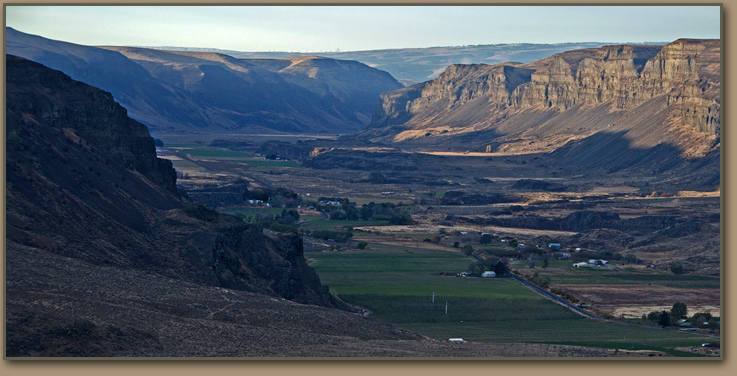
The Palouse Falls and Cheney-Spokane Chapters of the IAFI invite you to a hike at Escure Ranch on the BLM Rock Creek Recreation Site on Saturday, March 14. The hike will start at 10:00 a.m. It will be led by Don Chadbourne, geologist and board member of the Cheney-Spokane Chapter, and Lloyd Stoess, president of the Palouse Falls Chapter. You will meet the leaders at the trailhead. Description of the Escure Ranch Hike The hike will begin and end at the Escure Ranch parking area, of the Bureau of Land Management, Rock Creek Recreation site. The hike will follow an old ranch road to Towell Falls and return on the same route. The out and back hike will be about 6.5 miles. The trail is mostly double track over dirt and rock, with an elevation gain and loss of about 160 feet. The hike is a pleasant trek through a remote scabland canyon. Features will include rock benches and basins, flood bars, Mima mounds, mesas and waterfalls. This hike is included in the book, On the Trail of the Ice Age Floods – Northern Reaches, by Bjornstad & Kiver. Directions to the trailhead will be provided to hikers after registration. Click on the Register button to sign up for the hike. The hike will be limited to 30 hikers. Items to bring with you: appropriate shoes, day pack, water, snacks, appropriate clothing for changes in the weather, sun protection, emergency items, camera and binoculars. Walking poles will be helpful. The hike is free; however, donations for support of Chapter activities will be accepted. For additional questions, contact Don at 509-891-5875, or Lloyd at 509-954-3927. Map available for download: 11 x 17 LIDAR map of Escure Ranch Area showing our hiking route to Towell Falls (downloadable PDF)
At the Sandhill Crane Festival, March 20-22, 2026 in the beautiful Columbia Basin, Othello, WA, you’ll have the chance to explore the Ice Age Floods story through presentations and field trips, and see thousands of Sandhill Cranes, ducks, and geese as they gather against the stunning backdrop of the Saddle Mountains and sprawling cornfields. There is a fantastic lineup of geology and wildlife viewing opportunities, along with engaging talks, fun tours, hikes, and workshops for everyone to enjoy. Registration is now open with a registration deadline of March 15 at noon (No refunds after this date). All Events are offered on a first-come, first-served basis. Reservations are filled in the order received. Please note, Lectures, tours and hike participants must purchase a General Admission Ticket for $10.00.
Researchers have established, based on the pioneering work of Dr. J Harlen Bretz and JT Pardee, that over 140 Ancient Mega-Flood, including Noah's Flood are discussed in oral traditions worldwide. Professional geologist Bill Burgel will briefly discuss how the research related to the Missoula Floods and Bonneville Flood has opened up the possibility of mega-floods being the most likely explanation for the formation of the Mediterranean Sea, the Persian Gulf, The Bosphorus Straits, the English Channel, Chimu in Peru and the floodwaters on Mars. Mega-flood events are also being cited for the draining of Glacial Lake Agassiz, Glacial Lake Iroquois and the Grand Canyon of the Yellowstone.
This presentation will begin by defining what an Ice Age is and then looking at our dynamic planet and those major events that can lead to dramatic temperature changes. Also included will be a look at hazards here in the Pacific Northwest and why they occur.
This field trip will head north from Othello along the eastern edge of the Quincy Basin with stops on the Ephrata Fan and Soap Lake at the mouth of Grand Coulee. Moses Coulee parallels Grand Coulee to the west and has puzzled scientists to this day. Several plausible explanations to its origins have been proposed. This off-the-beat coulee is always a surprise to first time visitors. On the way back to Othello, there will be stops at Potholes Coulee and Drumheller Channels which were two of the four outlets for the Missoula Floods exiting the Quincy Basin. Go to www.othellosandhillcranefestival.com to sign up for this trip.
The Lake Lewis Chapter of the Ice Age Floods Institute is sponsoring an informal (carpool) field trip focus on the geology in and around Richland, Washington
The 3-mile hike will be led by IAFICS board member geologist Michael Hamilton. It will take place along Rimrock Drive, which has spectacular views of Spokane and the Spokane Valley. The Glacial Outburst Flood Story will include a lot of "arm-waving," pointing out flood features both along the trail and with views to the east. The geology discussion will include details of another kind of flood that hit the Spokane area 14 million years ago. The hike will then cut to the west along one of the park's trails to find mysterious Mima mounds, and then loop back to the parking area.
Saturday April 11—Lower Crab Creek. We will meet on the east end of the Chicago, Milwaukee, St. Paul & Pacific bridge in Beverly at 10:00am. Over the day, we will explore: 1) the tectonic origins of Crab Creek “Coulee” and the Saddle Mountains; 2) impacts of Ice Age flooding on the area; 3) formation of prominent rockfall and landslides from the Saddle Mountains; and 4) how geology, weather and climate, and human activity have shaped sand dunes and salt flats in the area. The trip will conclude around 3pm giving participants plenty of time to get back to Ellensburg for Nick Zentner’s lecture. More details will be forthcoming. Field trip leader Karl Lillquist.