
Jeff Becklund

Wenatchee Valley Erratics Chapter President Retired 42 yrs Licensed Coast Guard Captain. Retired Senior Captain Trilogy Excursions . Bellevue High School. Western Washington State College, 74-78, Recreation Park Management Program. Moved to NW in 2020 now resides in Wenatchee. Americorp Volunteer 2022-2025, serving at Wenatchee Valley Museum and Cultural Center as Program and Tours Coordinator. Coordinated tours for Ken Lacy and Brent Cunderla. Supported Wenatchee Valley Erratics Chapter tours since 2023
There IS such a thing as ‘settled science’

How bad-faith arguments sow doubt by weaponizing scientific humility Good advice to consider when either claiming or questioning scientific (and geologic) theories and hypotheses “Science is never settled” has become a go-to slogan for populists seeking to legitimize fringe scientific positions. In 2020, Representative Nancy Mace was asked whether she agreed that climate change is the result of humanmade greenhouse emissions. She responded: “My opponent has said that the science is settled on this. Well, the science is never settled. Scientists will tell you that.” In February, Senator Roger Marshall argued more money should be spent on investigating widely debunked links between autism and vaccines, saying “I’m a physician. Science is never settled. That’s what makes us scientists.” When U.K. Reform party leader Nigel Farage was pressed on whether he would “side with medical experts who say ‘a link between Tylenol use in pregnancy and autism’ is dangerous nonsense,” he responded, “When it comes to science, I don’t side with anybody… because science is never settled.” The issue is, of course, that in many areas, from the theory of evolution to the theory of gravity, science is very much settled. To pretend otherwise is to misrepresent the position of the scientific community. That doesn’t mean that scientific positions are eternally fixed and can’t be updated in light of new evidence. It means that our current best explanations have been tested enough for us to be confident that they are good descriptions of the way things work. Myth of overturned consensus A favorite trope of climate denialists is that scientists in the 1970s predicted “global cooling” — an imminent ice age. It’s a smart argument, because if you can suggest that the exact opposite of global warming was once the prevailing view, surely you throw the current consensus on climate science into doubt? Despite media attention and much discussion of the idea, global cooling was never a consensus scientific position. Reviews of the literature at the time show that even 50 years ago, global warming dominated scientific thinking about the Earth’s short-term climate future. That climate change is the result of greenhouse gas emissions is now very much the consensus scientific position. There are, however, examples in science where consensus positions have been modified or updated. Gravity is a classic case. Galileo established that acceleration due to gravity is the same for all objects near Earth’s surface. But it wasn’t until Newton that we had a universal theory of gravitation. Newton’s theory unified the behavior of objects falling on earth with the motions of planets. For years, every measurement seemed to confirm it, and the theory became known as a “law” that nature was thought to obey without exception. But as experiments expanded and instruments improved, the edges of Newton’s “law” began to fray. When dealing with strong gravitational fields like those near a black hole, or when calculating to high precision or over short astronomical distances, Newton’s law wasn’t sufficient. In the 20th century, Einstein’s general relativity filled many gaps — resolving a range of seeming astronomical anomalies and describing how light bends near a black hole. Yet even the relativistic interpretation of gravity is not perfect. We know, for example, that it must break down inside a black hole. First Galileo’s and then Newton’s theories were superseded, and we know Einstein’s isn’t correct in every situation. Does that mean these earlier theories are useless and not examples of settled science? Definitely not. In contexts where these theories have been rigorously tested and shown to give the correct answers (to a given degree of precision), they remain valid. They aren’t wrong — just special cases of the more general theories, valid within a given domain of legitimacy in which they were originally postulated and tested. In the same way, whatever supersedes Einstein’s theory will have to include it as a special case. The example of gravity shows that scientific knowledge can evolve yet still be considered settled within its domain of legitimacy. We can point to other consensuses, like evolution or germ theory, as settled science that has been expanded and generalized over time. Scientific ‘facts’ There are also questions that most would call definitively settled. That Earth is round, not flat, is perhaps the most obvious. But whether we choose to call this a “fact” or not depends on how we define the word. If we demand 100% certainty, science can’t provide it. If you want certainty, you need to look to mathematics, where knowledge is built through deduction from axioms (a fundamental set of premises), independent of the world. Science, in contrast, built on evidence and induction, can only ever offer increasing confidence. A key premise of the scientific method is openness to new evidence. If you consider yourself 100% certain, then no new evidence, however convincing, can change your mind. That is not good science. However, if you accept that science provides evidence for hypotheses, it can offer what we might call indisputable evidence — so robust that disputing it isn’t a tenable position. Overturning the not-flat worldview would require such a massive reconsideration of what we understand about reality as to make it practically impossible. So, “settled science” does not mean we know something with absolute certainty, but that the weight of evidence is heavily in favor of this interpretation. Perhaps more importantly, if someone wants to change the currently held conception, the burden of proof is on them. All scientific knowledge comes with uncertainty. That is the hallmark of good science. But uncertainty doesn’t mean we cannot confidently assert that entropy always increases (the second law of thermodynamics) or that Earth orbits the sun. Science embraces uncertainty and is open to revision when new information appears, but that does not mean we shouldn’t take a position when the evidence stacks up on one side of the balance. Issues that have been rigorously tested can still be considered settled. Not being 100% certain isn’t the same as being 50-50. Admitting doubt isn’t the same as both-siding a one-sided issue. The fact that scientists acknowledge uncertainty isn’t a reason for championing false balance. But these are the fallacious positions populists are taking when
Kititas Valley Historical Museum – Ellensburg
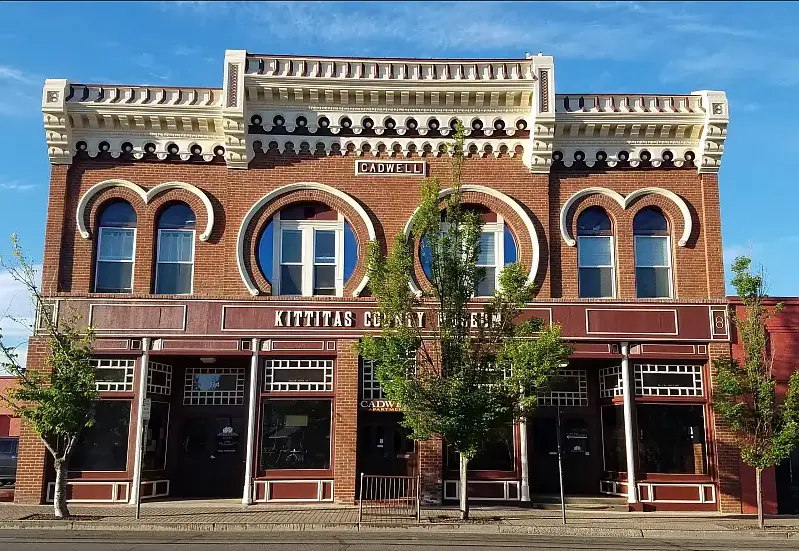
IN THE CITY OF ELLENSBURG… when you want to spend some time indoors, a great place to visit is the KITTITAS VALLEY HISTORICAL MUSEUM. It has about 30,000 items from which more than 50 exhibits and displays are chosen. The mission of the museum is to, “Collect, Preserve and Share the History, Heritage, and Culture of Kittitas County.” In experiencing it you feel a strong connection to the Pacific Northwest. Collection highlights include: Indigenous cultural items (especially from the K’tɨ́taas and Pshwánapam bands). Note the roots here for the local names of Kittitas and Wanapum. Geological specimens, including Ellensburg Blue Agate Some fossilized animals Household goods, textiles, and furnishings Military memorabilia and service records Historic photographs and albums Agricultural tools and equipment Business records and local commerce material Even the building itself is interesting. Built of brick, it was constructed after the Great Ellensburg Fire of July 4, 1889. (There is an exhibit about that fire and its devastation to the town). Some examples of what you will see: So, if you are so inclined, spend some time and enjoy. The museum is open Monday through Saturday from 10am to 4pm. The address is 114 E. 3rd Ave. Ellensburg Admission is free and donations are accepted. Article by Mike Doran: President of the Ellensburg Chapter of the Ice Age Floods Institute
Glacial erratics of the Puget Lowland
Strewn among the forests of the Puget Lowland are an impressive array of Glacial Erratics. Although technically erratics include small pebbles and even sand grains in till, people tend to get the most excited by really big erratics- those the size of a house or building. Whatever their size, glacial erratics often reveal the direction of the ice flow that ripped them from their source region and deposited them at their resting place. Erratics can also help determine the thickness of the ice sheet that deposited them. In the Seattle area, it is relatively straightforward to determine the provenance of erratics containing quartzite, as that rock can not be found anywhere in the Olympics, the Cascades, or in the native bedrock of the Puget Lowland. Quartzite, which is durable and resistant to weathering, is commonly found in river valleys of central British Columbia and in the glacial tills of the Puget Lowland. However, granodiorite erratics found in the lowland and on the slopes of the Olympics and Cascades can be more difficult to decipher. The granodiorite in these erratics is chemically similar to rock bodies both in the British Columbia Coast Mountains and in the Cascades. In the mountains east of Bellingham, erratics found at 5,000 ft of elevation imply that the thickness of the Puget Lobe of the Cordilleran Ice sheet was at least 5,000 ft thick at that location. Maps showing the thickness of the Cordilleran Ice Sheet at various places in Western Washington are drawn, in part, by looking at the depositional altitude of erratics on ridges around the region. The two most massive erratics in the Puget Lowland are composed of Greenschist metamorphic rock. One of the giant erratics of Western Washington hides in the forest in Saratoga Woods Park on Whidbey Island. The Waterman erratic is 38ft high and has a circumference of 135 ft. Analysis of the rock shows that it is composed of Greenschist, a rock containing the low grade metamorphic minerals Chlorite and Epidote. The Greenschist chemically matches the rock of Mt. Erie, a prominent Roche Moutonée found 40 miles to the north on Fidalgo Island. An even larger erratic can be seen in a suburban neighborhood near Everett. The Lake Stevens erratic, 34 ft tall with a circumference of 210 ft, is considered the largest erratic in the Northwest, and possibly the largest erratic in the United States. This erratic is also composed of a Greenschist, although chemical analysis cannot give us a definitive origin for the big rock. There is similar Greenschist on the northern tip of Whidbey Island at Deception Pass, around Mt. Shuksan in the North Cascades, and also up the Fraser River in British Columbia. Article by Dale Lehman
Julie Bishop – Coeur du Deluge Volunteer
Julie Bishop is a founding member of the Coeur du Deluge Chapter of the ice Age Floods Institute and the only continuous member of the Chapter. She has served as Treasurer of our chapter for at least 15 years. Her service to the Coeur Du Deluge Chapter goes way beyond taking care of our financial needs. Julie was and is always there supporting our chapter’s activities (public lectures, field trips and the distribution of IAF-related educational material). She did and does this cheerfully and efficiently. She somehow finds time for our chapter even though she has a full-time job with the Idaho Department of Highways. She has another full-time job at home taking care of the family farm, especially their horses. Julie casually brushes off her contributions to IAFI and Coeur du Deluge, saying that although she did some of the “legwork to start the chapter” the ultimate responsibility for the creation of our chapter was based on the long time flood interest of her friends and co-founders of the CDD Chapter: Kermit Kiebert, Jon Burkhart and Mark Heisel. She continually underplays her contributions. But that is the grace and charm of our Julie Bishop. Thanks for you unstinting service Julie, it’s truly appreciated!
Yvonne Addington – Lower Columbia Volunteer
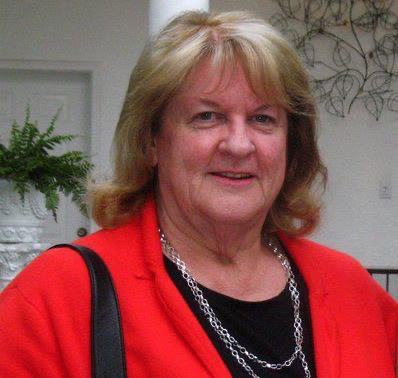
Lower Columbia Chapter/Ice Age Floods Institute (IAFI) is privileged to recognize our outstanding volunteer, Yvonne Addington, who has always been there for us, doing so much for our Chapter, and that’s been lots! Yvonne Addington looks to the future and connects people to make things happen. Even before the Ice Age Floods Institute was formed Yvonne was an Ice Age fan and was storing the bones of a mastodon dug up in Tualatin, Oregon. Tualatin decided to become an ice age destination and Yvonne was one of the most enthusiastic supporters. In many instances she was the driving force or one of a team of people who made the ice age theme come alive in Tualatin. If you dig into Tualatin’s many ice age interpretive displays, public artwork, artifacts like prehistoric animal bones and erratic rocks, you will find Yvonne’s impact. She arranged many of the donations to the Tualatin Public Library ice age displays including the mastodon which Yvonne stored for many years before it found a suitable home in the Tualatin Public Library. She supported the work of making Tualatin the first partner of the Ice Age Floods National Geologic Trail. She spearheaded the renaming of the Tonquin Trail to the Ice Age Tonquin Trail. The Tualatin River Greenway Trail, with its many ice age displays and interpretive signs, has an “Yvonne Addington Overlook” named in her honor for her extraordinary contributions to the mission of parks and recreation in Tualatin. She arranged the donation and transport of a 20,000 lb. granite boulder and a 5,500 lb. quartzite boulder to the Tualatin Historical Center. She encouraged the donation of a 9’ bronze mastodon statue at the Nyberg Rivers mall. She is a founding member of the Tualatin Ice Age Foundation which is working on the future creation of a Willamette Valley Ice Age Interpretive Center. She is an advocate for the preservation of Ice Age fossils, having kept them from being destroyed by identifying places where they can be adequately displayed, not only at Tualatin Heritage Center, but in larger venues including the proposed Ice Age Floods Interpretive Center and the now completed rebuilding of the West Linn City Hall. In addition to her long established career in public service at so many levels, including judgeship and public administration, she has played a significant role in our Lower Columbia Chapter. When we needed a new home for our featured speaker meetings she was there for us, bringing us into the Tualatin Heritage Center on the third Thursday of each month at 7PM. Today Yvonne is a respected member of the Lower Columbia Chapter Board of Directors.
The first people in the Americas
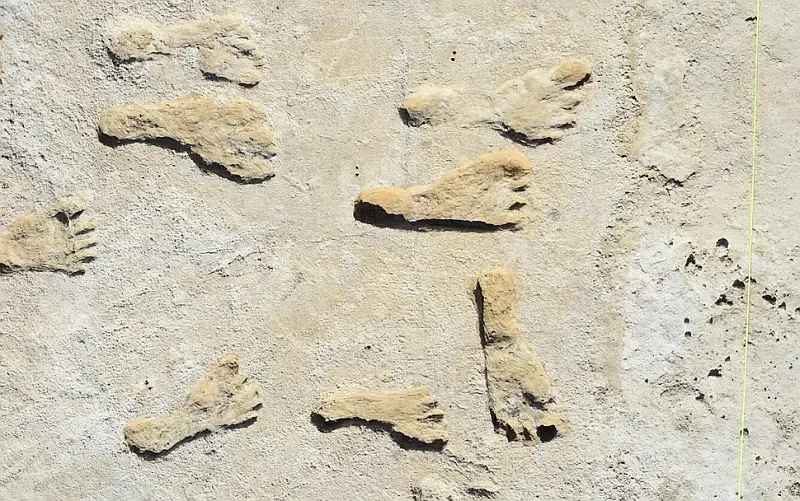
The first people to arrive in the Western Hemisphere were Indigenous Americans, who were descended from an ancestral group of Ancient North Siberians and East Asians. They likely traveled along the Bering Land Bridge by land or sea. When the first Americans arrived is a source of ongoing debate. Several studies suggest that a series of fossilized human footprints found at White Sands National Park in New Mexico date to sometime between 21,000 and 23,000 years ago. That dates them to the coldest part of the last ice age, the last glacial maximum (which lasted from around 26,500 to 19,000 years ago), when the northern part of the continent was covered in glaciers and ice sheets. Other controversial studies suggest even earlier dates. For example, dated stone artifacts in Chiquihuite Cave, in Mexico, to more than 30,000 years ago. However, it’s unclear if humans actually crafted these rocks or if they formed naturally that way, making the finding uncertain. Other studies go back much further. In 2017, a controversial study in the journal Nature reported mastodon bones in California that may have been modified by humans around 130,000 years ago. However, other archaeologists have expressed concerns about the excavation of this finding and noted that other natural events or animals could have modified the bones. To put the 130,000-year-old date into context, the earliest evidence for Homo sapiens dates to around 300,000 years ago in Morocco, while the earliest evidence for a successful migration of humans into Asia was more than 100,000 years ago and the earliest evidence of successful human migration into Europe was around 55,000 years ago. Excerpted from Who discovered America? By Owen Jarus in LiveScience
Hanford site can now transform nuclear waste
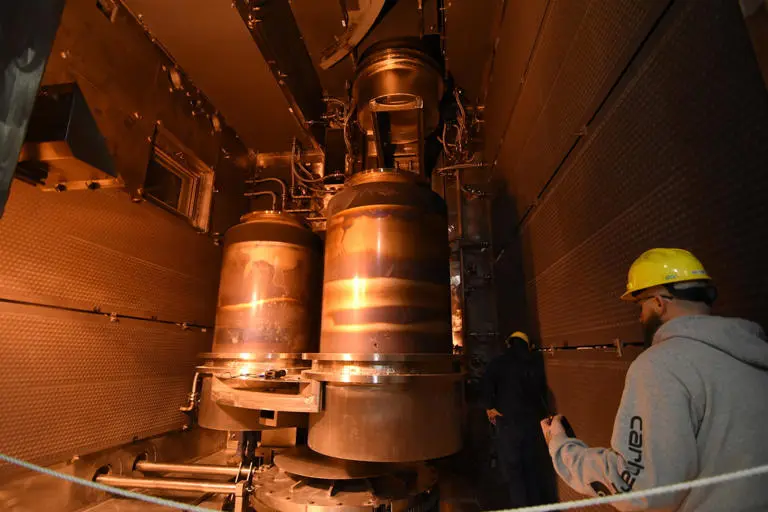
For much of the 20th century, a sprawling complex in the desert of southeastern Washington state turned out most of the plutonium used in the nation’s nuclear arsenal, from the first atomic bomb to the arms race that fueled the Cold War. Now, after decades of planning and billions of dollars of investment, the site is turning liquid nuclear and chemical waste at the Hanford Nuclear Reservation into a much safer substance: glass. State regulators on Wednesday issued the final permit Hanford needed for workers to remove more waste from often-leaky underground tanks, mix it in a crucible with additives, and heat it above 2,000 degrees Fahrenheit (1,000 Celsius). The mixture then cools in stainless steel vats and solidifies into glass — still radioactive, but far more stable to keep in storage, and less likely to seep into the soil or the nearby Columbia River. The long-awaited development is a key step in cleaning up the nation’s most polluted nuclear waste site. Construction on the Hanford Waste Treatment and Immobilization Plant began in 2002. “We are at the precipice of a really significant moment in Hanford’s history,” said Casey Sixkiller, director of the Washington State Department of Ecology, in a video interview. Article by Cedar Attanasio reprinted from MSN
Amazing Forensics Solve 150-Million-Year Pterosaur Mystery
Two tiny pterosaur fossils, each smaller than a mouse, have finally solved a puzzle that has mystified paleontologists for decades. The perfectly preserved hatchlings, nicknamed “Lucky I” and “Lucky II,” were discovered in Germany’s famous Solnhofen limestone formations and reveal both how they died and why juvenile flying reptiles dominate this fossil record. The Tragic Discovery Both Pterodactylus hatchlings, just one to two weeks old when they perished, share a telling characteristic: broken wing bones with identical fracture patterns. The clean, slanted breaks to their humerus bones suggest the same type of twisting force killed them both 150 million years ago. University of Leicester paleontologist Rab Smyth and his team reconstructed their final moments through careful forensic analysis. The evidence points to a violent Late Jurassic storm that battered the tiny pterosaurs with winds so powerful their fragile wing bones snapped under pressure. The same storm then hurled their bodies into a saltwater lagoon, where churning waters quickly carried them to the bottom for rapid burial and exceptional preservation. Solving the Solnhofen Paradox The discovery resolves a long-standing mystery about the Solnhofen formations, which contain hundreds of pterosaur specimens but are dominated by juveniles. This seemed counterintuitive since young pterosaurs had more fragile bones and should be less likely to fossilize than adults. The research reveals this apparent contradiction actually makes perfect sense. The same catastrophic storms that killed vulnerable hatchlings created ideal conditions for their preservation. Adult pterosaurs, being stronger and more experienced, could survive the violent weather that proved fatal to their offspring. When adults eventually died under calm conditions, their remains would float and decompose before sinking, making fossilization unlikely. “For centuries, scientists believed that the Solnhofen lagoon ecosystems were dominated by small pterosaurs,” Smyth explains. “But we now know this view is deeply biased. Many of these pterosaurs weren’t native to the lagoon at all – they were inexperienced juveniles caught up in powerful storms.” Broader Implications This discovery transforms our understanding of pterosaur ecology and fossil preservation. Rather than reflecting true population dynamics, the juvenile-heavy fossil record represents a preservation bias created by extreme weather events. The findings also provide rare insight into Late Jurassic climate patterns, suggesting violent storms regularly impacted ancient ecosystems. The research exemplifies how modern paleontology combines traditional fossil analysis with environmental reconstruction. By examining preservation circumstances alongside the bones themselves, scientists can extract far more information from specimens and avoid misinterpreting ancient ecosystems. Published in Current Biology, this work offers a new framework for understanding how environmental factors influence fossil records – reminding us that every preserved specimen tells a story not just about the creature’s life, but about the dramatic events that led to its preservation across deep time. AI adapted from Original reporting by Michelle Starr, ScienceAlert about research by Rab Smyth and colleagues, University of Leicester..
1954 Mystery Quake Came from ‘Eerily Quiet’ Cascadia Subduction Zone
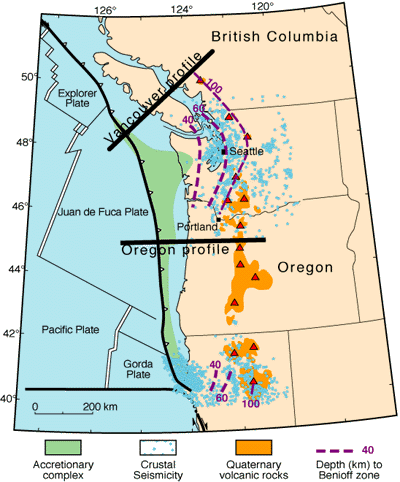
A new study finds a 1954 earthquake that rattled Northern California was likely caused by the infamous Cascadia Subduction Zone. The linking of the magnitude 6.5 quake with this particular seismic zone is important, because the Cascadia Subduction Zone, which stretches from northern California to Vancouver Island in Canada, is not known to give off many small or medium quakes. In seismology parlance, the fault is “locked,” or unmoving. The last known rupture was a massive magnitude 9 earthquake in 1700 that caused landslides and an enormous tsunami that was so powerful that waves over 16 feet high (5 meters) hit Japan, according to the U.S. Geological Survey. In modern times, though Cascadia “has been eerily quiet,” one of the study’s co-authors said in a statement. “We don’t have smaller earthquakes, and that’s not something you usually see in subduction zones.” That lack of small earthquakes in the decades since scientists started monitoring faults with seismometers and other instruments means they have a limited sense of Cascadia’s behavior. But the new research suggests that the fault has possibly ruptured on a smaller scale within recent memory. The study re-evaluated a Dec. 21, 1954 quake that shook the Humboldt Bay, California area just before noon. Residents reported strong, rapid ground motion that toppled chimneys. Researchers had previously proposed 14 different epicenters for the quake. The new study honed in on Fickle Hill, a small forest community along a two-lane road not far from the larger city of Arcata. The researchers also found that the fault that caused the quake likely ruptured between about 6.8 miles and 8.7 miles (11 to 14 kilometers) below the surface. Arcata sits in a particularly interesting earthquake region. It’s not far from the offshore “triple junction,” where the Pacific oceanic plate meets the Gorda oceanic plate and the North American continental plate. It’s also in the transition zone between the San Andreas fault zone (where the North American plate and the Pacific plate slide past each other) and the Cascadia Subduction Zone (where the oceanic Juan de Fuca plate dives under the North American plate). Most quakes near Humboldt originate on the Gorda plate. But the Fickle Hill quake didn’t, the researchers found. Based on the depth and the direction of the earthquake waves, the quake instead seems to have come from the Cascadia Subduction Zone. That makes Fickle Hill one of only two known possible Cascadia quakes since 1700. (The magnitude 7.2 Cape Mendocino quake in 1992 might also have been a Cascadia quake, though that is still hotly debated.) The finding would suggest that Casadia does not have to rupture all at once, causing devastatingly huge quakes, but that it can also break in segments, creating smaller temblors. Though the new research doesn’t yet translate to any predictions of what Cascadia might do in the future, reviewing existing data can help improve scientists’ understanding of the area’s tectonics, ultimately helping improve their estimation of the earthquake hazard for the Pacific Northwest. Excerpted from a Live Science article by Stephanie Pappas published August 20, 2025