
How Has Your Address Moved Over the Past 750 Million Years?

Some 240 million years ago, an enormous supercontinent known as Pangea encompassed nearly all of Earth’s extant land mass, Pangea bore little resemblance to our contemporary planet, but thanks to a recently released interactive map interested parties can now superimpose the political boundaries of today onto the geographic formations of yesteryear—at least dating back to 750 million years ago. Ancient Earth is an interactive Map tool that enables users to home in on a specific location and visualize how it has evolved between the Cryogenian Period and the present. The tool behind this millennia-spanning visualization, is the brainchild of Ian Webster, curator of the world’s largest digital dinosaur database. Webster drew on data from the PALEOMAP Project—spearheaded by paleogeographer Christopher Scotese, the initiative tracks the evolving “distribution of land and sea” over the past 1,100 million years—to build the map. Users can input a specific address or more generalized region, such as a state or country, and then choose a date ranging from zero to 750 million years ago. Currently, the map offers 26 timeline options, traveling back from the present to the Cryogenian Period at intervals of 15 to 150 million years. Ancient Earth includes an array of helpful navigational features, including toggle display options related to globe rotation, lighting and cloud coverage. Brief descriptions of chosen time periods pop up on the bottom left side of the screen, while a dropdown menu at the top right allows users to jump to specific milestones in history, from the arrival of Earth’s first multicellular organisms some 600 million years ago to early hominids’ relatively belated emergence around 20 million years ago. To switch from one time period to another, you can either manually choose from a dropdown menu or use your keyboard’s left and right arrow keys. Start at the very beginning of the map’s timeline and you’ll see the planet evolve from “unrecognizable blobs of land” to the massive supercontinent of Pangea and, finally, the seven continents we inhabit today. Edited from Smithsonian Magazine article by Meilan Solly, February 15, 2019
Continents Were Created on Ancient Earth by Giant Meteorite Impacts

To date, Earth is the only planet we know of that has continents. Exactly how they formed and evolved is unclear, but we do know – because the edges of continents thousands of miles apart match up – that, at one time long ago, Earth’s landmass was concentrated in one big supercontinent. Since that’s not what the planet looks like today, something must have triggered that supercontinent to break apart. Now, we have new evidence to suggest that giant meteorite impacts played a significant role. The smoking gun consists of crystals of the mineral zircon, excavated from a craton in Western Australia, a piece of Earth’s crust that has remained stable for over a billion years. Known as the Pilbara Craton, it is the best-preserved chunk of crust on the planet… and the zircon crystals within it contain evidence of ancient meteorite impacts before the continents broke apart. “Studying the composition of oxygen isotopes in these zircon crystals revealed a ‘top-down’ process starting with the melting of rocks near the surface and progressing deeper, consistent with the geological effect of giant meteorite impacts,” explained geologist Tim Johnson of Curtin University in Australia. Our research provides the first solid evidence that the processes that ultimately formed the continents began with giant meteorite impacts, similar to those responsible for the extinction of the dinosaurs, but which occurred billions of years earlier.” The work was conducted on 26 rock samples containing fragments of zircon, dating between 3.6 and 2.9 billion years old. The research team carefully analyzed isotopes of oxygen; specifically, the ratios of oxygen-18 and oxygen-16, which have 10 and 8 neutrons, respectively. These ratios are used in paleogeology to determine the formation temperature of the rock in which the isotopes are found. Based on these ratios, the team was able to distinguish three distinct and fundamental stages in the formation and evolution of the Pilbara Craton. The first stage is the formation of a large proportion of zircons consistent with partial melting of the crust. This partial melting, the researchers show, was likely the result of bombardment by meteorites, which heated the planetary crust on impact. The oldest cluster of these zircons, according to the team’s interpretation, was the result of a single giant impact that led to the formation of the craton. The second stage was a period of reworking and stabilization of the crustal nucleus, followed by the third stage – a period of melting and granite formation. This stabilized nucleus would then, much later, evolve to become today’s continents, as did the cratons found on other continents around the world. Many meteorites have pelted Earth in eons past, in numbers much higher than the number of continents. It’s only the largest impacts that could generate enough heat to create the cratons, which appear to be twice as thick as their surrounding lithosphere. These findings are consistent with previously proposed models for the formation of cratons around the world – but constitute, the researchers said, the strongest evidence yet for the theory. However, it’s just one craton, out of around 35 known. To make the evidence even stronger still, the team will need to compare their results with more samples from other cratons, to see if their model is consistent globally. “Data related to other areas of ancient continental crust on Earth appears to show patterns similar to those recognized in Western Australia,” Johnson said. “We would like to test our findings on these ancient rocks to see if, as we suspect, our model is more widely applicable.” Article by MICHELLE STARR, Science Alert,10 August 2022 – The research has been published in Nature.
Quaternary

Quaternary—What is that??? Ice Age Floods Institute Members may have heard the term Quaternary during Chapter Presentations and Field Trips, or may have learned that the Quaternary Period represents the last 2.588 million years (~2.6 million years) of earth history, or that it is divided into the Pleistocene and Holocene Epochs. The Quaternary began with the Pleistocene (~2.6 million years ago) and the strata and landscape features reflect the major climate changes of the last Ice Age (synonymous with the Pleistocene Epoch). But where did the term Quaternary come from? The word suggests the number four as in quadrangle, quadrant, quadruplet, etc. For its origins we need to go back a few hundred years to see how the geologic time scale in use today had its origins. The science of geology had a very slow start only beginning to take hold in the late seventeenth and early eighteenth centuries. Both Giovanni Arduino (1714-1795) a mining geologist studying the rock layers in northern Italy around 1759 and Jules Desnoyers working in the Seine Basin in France in 1829 divided their rock sequences into four units; Primary, Secondary, Tertiary and Quaternary. The term Quaternary was applied by Desnoyers to the fourth more recent strata that consists of loose to poorly indurated or cemented strata. The terms Primary and Secondary have been dropped but Tertiary and Quaternary are still used today. These attempts to develop a regional framework of strata were based on the publication of a paper by NIcholaus Steno in 1669 where he laid out the geologic Principle of Superposition. He argued that lower strata in a tectonically undisturbed section must be older than those on top. He also pointed out that strata tend to be deposited in a horizontal position, the law of Original Horizontality. How old these strata might be was not known, new tools would need to be developed to answer that question. However, that is another story. Gene Kiver June 2020
What Made This?
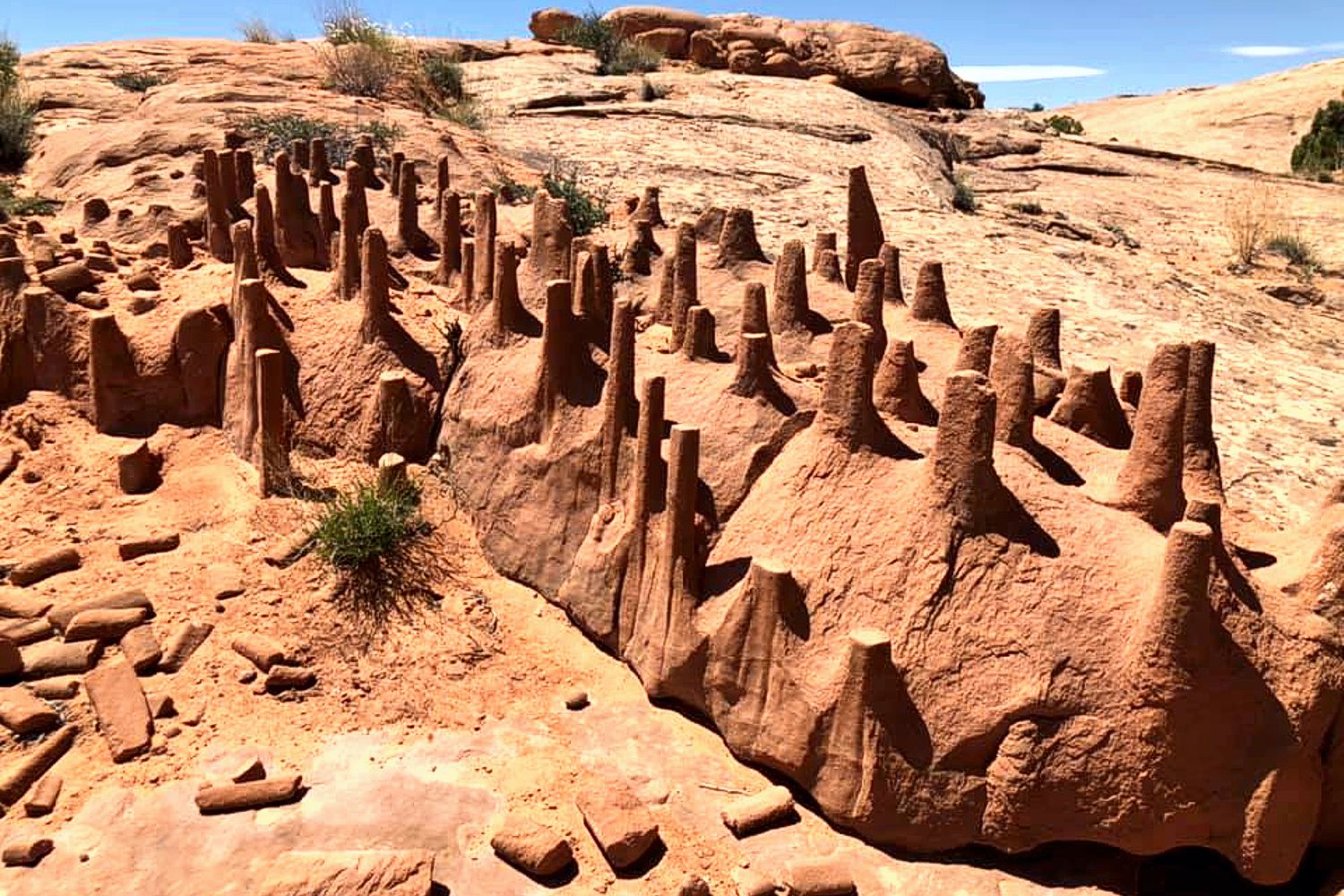
Any idea what made this formation? Q – This is in the Utah desert, south of Green River. I keep hearing that it might be clastic dikes? I have sent this pic to the USGS and they are kinda stumped too but plan to send some paleontologists to check it out. A – The clastic dike explanation looks quite probable. As I understand it, when a fluid (typically water) saturated body of sediment is overlain by another thick layer of sediment the weight of the overlying sediment over-pressures the fluid in the saturated sediment body, resulting in the fluid forcing its way toward the surface, where the pressure is lower, and entraining the accompanying sediment as it rises. Probably looks like a lava lamp, though the processes are distinctly different Comments Any idea what made this formation? — 3 Comments Lloyd DeKay on Dec. 2, 2023 at 2:40 pm said:I suggest the flat tops of these clastic dikes are the result of an impenetrable layer atop the dike-bearing strata, which has subsequently been eroded away.Lloyd DeKay – Webmaster for IAFI Bradai Mohammed on December 2, 2023 at 2:14 pm said: These are called clastic dikes, commonly vertical, they fill open fractures with the help of water, cutting another bed (mud) that’s sitting above, after that it goes through differential erosion, where the soft sediment (mud) gets eroded, and the harder one (sandstone) survive to give you this formation. BRADAI Mohammed El AmineGraphic Designer & Mag. Editor, CEO & Founder of GeoTeach.MePhD student in Stratigraphy-Paleontology, University of Mohamed Ben Ahmed Oran 2, Algeria. Blog: www.geoteachme.blogspot.comInstagram: @the.gneiss.moFacebook: Mohammed BrdYouTube: Explore with Mo Phone: (+213) 798 23 96 50Professional email: Bradai@bk.ru Norman Smyers on July 31, 2020 at 12:18 pm said: My Masters Thesis was clastic dikes of the Panoche Hills (central) California. And yes, the features seen in these photographs from Utah and seen in the recent issue of the Newsletter do look somewhat that they could be associated with clastic dikes. However, I would want to view them up close and personal before saying anything more. For one, the fracture system of the area is a strong clue as to their origins, something difficult to determine with the information at hand. I don’t remember any of my dike structures being evenly truncated at their tops. Obviously at some point in their history there was significant erosion that planed the top of the structure off as well as the surrounding area; and the structures were durable enough to resist subsequent erosion and weathering enough so to persist, as we see them, to present. To make them as durable as they appear to be I would speculate that they were injected from below and into their existing cracks by sediment overlying a fluid rock unit (unconsolidated and wet sediment). Norman Smyers3
Ice In Puget Valley

ice in puget valley Q – My daughter and family live west of Dean Kreger Rd, above Silver Lake, west of Eatonville. I tease her that her yard is gravel held together with a little sand. I believe they are close to the margin of an ice sheet but, I can’t find a map showing the margins. I’ve always been curious when I see different geology features and after watching all of Nick Zentner’s videos I’ve learned enough to be a hazard to myself and society. A – Google Search “Ice in Puget Valley”, “Vashon ice lobe”, “Glacial landforms of Puget Valley” and you will get more than you likely want! WA-DNR – Washington’s Glacial Geology WA-DNR – Glacial Landforms of the Puget Lowland Ice Thickness In Puget Sound
Height of Dry Falls
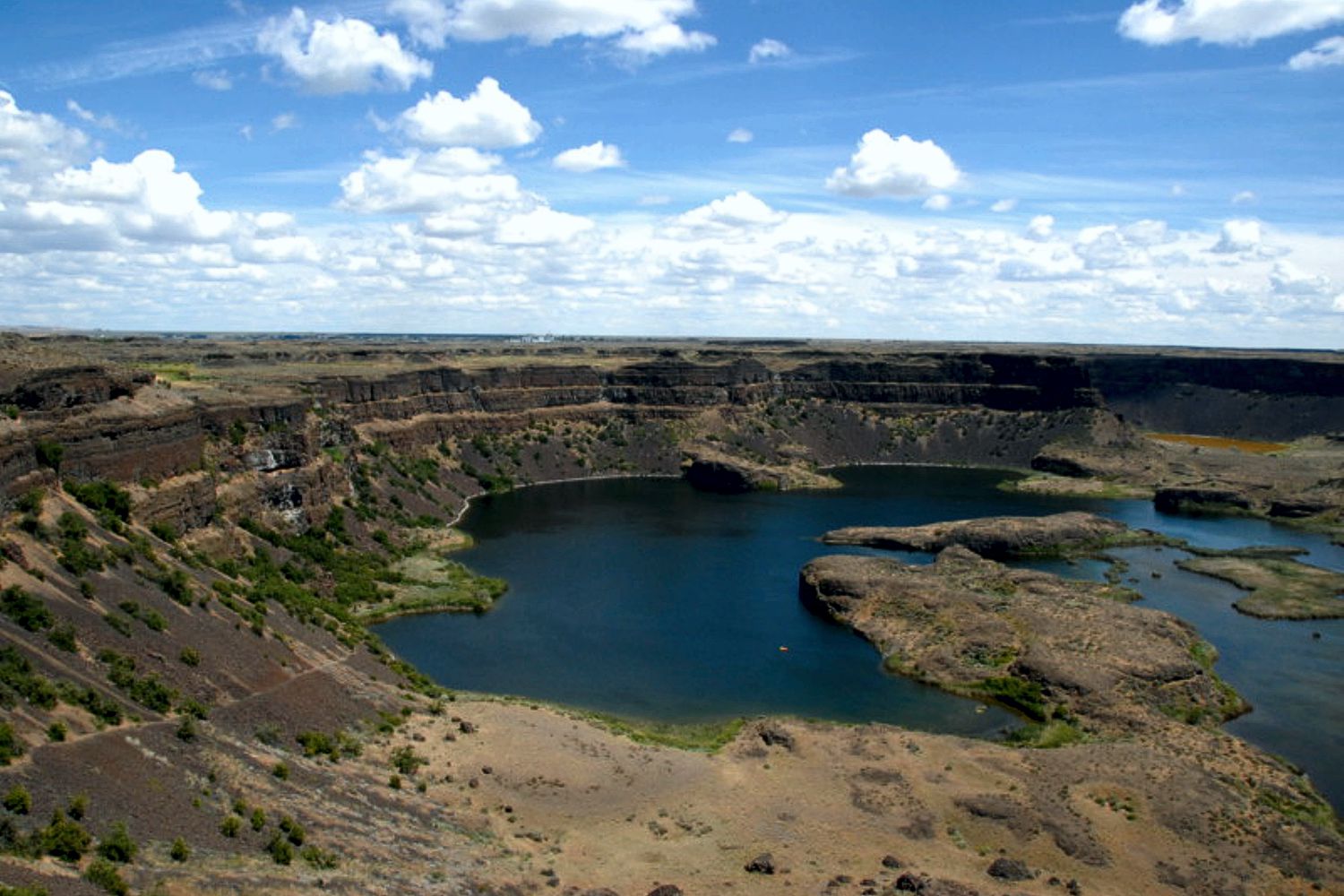
height of dry falls Q – I am a long time resident and have been to Dry Falls several times. Can you please tell me the elevation change between the top of the falls to the lake below ? Do you know or can you direct me to the information? Thank You! A – The height is often cited as 400′ but it appears to be a bit over 500′ based on USGS topographic maps.
Rounded Boulders Spokane
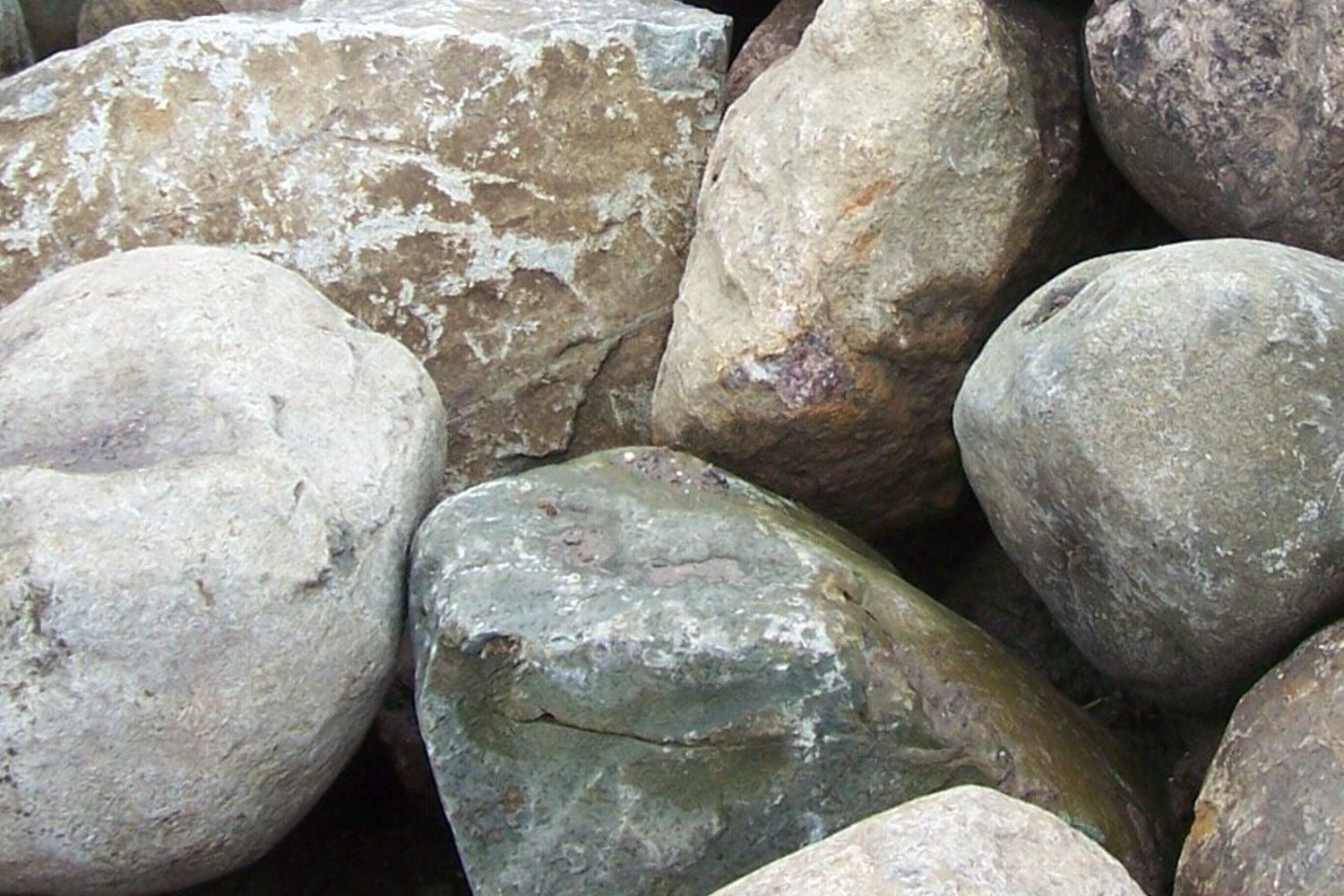
Rounded Boulders in Spokane Ice Rafted Erratics? Q – I have noticed places around Spokane where there are large accumulations of similarly-size boulders. They are smooth and generally about a meter in diameter.. The type of stone varies, but none are Columbia Basin basalt. I assume these are ice-rafted erratics. My question is how did so many end up in a few locations and why are they all similarly sized? My guess is that the flood waters ran into a slope and became still enough to drop similarly-sized loads. Is that right? Or is there another explanation? The South Hill Park and Ride has 81 scattered around the site, some of which I assume were pushed out of the way for paving. Another site nearby has perhaps 40 used for a retaining wall. The Spokane Valley YMCA has a lot, as does the parking lot for the Dishman Hills Natural Area. There are also places along Trent Avenue where these stones are found. Thanks for your reply. – James VanderMeer A – Most all of the well-rounded boulders that clutter parts of the floor of the Spokane Valley are, indeed, derived from the Ice Age floods, but are probably were not ice-rafted to their present locations. They were moved by the tremendous power just downstream from the initial Ice Dam failure, rolled or bounced along the bottom of Glacial Lake Columbia and accumulated rapidly in the deeper parts of the lake. The power of the flood currents dissipated as the waters moved west. Most of the large boulders found father west were probably ice-rafted. The source for these boulders was most likely glacial moraine and stream sediments from Idaho, Montana, and Canada, thus no local basalt in the mix. Because they were “current” derived, they are often sorted in size, and derive from a source where there has been much erosion already and well rounded. More information on this can be had in the online Zoom lecture “What Happened When the Dam Burst” by the IAFI on November 24 by Michael Hamilton.
Spokane Haystack Rocks
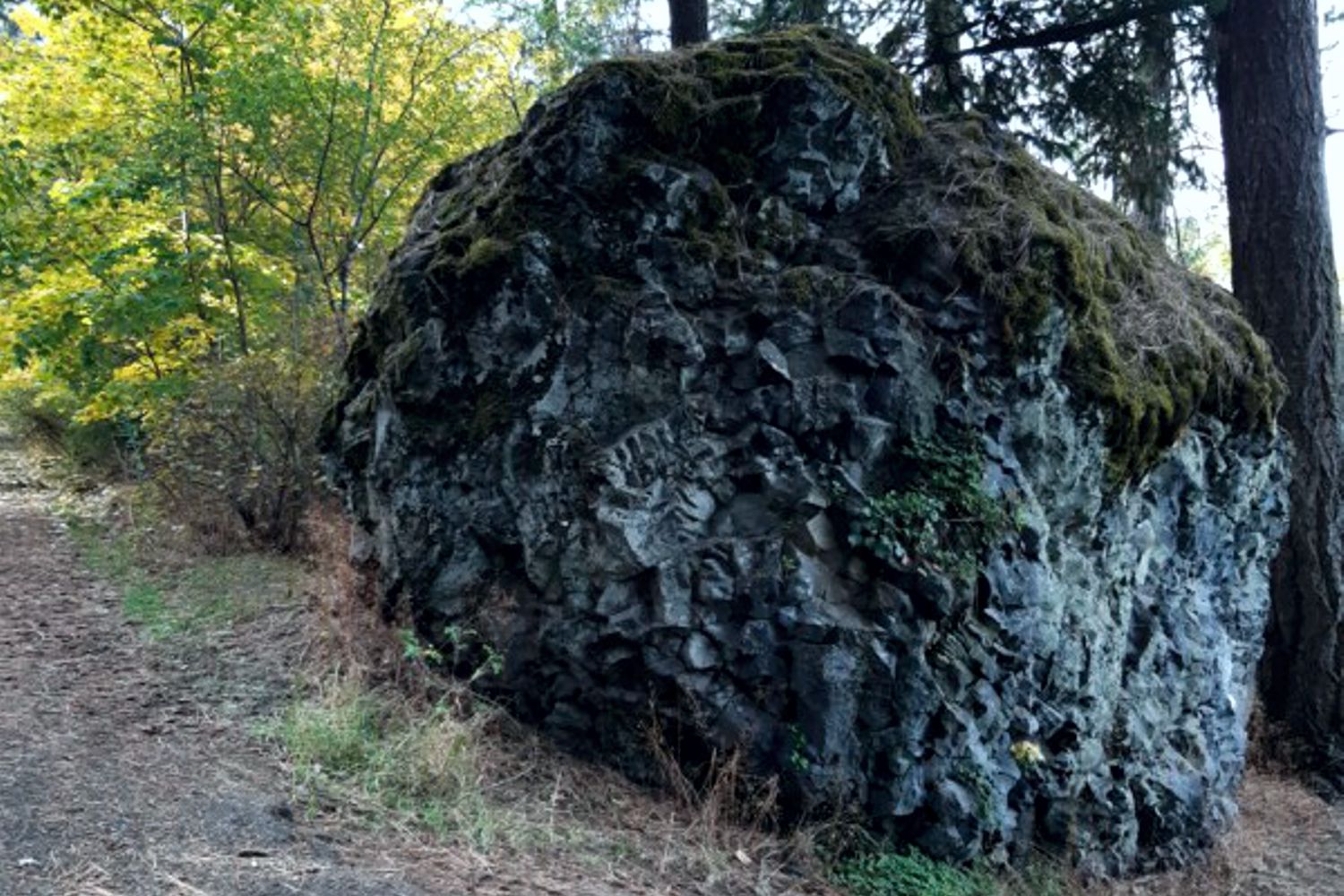
What are Spokane’s Haystack Basalt Mounds? Q – Throughout the Spokane area there are what some call ‘haystacks’, basalt mounds that look like haystacks. There are many such on Spokane’s south hill and I’m including a photo of one that’s in lower Lincoln Park. How did these form? Do they indicate the location of a volcanic vent? – John Ludders A1 – The picture is a large chunk of chill zone basalt. The sequence is chill zone, columnar basalt, entablature, capped by chill zone of the next flow. Like the columns, the chill zone is resistant to plucking but is weak and susceptible to hammering and chipping from rocks in the flow. Many are huge but are basically made in place by chipping, not being carried by flow. – Jim Shelden A2 – The basalt boulder appears to be a portion of the entablature portion of the basalt flow. This portion of the flow commonly worked on by the floodwaters is undercut and portions fall off and get rolled downstream. I have noted hundreds of these boulders in the Spokane area below basalt exposures (cliffs) especially along the north hills (north of Spokane River). They are analogous to the basalt boulders that are observed below Dry Falls (along Umatilla Rock-west side) as seen from the Dry Falls visitor center. The only difference is that the Spokane area gets more precipitation allowing ponderosa pines to grow around them. Also I am not aware that the Cordilleran Ice Sheet advanced south enough into the Spokane vicinity so the basalt boulders are not erratics or “haystack rocks” left after glacial melt. – Brent Cunderla
Badger Mountain Landslide
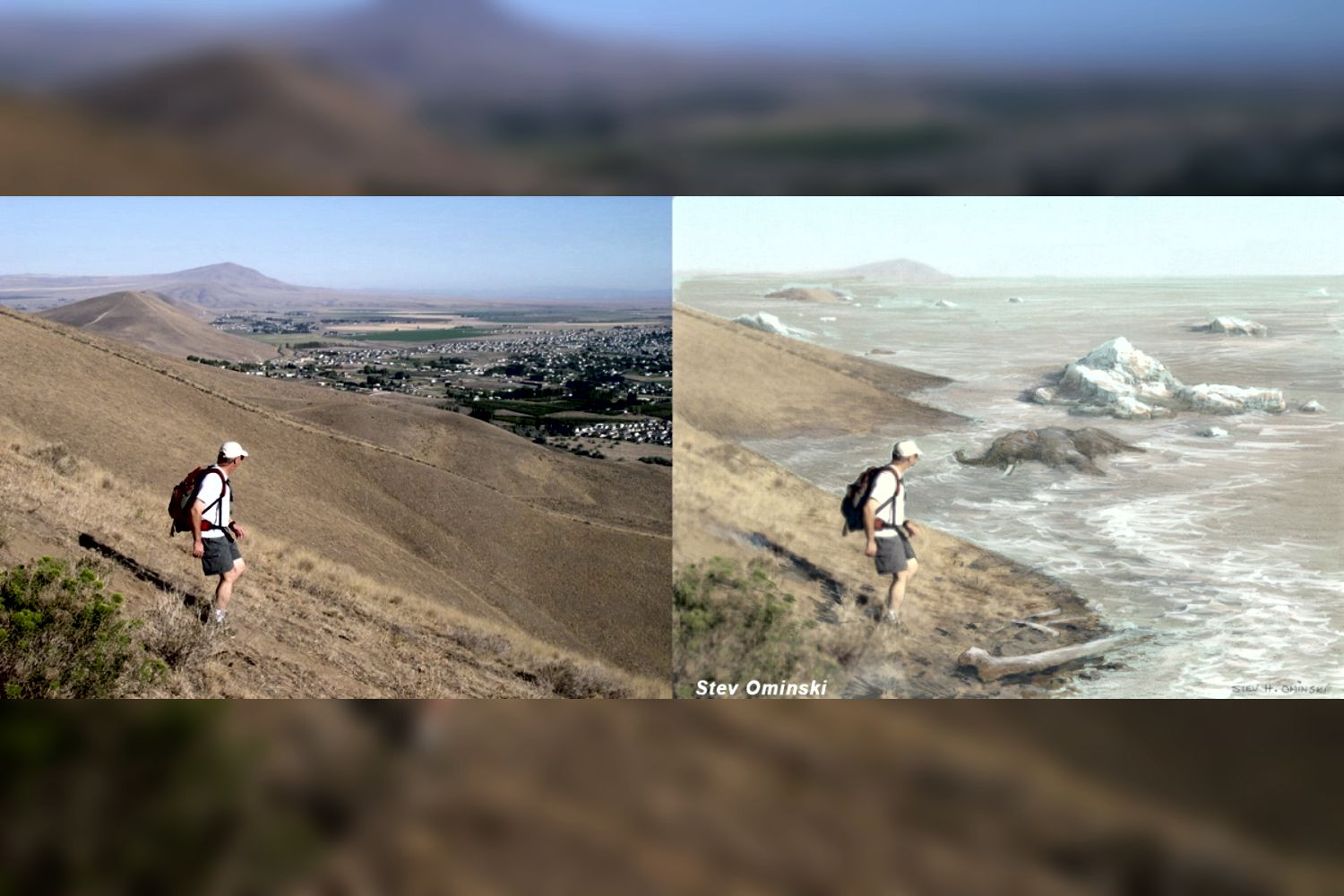
Badger Mountain Landslide Potential? Q – With all the homes being built on and around Badger mountain in the Tri-Cities, is there any danger of landslides, similar to what is happening at Rattlesnake Hills? I’m unfamiliar with the geology there, and I understand that building homes can affect stability, but are there other likely dangers in that area that potential homebuyers/builders should be wary of? A – There have been prehistoric landslides (now stabilized) on Badger Mountain along with the other ridges nearby. These may have occurred following one more of the Ice Age floods >15k years ago. Renewed landsliding is unlikely as long as there is no significant addition of water that could load the slope and/or lubricate weak zones within, or between, basalt flows – leading to instability. Badger Mountain itself is probably safe since there has been little new development on top or on the steeper sides of the mountain. Most of the mountain is now free from future development, thanks to the Friends of Badge Mountain, who have turned most of the mountain into a preserve. (One exception is the group of new Sterling homes built at the west end of the ridge). Other unprotected ridges may not be as lucky. The cluster of new homes built on top of and along the sides of Little (East) Badger Mountain could generate stability problems, especially if excess water used for landscaping is allowed to percolate underground. There are also a number of new roads dug into the steeper north side of the ridge that potentially could undermine and destabilize the slopes above. Adding irrigation water to these slopes will only increase the likelihood of slope failure in the future. – Bruce Bjornstad
Evidence Elsewhere
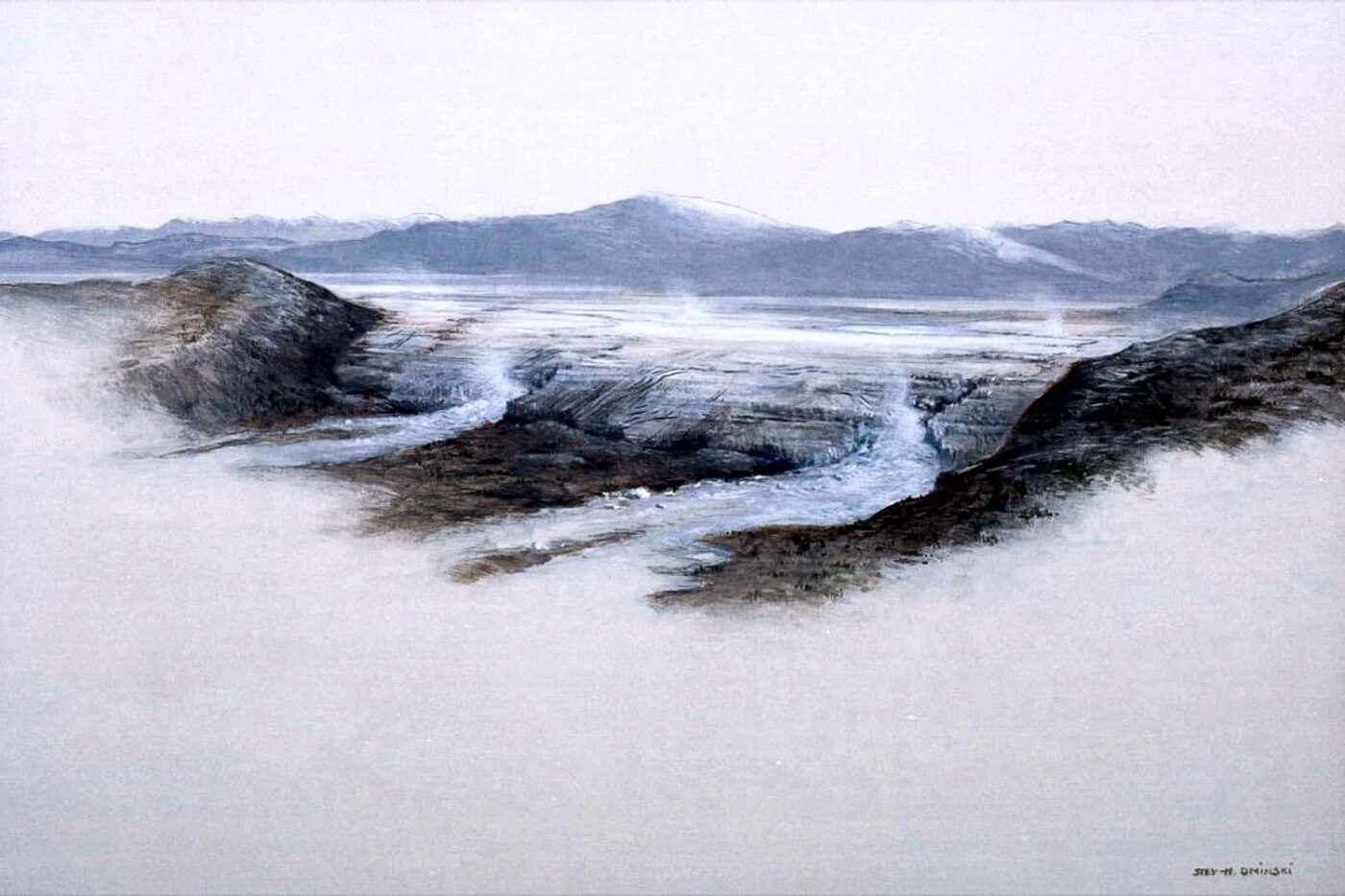
Evidence Elsewhere of Ice-Age Floods? Q – Is there evidence elsewhere in the world of ice age floods? Intuitively, I would think glaciers dammed other rivers, created lakes and then eventually collapsed? A – Your instincts are correct. The rivers with big ice and big gorges pretty much all had outburst floods on them. The St. Lawrence Seaway is a flood path as is the Strait between Denmark and Norway and the English channel at the Dover Straits. The Altai Mountain Floods in Mongolia were very steep and fast much like Lake Missoula. The latitude where the ice was melting on its own appears to be more susceptible to very large floods. The Tibetan Plateau also had a series of large floods. Geologist Dr. Vic Baker has created an info-graphic comparing the scale of several terrestrial and Martian flood volumes, though not all are ice-age floods.