2025 IAFI YEAR-IN-REVIEW

We normally include a review of our past year’s activities in our January newsletter for our members and interested others, but that newsletter was just too overfull with other important news. Our 2025 Year-In-Review below was compiled January 30, 2026.This is our 9th year preparing a Year-in-Review report for you, our members. We appreciate your continued support, friendship and membership. INSTITUTE MEMBERSHIP – Our members provide most of our support and much of the reason for the various materials, activities and events we provide. In 1996, we started with 11 members. At the end of 2025, we have 583 members (446 memberships). Our members come from the following states: Washington (67%), Oregon (15%), Idaho (7%), Montana (5%) with smaller amounts from CA, NV, AZ, WY, TX, AK, NM and OK, Canada and Germany. INSTITUTE BOARD ACTIVITIES – IAFI work activities that occur at both the Institute Board of Director level and at the Chapter level generally benefit the entire organization. Listed below are some of these activities. The Board works closely with the National Park Service Program Manager for the Ice Age Floods National Geologic Trail. We have a formal partnership agreement and work cooperatively to further the missions of both organizations. The Education Committee, in partnership with IAFL-NGT and Engaging Every Student, has developed a curriculum program for our 4 state region, “Ice Age Floods Detectives”, of 4 one-hour lesson plans focused on a 4th grade audience. The Education Committee also developed a K-12 Grant program to provide funding to teachers and students for field trips, lab supplies, and to provide funds for other ancillary needs that will enhance implementation of the curriculum. The Cheney-Spokane Chapter established a Student Research Grant program that covers the entire institute area. It recently awarded its first grant The Membership Committee created a Floods Photo of the Week program which provides photos of features throughout the four-state area for all our members. Our webmaster keeps the website (iafi.org) fresh and stimulating. He also, with support from the chapters, issues the Pleistocene Post Newsletter four times a year. Our Membership Manager provides quarterly reports on member/memberships for all chapters and the institute. She responds to membership queries, resolves problems and keeps records current. Our IAFI Treasurer works with our Certified Public Accountant who maintains all our financial records and provides monthly reports to the Board. Our IAFI Store Manager provides service to our members by stocking and processing orders for the most recent books, maps, etc related to the ice age floods. ANNUAL MEMBERSHIP MEETING – This year the annual IAFI membership meeting and field trip was held hosted by the Columbia River Gorge Chapter and there. Approximately 146 people attended the event. Click here for a reflective review of the event. 2025 CHAPTER PROGRAMS – Outreach to inform and educate the public about the Ice Age Floods and their long-lasting impact on our area is a key part of the IAFI mission. Our local chapter programs are possibly the most effective way we meet this challenge. Three of the more important ways we help people learn about the Ice Age Floods are with lectures, field trips and hikes. LECTURES – In 2025 we had 37 lectures attended by over 1549 people. Many more people viewed lectures when they were posted on YouTube. FIELD TRIPS- In 2025 we conducted 22 field trips with 735 attendees. HIKES – In 2025 three chapters sponsored 7 hikes with 106 attendees. PRESENTATIONS TO K-12 STUDENTS Columbia River Gorge chapter – talk and 2 field trips for Hood River New School and a talk for Hood River Elementary 4th grade classes Cheney–Spokane Chapter – Jefferson Elementary School STEM Expo requested that the IAFICS Chapter staff an educational booth on the Ice Age floods. The booth was so popular with the kids and their parents that our chapter was asked to participate in a follow up at the Westview Elementary School STEM Expo. The IAFICS Chapter was contacted by Spokane City Councilman Zack Zappone, requesting a talk and short hike for the North Central Middle School. Lake Lewis Chapter – A number of members helped with education programs at The Coyote Canyon Mammoth Site (MCBONES) near Kennewick. Palouse Falls Chapter: talk and presentation to Pomeroy Home School. Lower Grand Coulee Chapter: Assisted with a presentation at the Ice Age Floods Fest at Dry Falls aimed at educating children on the Ice Age Floods story (350+ attendees). INVOLVEMENT WITH PROFESSIONAL ORGANIZATIONS AND UNIVERSITIES Cheney–Spokane Chapter – Dr. Isaac Larsen (Univ. Massachusetts), accompanied by a graduate student, requested a three-day field trip to collect flood ice-rafted erratics and in-situ exposure for exposure dating of the glacial floods in the Spokane and Vantage areas. Drs. Jim O’Connor and Lydia Staich (USGS) requested a two-day research field trip to look at historical till and flood sites on the Spokane Indian Reservation southeastward to Reardan and Spokane-Mica area. All chapters routinely recruit knowledgeable speakers from universities or state/federal agencies to ensure we are presenting the most current scientific information to our members. PRESENTATIONS AT COMMUNITY EVENTS Cheney-Spokane Chapter – Great Outdoor Sports Expo requested that the IAFICS Chapter staff an educational booth on the Ice Age floods. Don Chadbourne and nine enthusiastic chapter volunteers manned the booth which had heavy traffic on both days. Over 100 people stopped by the booth to get information on our upcoming events and pick up brochures providing information on local flood features and the National Geologic Trail. For the second year the Spokane County Library System asked the Cheney-Spokane chapter to provide speakers for four library branches. All four talks filled the rooms. The Turnbull National Wildlife Refuge asked the chapter to staff a booth and lead a hike. Columbia River Gorge Chapter – Gorge History Museum talk. Nature Conservancy talk at Rowena Crest . Co-led a number of field trips sponsored by the Columbia Gorge Naturalist Program. Coeur Du Deluge Chapter – Again led programs for the Idaho Master Naturalists. Interviewed for Sandpoint Magazine (Summer 2025). Ellensburg Chapter: had information booths at two Ellensburg Farmers Markets. Spoke with about
Doug Huber – Key Puget Lobe Chapter Volunteer

Doug Huber has been an active member of the Puget Lobe Chapter of IAFI almost since its inception in 2007. For the past ten years, Doug has been the unseen hero of our chapter meetings, where he has ensured that the computer, audio, and projection systems were maintained and working as they should at the start of our meetings. In addition, Doug has served as our webmaster, updating the chapter webpage so that our members and members of other chapters alike had access to information on our field trips, meetings, and special events. Hats off to you, Doug, for your tireless efforts to help our chapter stay strong!
Malaga Landslide: Ice Age Catastrophe Along the Columbia River

The east bank of the Columbia River near Malaga, Washington, is home to one of the largest and most visually striking landslides in the Pacific Northwest: the Malaga Slide. Covering an estimated 45 square miles, this massive slope failure poured weakened basalt and sediment into the Columbia River valley at the close of the last Ice Age. Today, it remains easily visible from State Route 28, making it an accessible outdoor classroom for geology enthusiasts and tour participants. The geologic story of the Malaga Slide is a tale of both slow preparation and sudden catastrophe. Layers of basalt from the Columbia River Basalt Group were fractured and weathered over millions of years. Interspersed with weaker sedimentary layers, these formations became prone to failure. Add in groundwater saturation, the erosive power of repeated Ice Age Floods, and over-steepened valley walls, and the stage was set for a massive collapse. Scientists believe the main phase of the Malaga Slide occurred approximately 15,000–13,000 years ago, during the final stages of the Missoula Floods. While the collapse itself was sudden, the landslide likely continued to adjust and move over time, creating the hummocky terrain and displaced boulders still visible today. One of the most intriguing aspects of the Malaga Slide is its interaction with the Columbia River. Some geologists have hypothesized that the massive slide may have temporarily blocked or partially dammed the river. This could have caused short-term ponding upstream, potentially extending back toward Peshastin. Evidence of this interaction remains visible today as enormous boulders and slide debris in the river channel. Travelers heading south from Wenatchee on State Route 28 are treated to a dramatic view of the slide, with scarred slopes and scattered boulders lining the west side of the river. This visibility makes the Malaga Slide an outstanding site for guided geology tours offered by the Wenatchee Valley Erratics Chapter of the Ice Age Floods Institute. Participants learn about Ice Age Flood processes, landslide mechanics, and the long-term evolution of the Columbia River valley. Learn more about Wenatchee-area geology tours: https://wverratics.org or contact@wverratics.org Article by Jeff Becklund, Wenatchee Valley Erratics Chapter President
The Bowl & Pitcher at Riverside State Park
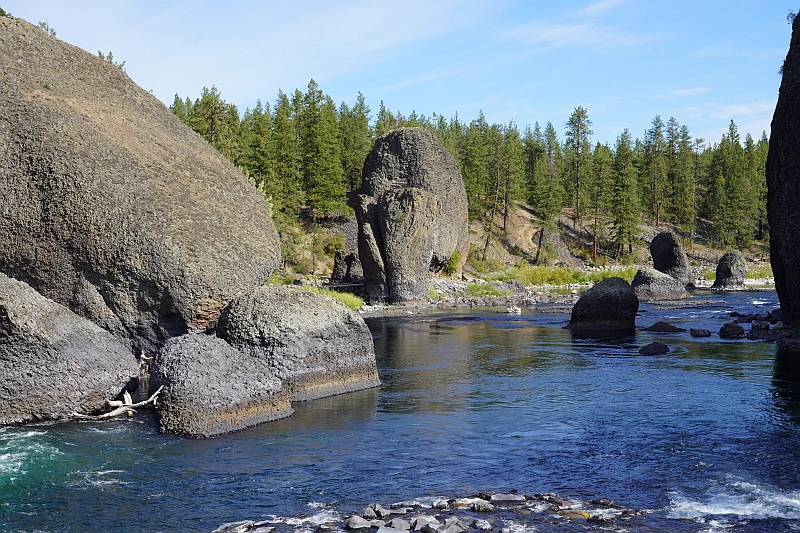
The Bowl and Pitcher is a rock formation along the Spokane River and one of the most scenic sites in the area, with basalt cliffs rising 500 feet above the river and large blocks of basalt in the river causing large rapids. The “Bowl” is a circular depression in the river and the “Pitcher” is a large detached block of highly fractured basalt. The geology of Spokane’s Bowl and Picher features dramatic basalt cliffs carved out of the flows from the Columbia River Basalt Group (CRBG), which reached this area 16 million years ago. There are river and flood deposits of sand and gravel, with granitic boulders forming terraces on the east side of the river, and huge blocks of basalt, causing the Dragon Tooth rapids, downriver from the Bowl and Pitcher. How did those rocks get there? The Spokane and Columbia rivers occupy a long, mostly bedrock canyon near the northeastern boundary of the Columbia Plateau. Glacial Lake Columbia, which formed behind the Okanogan ice lobe, occupied all of the Spokane River and a portion of the Columbia drainage basin during the last Ice Age. Then the glacial Lake Missoula outburst floods first surged over the Columbia Basin beginning around 17,000 years ago, ripping away the CRBG and other bedrock from Bayview, Idaho, to the Pacific Ocean. These floods also deposited a thick sequence of flood gravel in the valley. As Lake Columbia water level dropped, the Spokane River began to remove the sand and gravel fill. Subsequent floods continued to remove the flood deposits, leaving the basalt benches on the west side of the river and the terraces on the east side. Riverside State Park is located northwest of Spokane and consists of over 9000 acres along the Spokane and Little Spokane Rivers. The park is the second largest state park and has many recreational activities including, camping, hiking, mountain biking, horseback riding and boating (Discover Pass required). There are two view points for the Bowl and Pitcher. The first is from a small parking lot off the entrance road from Aubry White Parkway that provides an elevated view of the site. The main parking area is down along the river with a picnic area and a network of trails. From the parking lot you can follow the wheelchair accessible path across the suspension bridge over the Spokane River. From the bridge you can enjoy a view of the features that give the site its name. The original bridge was built in 1942 by the Civilian Conservation Corps. The existing bridge, based on the same plans, opened in 1998. On the west side of the river, you can access a network of trails along the river or climb up along the bluffs above the river.
Missoula Chapter Field Trip TV News Coverage
Missoula chapter field trip – tv news coverage Recently the Montana Natural History Center identified a group of people new to the floods that wanted to do “something” outdoors, but not too early, or too long, or too strenuous, or too late. So IAFI’s Glacial Lake Missoula Chapter worked with the Center to put together a 4 hour, middle of the day field trip. We saved money by using the History Center short bus and our History Center liaison as our driver. Bring your own lunch and water, dress for short hikes and variable weather. The short bus limited us to twelve plus a speaker. We went for $60 per person, $40 for IAFI members, students and Natural History Center members. The trip sold out instantly as soon as we started to publicize. Chapter president Jim Shelden said, “I was surprised that much of the interest was from members that had done 1 or more trips before. The rest was from other newbies. Clearly we want to do more of this.” On trip day a reporter from the local KPAX-TV news popped in and wanted to come along, but he had to follow the bus because we were out of room. A member of The History Center board of directors also wanted to come along, so since we had no seat for him and he wanted to talk more with the reporter, he rode with the reporter. The reporter also needed to be back in town by one PM to edit and get the video ready, so we ran the trip in reverse order to get the summation speech in for our new guests to make the deadline. Then we proceeded to the other sites to show the other participants all the evidence. The day was beautiful with lunch by the river and the reviews were very good. The station got good feedback, the board member was pleased talking to the participants, and we will make the station aware of all our events in the future.
Kititas Valley Historical Museum – Ellensburg
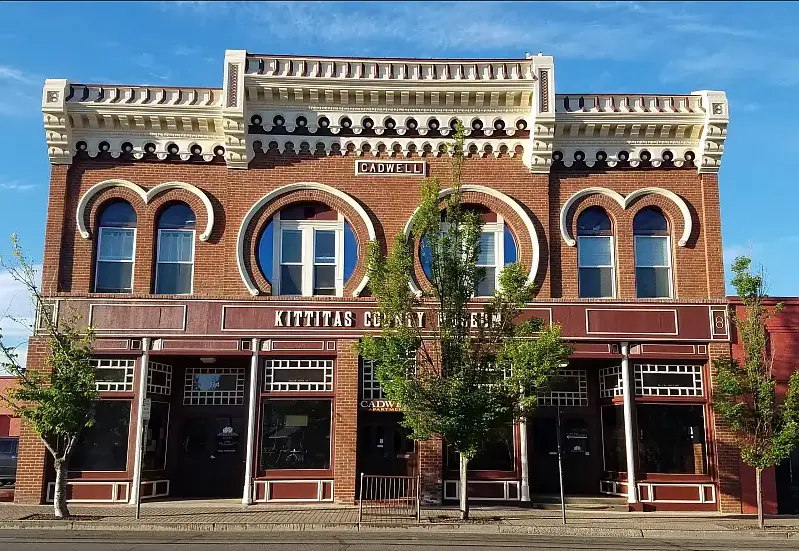
IN THE CITY OF ELLENSBURG… when you want to spend some time indoors, a great place to visit is the KITTITAS VALLEY HISTORICAL MUSEUM. It has about 30,000 items from which more than 50 exhibits and displays are chosen. The mission of the museum is to, “Collect, Preserve and Share the History, Heritage, and Culture of Kittitas County.” In experiencing it you feel a strong connection to the Pacific Northwest. Collection highlights include: Indigenous cultural items (especially from the K’tɨ́taas and Pshwánapam bands). Note the roots here for the local names of Kittitas and Wanapum. Geological specimens, including Ellensburg Blue Agate Some fossilized animals Household goods, textiles, and furnishings Military memorabilia and service records Historic photographs and albums Agricultural tools and equipment Business records and local commerce material Even the building itself is interesting. Built of brick, it was constructed after the Great Ellensburg Fire of July 4, 1889. (There is an exhibit about that fire and its devastation to the town). Some examples of what you will see: So, if you are so inclined, spend some time and enjoy. The museum is open Monday through Saturday from 10am to 4pm. The address is 114 E. 3rd Ave. Ellensburg Admission is free and donations are accepted. Article by Mike Doran: President of the Ellensburg Chapter of the Ice Age Floods Institute
Glacial erratics of the Puget Lowland
Strewn among the forests of the Puget Lowland are an impressive array of Glacial Erratics. Although technically erratics include small pebbles and even sand grains in till, people tend to get the most excited by really big erratics- those the size of a house or building. Whatever their size, glacial erratics often reveal the direction of the ice flow that ripped them from their source region and deposited them at their resting place. Erratics can also help determine the thickness of the ice sheet that deposited them. In the Seattle area, it is relatively straightforward to determine the provenance of erratics containing quartzite, as that rock can not be found anywhere in the Olympics, the Cascades, or in the native bedrock of the Puget Lowland. Quartzite, which is durable and resistant to weathering, is commonly found in river valleys of central British Columbia and in the glacial tills of the Puget Lowland. However, granodiorite erratics found in the lowland and on the slopes of the Olympics and Cascades can be more difficult to decipher. The granodiorite in these erratics is chemically similar to rock bodies both in the British Columbia Coast Mountains and in the Cascades. In the mountains east of Bellingham, erratics found at 5,000 ft of elevation imply that the thickness of the Puget Lobe of the Cordilleran Ice sheet was at least 5,000 ft thick at that location. Maps showing the thickness of the Cordilleran Ice Sheet at various places in Western Washington are drawn, in part, by looking at the depositional altitude of erratics on ridges around the region. The two most massive erratics in the Puget Lowland are composed of Greenschist metamorphic rock. One of the giant erratics of Western Washington hides in the forest in Saratoga Woods Park on Whidbey Island. The Waterman erratic is 38ft high and has a circumference of 135 ft. Analysis of the rock shows that it is composed of Greenschist, a rock containing the low grade metamorphic minerals Chlorite and Epidote. The Greenschist chemically matches the rock of Mt. Erie, a prominent Roche Moutonée found 40 miles to the north on Fidalgo Island. An even larger erratic can be seen in a suburban neighborhood near Everett. The Lake Stevens erratic, 34 ft tall with a circumference of 210 ft, is considered the largest erratic in the Northwest, and possibly the largest erratic in the United States. This erratic is also composed of a Greenschist, although chemical analysis cannot give us a definitive origin for the big rock. There is similar Greenschist on the northern tip of Whidbey Island at Deception Pass, around Mt. Shuksan in the North Cascades, and also up the Fraser River in British Columbia. Article by Dale Lehman
Julie Bishop – Coeur du Deluge Volunteer
Julie Bishop is a founding member of the Coeur du Deluge Chapter of the ice Age Floods Institute and the only continuous member of the Chapter. She has served as Treasurer of our chapter for at least 15 years. Her service to the Coeur Du Deluge Chapter goes way beyond taking care of our financial needs. Julie was and is always there supporting our chapter’s activities (public lectures, field trips and the distribution of IAF-related educational material). She did and does this cheerfully and efficiently. She somehow finds time for our chapter even though she has a full-time job with the Idaho Department of Highways. She has another full-time job at home taking care of the family farm, especially their horses. Julie casually brushes off her contributions to IAFI and Coeur du Deluge, saying that although she did some of the “legwork to start the chapter” the ultimate responsibility for the creation of our chapter was based on the long time flood interest of her friends and co-founders of the CDD Chapter: Kermit Kiebert, Jon Burkhart and Mark Heisel. She continually underplays her contributions. But that is the grace and charm of our Julie Bishop. Thanks for you unstinting service Julie, it’s truly appreciated!
Yvonne Addington – Lower Columbia Volunteer
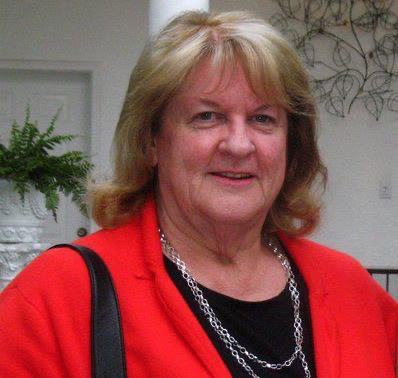
Lower Columbia Chapter/Ice Age Floods Institute (IAFI) is privileged to recognize our outstanding volunteer, Yvonne Addington, who has always been there for us, doing so much for our Chapter, and that’s been lots! Yvonne Addington looks to the future and connects people to make things happen. Even before the Ice Age Floods Institute was formed Yvonne was an Ice Age fan and was storing the bones of a mastodon dug up in Tualatin, Oregon. Tualatin decided to become an ice age destination and Yvonne was one of the most enthusiastic supporters. In many instances she was the driving force or one of a team of people who made the ice age theme come alive in Tualatin. If you dig into Tualatin’s many ice age interpretive displays, public artwork, artifacts like prehistoric animal bones and erratic rocks, you will find Yvonne’s impact. She arranged many of the donations to the Tualatin Public Library ice age displays including the mastodon which Yvonne stored for many years before it found a suitable home in the Tualatin Public Library. She supported the work of making Tualatin the first partner of the Ice Age Floods National Geologic Trail. She spearheaded the renaming of the Tonquin Trail to the Ice Age Tonquin Trail. The Tualatin River Greenway Trail, with its many ice age displays and interpretive signs, has an “Yvonne Addington Overlook” named in her honor for her extraordinary contributions to the mission of parks and recreation in Tualatin. She arranged the donation and transport of a 20,000 lb. granite boulder and a 5,500 lb. quartzite boulder to the Tualatin Historical Center. She encouraged the donation of a 9’ bronze mastodon statue at the Nyberg Rivers mall. She is a founding member of the Tualatin Ice Age Foundation which is working on the future creation of a Willamette Valley Ice Age Interpretive Center. She is an advocate for the preservation of Ice Age fossils, having kept them from being destroyed by identifying places where they can be adequately displayed, not only at Tualatin Heritage Center, but in larger venues including the proposed Ice Age Floods Interpretive Center and the now completed rebuilding of the West Linn City Hall. In addition to her long established career in public service at so many levels, including judgeship and public administration, she has played a significant role in our Lower Columbia Chapter. When we needed a new home for our featured speaker meetings she was there for us, bringing us into the Tualatin Heritage Center on the third Thursday of each month at 7PM. Today Yvonne is a respected member of the Lower Columbia Chapter Board of Directors.
IAFI Cheney-Spokane College Student Research Grants Available
The Cheney-Spokane Chapter of the Ice Age Floods Institute is offering $500 grants to support geologic fieldwork on Ice Age flood research in the Pacific Northwest. Open to undergraduate and graduate students in the U.S. and Canada, proposals are due by April 15 and must focus on Quaternary flood geology. Applications are reviewed for scientific merit, practicality, and impact. Lab costs for dating techniques are eligible, but funding excludes equipment, salaries, tuition, and travel. Submit your proposal (up to 4 pages) to cheneyspokane@iafi.org Progress report & field photos due the following February. 2025 IAFICS Student Research Grant Guidelines