Relive Important Archive Articles

A large number of important articles get buried over time as new articles are added to our website, so here’s a chance to review and relive some of our most important articles. We think you might enjoy reviewing these timeless features.

Incredible Glacier Collapse Video

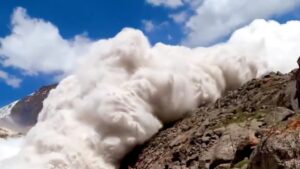
 On Friday,July 8 around 2:45 p.m., British tourist Harry Shimmin reached the highest point in his trek along the Jukku pass in the Tian Shan mountains in Kyrgyzstan. He separated from the group to take pictures from the edge of a cliff when he heard deep ice cracking behind him. He turned around to an avalanche of glacial ice and snow rushing toward him and within moments found himself in a blizzard. The avalanche was the second glacier collapse of the week, demonstrating the perils of human-caused climate change amid a blistering hot summer in parts of Europe and Asia. These are glacier ice avalanches, rather than primarily snow, in which a glacier broke off and collapsed under the force gravity. The high density of ice added speed and weight to the avalanche. In the Tian Shan event, glaciologist Peter Neff, of the University of Minnesota, pointed out that there was no apparent snow around the mountain so the avalanche was largely a solid chunk of glacial ice. In high mountain regions with permafrost, warm temperatures not only destabilize the glacier ice but also the density of the ice around it. “It’s very dense, more like a landslide than an avalanche,” he said. “The British trekker is indeed, as he is aware, very lucky to be alive in the case of the Kyrgyzstan event,” added glaciologist Jeff Kargel, a senior scientist at the Planetary Science Institute. “A pretty solid hypothesis is that as temperatures warm [and] climate warms, the amount of melting increases,” Kargel said. “The effects of meltwater on destabilizing ice masses increases, and so the number, the frequency and magnitude of glacier ice avalanches should be increasing … and that does seem qualitatively to be the case.” Daniel Farinotti, a glaciologist at ETH Zurich, agreed. “It is long known that meltwater caused by high temperatures increase the pressure in the glaciers’ subglacial drainage system, which in turn can accelerate glacier motion,” said Farinotti in an email. “This increase in pressure and motion have certainly a role to play in such collapses.” Among the greatest downstream effects from such mountain glacier loss and collapses are on fresh water systems, Neff said. For instance, glaciers in High Mountain Asia play a critical role in funneling freshwater into river basins used for drinking, irrigation and hydropower by nearly 1.5 billion people. From the Washington Post article by Kasha Patel

Read More »

Could a Glacial Outburst Flood Repeat the “Younger Dryas” Cooling Event?

An ancient flood seems to have stalled the circulation of the oceans, plunging the Northern Hemisphere into a millennium of near-glacial conditions. Thirteen thousand years ago, an ice age was ending, the Earth was warming, the oceans were rising. Then something strange happened – the Northern Hemisphere suddenly became much colder, and stayed that way for more than a thousand years. For some time, scientists have been debating how this major climatic event – called the “Younger Dryas” – happened. The question has grown more urgent: Its answer may involve the kind of fast-moving climate event that could occur again. This week, a scientific team made a new claim to having found that answer. On the basis of measurements taken off the northern coasts of Alaska and Canada in the Beaufort Sea, the scientists say they detected the signature of a huge glacial flood event that occurred around the same time. This flood, they posit, would have flowed from the Arctic into the Atlantic Ocean and shut down the crucial circulation known as the “Atlantic meridional overturning circulation” (or AMOC) – plunging Europe and much of North America back into cold conditions. “Even though we were in an overall warming period, this freshwater, exported from the Arctic, slowed down the vigor, efficiency of the meridional overturning, and potentially caused the cooling observed strongly in Europe,” said Neal Driscoll, one of the study’s authors and a professor at the Scripps Institution of Oceanography. The work, published in Nature Geoscience, was led by Lloyd Keigwin of the Woods Hole Oceanographic Institution along with researchers at that institution, Scripps and Oregon State University. The result remains contested, though, with other researchers still arguing for different theories of what caused the Younger Dryas – including a very differently routed flood event that would have entered the ocean thousands of miles away. Nonetheless, the story is relevant because today, we’re watching another – or rather, a further – deglaciation, as humans cause a warming of the planet. There is also evidence that the Atlantic circulation is weakening again, although scientists certainly do not think a total shut-off is imminent, and are still debating the causes of what is being observed. Either way, the new research underscores that as the Earth warms and its ice melts, major changes can happen in the oceans. And could happen again. The researchers behind the current study, working on board the U.S. Coast Guard Cutter Healy, analyzed sediments of deep ocean mud, which contain the shells of long-dead marine organisms called foraminifera. In those shells, the scientists detected a long-sought-after anomaly recorded in the language of oxygen atoms. The shells contained a disproportionate volume of oxygen−16, a lighter form (or isotope) of the element that is found in high levels in glaciers. That is because oxygen−16, containing two fewer neutrons and therefore lighter than oxygen−18, evaporates more easily from the ocean but does not rain out again as readily. As a result, it often falls as snow at high latitudes and is stored in large bodies of ice. “This is the smoking gun for fingerprinting glacial lake outbursts,” Driscoll said. And that means the findings may also represent the trigger for the Younger Dryas. The thinking is that as the ice age ended and the enormous Laurentide ice sheet atop North America began to retreat, the resulting meltwater fed a bevy of large lakes atop the depressed surface of the continent. That included the massive glacial Lake Agassiz, which stretched from the Great Lakes northwestward across much of Canada. The approximate maximum extents of major glacial lakes that formed from the retreat of the western Laurentide Ice Sheet. (Shannon Klotsko, Scripps Institution of Oceanography, University of California at San Diego) Prior research had shown that for a while, much of the resulting freshwater drained down the Mississippi River and into the Gulf of Mexico. But at some point, as the ice sheet continued to shrink, the flow of water appears to have been suddenly rerouted to the north or to the east, where it could do more potential damage to the ocean circulation in the Atlantic. There has long been scientific debate about where all the meltwater actually entered the ocean, though – with some contending that it would have occurred through the St. Lawrence River, which flows past today’s Montreal and Quebec City and thus out into the Atlantic. The new research holds that, instead, the floodwater exited through the Mackenzie River, which stretches across today’s Northwest Territories, emptying straight into the Arctic Ocean. It would certainly have been an enormous flow of fresh water. “I would say somewhere between the Mississippi and the Amazon,” Keigwin said. That could have interfered with the Atlantic circulation, which is crucial because it carries warm water northward, and so heats higher latitudes. Eventually, the waters of the circulation become very cold as they travel northward, but because they are also quite salty, they sink because of their high density and travel back south again. Freshening is therefore the Achilles’ heel of the circulation. And the new study argues that although the glacial water would have entered the seas very far away near the present Alaska-Canada border, it would have then circulated around the Arctic, eventually traveling south past Greenland and entering the key regions that are crucial to the overturning circulation, which tend to be off Greenland’s southern coasts. Not everyone is convinced, though – including some researchers who have previously published results suggesting that the outburst flood or flow was instead to the east, through the St. Lawrence River. “They have produced a nice signal of the release of freshwater into the Arctic Ocean, but the conclusions are based on an uncertain chronology which, when trying to tie together events so closely, requires some independent confirmation,” Peter Clark, an Oregon State University geoscientist who has published evidence supporting the St. Lawrence River theory, said in an email. Anders Carlson, Clark’s co-author and colleague at Oregon State University, sent a geological study finding that, as he put

Read More »

ESA Maps a Lava Tube for Moon and Mars Expeditions

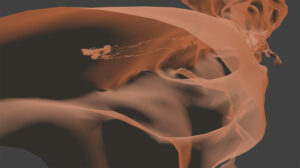
With all deference to the book and movie “The Martian”, wouldn’t you, as part of an interplanetary expedition, prefer to be protected from the radiation, micro-meteorites and extreme temperature fluctuations of the Moon or Martian surface? Though some of the hazards depicted in “The Martian” are way over-dramatized (the thin Martian atmosphere wouldn’t sustain the depicted raging storms), there are still hazards aplenty on the surface. So why not site your habitat in a cozy lava tube, protected from many of those surface nasties. At least that’s some of the reasoning behind a European Space Agency (ESA) effort to map a portion of Spanish lava tube in centimeter-scale detail as part of the ESA’s 2017 Pangaea-X campaign. Some chambers in the 8 km long La Cueva de los Verdes lava tube are large enough to hold residential streets and houses (or a prototype Martian research station/habitat). In less than 3 hours the cave research team mapped the lava tube using the smallest and lightest imaging scanner on the market and a wearable backpack mapper that collects geometric data without a satellite and synchronizes images collected by five cameras and two 3D imaging laser profilers. While the data is still being analyzed, ESA has released this ghostly fly-thru of a 1.3 km portion of the lava tube. Click the play button and prepare to take a pseudo-trip to Mars. So, the next time you visit a cave or lava tube, especially a large one, imagine yourself in a spacesuit on the Moon or Mars and realize that you’re actually an inner-space explorer. But don’t be too surprised at the creatures you may run into, they’re just other inner-space explorers too.

Read More »

Earth in the Next Billion Years

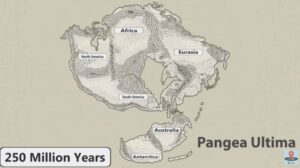
No one can ever say for sure what the future will bring, but this new video has summed up all the science-backed predictions that we can reasonably make about how Earth will change over the next 1 billion years. It’s highly unlikely that anyone will be around to see most of these changes come to pass, so consider this an exclusive front-row seat to a world where supercontinents reign supreme, Mount Everest is no longer the tallest mountain on our planet, Earth enters another glacial period regardless of current global warming trends. and then the Sun becomes a lot hotter. Just another reason we should be glad we live at the time we do. Reposted from Science Alert and RealLifeLore

Read More »

Palagonite Maar Near Hood River

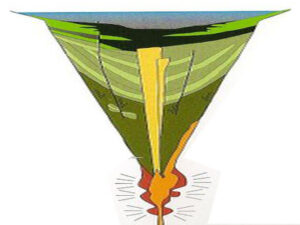
Palagonite Maar Just west of Hood River is a distinctive, short (<500 m) section of stratified orangeish oxidized volcanic tephra and highly fractured lava bombs.  This mixture of oxidized volcanic particles ranging down to sub-micrometer sizes mixed with the larger lava bombs is a palagonite tuff. This deposit is the result of a “phreatic” eruption when lava erupted explosively from a volcanic vent through water, like a lake or groundwater. The rapid heating expansion of water to steam blew the rising lava out of the vent as tephra (volcanic rock fragments) ranging from ash-size to volcanic bombs (blobs of lava) up to several inches in diameter.  Rapid oxidation of the water-quenched tephra turned the iron content to rust, producing the orangeish color of the tephra. The lava bombs were heavily fractured due to rapid cooling of the blob as it came in contact with the water and as it flew through the air. The tephra deposits dip inward on either side of a central gap toward the gap, with NE dips in the western section and NW dips in the eastern section, forming an inverted cone that converges downward toward the central gap. This feature is a “maar” deposit; an inverted cone of tephra and lava resulting from rapidly rising magma interacting with groundwater causing a steam-driven explosive eruption that builds the surrounding maar.  The vent of this maar was in the area of the central gap.

Read More »

Hiking Drumheller Channels

Hiking Drumheller Channels Ice Age Floods National Geologic Trail There are scads of hiking trails all through Drumheller Channels National Natural Landmark. On a cloudy day in early June we took off on a couple of exploratory hikes that were simply amazing. We first proceeded south from the parking lot at Lower Goose Lake, running through late Spring wildflowers, eventually looking for one of Bruce Bjornstad’s geocaches. We wandered over hills and down into deeper valleys, always surrounded by the towering walls of basalt defining that section of Drumheller Channels. Along the way we found an area of apparent Kolk depressions with odd spires of basalt poking up out of the middle of a central mound. Soon we passed through a reedy area that bounded the southern edge of Lower Goose Lake. We continued on south to the edge of Black Lake where the geocache was supposed to be, but after 20 minutes with 4 of us looking in the area of the GPS coordinates, we finally decided the cache was no longer there and headed back. The hike was easy, very pleasant, and mercifully cool due to the cloudy morning. We then drove north across the O’Sullivan Dam, and back south through Columbia National Wildlife Refuge to the W. McManamon Road entrance to Crab Creek Marsh Unit #3 and the Basalt Columns at Drumheller Trailhead, the kickoff point to go to the top of “Nick’s Columns”. Nick Zentner’s videos about the columns are great, but the blooper where his rock hammer falls down between columns is priceless. We just had to see those columns for ourselves, and we weren’t disappointed. It’s interesting how only the columns along the edge are free standing, while those inboard are packed around with sediment. The little rain the area gets probably washed the sediment out of the spaces between the bordering columns. After walking around for a while we made our way back to the car and drove to the Drumheller Channels National Natural Landmark overlook for a final sweeping viewpoint. The entire area is huge and worth several days of exploring, but it’s also pretty easy to have a great time in just a few hours. This is a place you just have to experience. Quick Facts  Location: Adams County, Washington 99371

Read More »

What’s Beneath Our Feet?

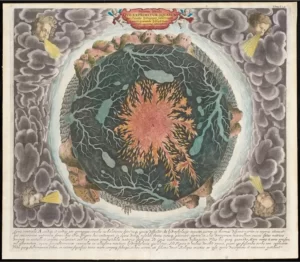
“Beneath Our Feet: Mapping the World Below” plumbs the depths of the question, “What’s beneath our feet?” through maps, images and archaeological artifacts. The exhibition explores nearly 400 years of maps and objects in an attempt to find out why and how humans imagine subterranean landscapes including caves, mines and water tables. Colorful and complicated images reflect the biases of long past and recent days and the concerns of their authors, including the United States’ desire to appropriate the natural resources of Native American lands and a 17th-century Jesuit priest’s attempt to use Scripture to create a framework for Earth’s geology. Catch the exhibition online, including a bibliography, reading lists and a 3-D tour of the Boston Public Library’s Norman B. Leventhal Map Center gallery itself. As you explore nearly 400 years of maps and images of the world below, you can compare the historical viewpoint with the modern, and see how we have advanced our perception and depiction of what lies beneath.

Read More »

Traveling the Ice Age Floods National Geologic Trail

In September 2021 my wife and I took a trip to see what was new along the Ice Age Floods National Geologic Trail and visit some places we did not make it to in our very first trip in 2004. The IAFI chapter brochures were very helpful in learning what there was to see in each area. We also remembered a preview of the National Parks Service unigrid map brochure that will come out hopefully later this year, so be sure and get one when it debuts. The other excellent tool was the online interactive map on the Ice Age Floods Institute website (https://iafi.org/floodscapes/), where you can click on a spot and see a photo and description of the site. All are great planning tools. We drove to Missoula, Montana and stayed there a couple of days as we made day trips. Our first one was to Ovando to see a granite glacial erratic that the Glacial Lake Missoula Chapter had etched and placed at the high-water line. You will find it at Trixi’s Antler Saloon which is a nice place to grab a bite for lunch. The chapter has a number of these high water markers placed already and have more planned to show the full extent of Glacial Lake Missoula. Unfortunately, due to the smoke from the wildfires we were not able to go to Hamilton to see the 8-ton granite erratics outside Ravaili Museum with four interpretive signs outside and additional displays inside. We drove up to the Paradise Center in Paradise, Montana. We had been there before in 2016 for the fall IAFI field trip and they were just dreaming of what the old Paradise Elementary School could become. They have done a wonderful job of making that dream come true. It was one of our favorite spots on this trip. They have dedicated an entire room to the Ice Age Floods story where an extremely accurate 3-D map of Glacial Lake Missoula has lights installed so you can push a button to light up the edge of the ice lobe and other features. Besides information about the Ice Age Floods, the Center also has wonderful displays about the trains & train yard that used to be in Paradise and the history of the Paradise Elementary School. We went to the Natural History Museum in Missoula and enjoyed the panels and video which told the Lake Missoula Floods story and also about Joseph Pardee, a very important pioneer in solving the mystery of these Floods. This museum also displays an amazing amount of taxidermy showing the wildlife and birds in the region. On our way up to Sandpoint, Idaho we passed through Eddy Narrows. Glacial Lake Missoula drained through this canyon going 80 mph leaving horizontal marks high up on the walls. Previously these were thought to be glacial striations, but Pardee speculated that these marks were from huge boulders as they shot through the Narrows. The Narrows is long with few places you can pull over on Highway 200, so it can be hard to really appreciate its scope. We got a good view from the Koo-Koo-Sint Bighorn Sheep Viewing Interpretive Site which has several interpretive signs that talk about the sheep and the geology of the Clark Fork River Valley. We then went over to Farragut State Park at the southern tip of Lake Pend Oreille to view the beginning of the outburst plain that formed the Rathdrum/Spokane Valley aquifer. Across Lake Pend Oreille is Green Monarch Ridge; the terminus of the Purcell Trench which held the 4,000 ft. ice dam that carved the steep walls. The display at the museum has several interpretive panels. The next day we met Consuelo Larrabee who gave us a personal tour of the 40,000 square foot Ice Age Floods Playground in Riverfront Park in Spokane, Washington. She and Melanie Bell, the president of the Cheney-Spokane chapter, did an enormous amount of work as consultants on this fabulous, themed park.  Kids can learn as they play on the three-story Columbian slide tower, Glacial Dam splash pad, log jam climber, an alluvial deposit fossil dig, and more. The park was filled with kids and the adults were enjoying it as much as the kids. We loved watching the excitement of a child as she saw the splash pad water fountains simulate the ice dam starting to rupture and then the cascade of water flooding over the manmade basalt rocks. Along the side of the building are actual basalt columns and the fossil dig led to many exciting discoveries by the children as they dug through the sand to reveal embedded replicas of fossils. Throughout the park are thoughtfully placed benches for people to sit and watch the fun going on around them. There are nine interpretive panels throughout the park adding a wonderful educational benefit to all the fun. This park will be quite a prize for years to come. The next day we drove along Highway 262 to W. McManamon Road to the Drumheller Channels National Natural Landmark. This outlet from the Quincy Basin, with floodwaters going 65 mph eroded not just the topsoil but the underlying basalt which created dramatic channels, basins, potholes and buttes. The viewpoints along the drive had several interpretive panels talking about these wonderful vistas. Since we live in Portland and this trip was to see places we had not recently seen, we skipped over the many wonderful places in the Columbia River Gorge, Willamette Valley & Tualatin. But for your trip, please check out the hundreds of beautiful and interesting sites to see in this region. The last stop for this trip was Cape Disappointment. The Floods debris flushing out the mouth of the Columbia River added substantially to submarine Astoria Fan and sediment cores have shown that ocean currents carried some of this debris all the way down to Cape Mendocino, California. Although not visible from the surface, the Park display has a relief map that shows the Astoria Canyon

Read More »

Share this article:

Like this:

Like Loading...