
The Rush to Oregon Territory
How the twisting and turning of 19th-century society crossed up with the Ice Age Floods
How the twisting and turning of 19th-century society crossed up with the Ice Age Floods

Dr. Scott burns will talk about ancient glacial flooding that preceded the most recent Glacial Lake Missoula Floods in the Pacific Northwest

Celebrating Ice Age Floods Institute's 30th Anniversary The annual IAFI Membership Meeting is coming to the Columbia Gorge this May 2-3, 2025, and all our members and their guests are cordially invited to come experience some of the best and most interesting features the Gorge has to offer. There’ll be opportunities to explore storied Gorge wildflowers and native plants, geology and winery field trips, whitewater rafting, a membership meeting/dinner and a presentation by the ever-entertaining Nick Zenter. Friday, May 2nd, will be action packed with activities during the day. Choose between a guided Spring Wildflower Walk, a Journey Through Terroir field trip, an Unveiling the Gorge field trip (repeated on Sunday, May 4). There are also opportunities available every day for full-day or half-day adventure whitewater raft trips on the Klickitat or White Salmon Rivers with Wet Planet Rafting, a local world-class rafting company. Friday evening will feature our members meeting and dinner, followed by an entertaining and informative presentation by the inimitable Nick Zenter exploring and geolocating J Harlan Bretz’s field notes. Jim O'Connor Richard Waitt Saturday, May 3rd, will feature the main Ice Age Floods Gorge Geology Field Trip – Explore evidence of the Ice Age Floods in the Columbia Gorge led by USGS expert geologists Jim O’Connor and Richard Waitt. This field trip will examine the geology of the Columbia River Gorge with emphasis on the effects of the Ice Age Missoula floods, examining key sites and discussing the latest research. Learn more about the Missoula Floods, explore dramatic flood landforms, and enjoy beautiful vistas, lunch at the Deschutes River Park (order a box lunch or bring your own), and a no-host afternoon recap at Maryhill Winery. Check-in begins each day at 8:00 AM at the Columbia Gorge Discovery Center Find more detailed information here There is also plenty to see and do in the Gorge to keep you fascinated and engaged if you can stay another day. Visit iconic Multnomah Falls (I-84 access only) and spectacular Vista House at Crown Point overlook. Visit Timberline Lodge, a stunning 1930’s CCC project, on the snowy upper flanks of Mt. Hood. Travel the Hood River Fruit Loop or ride the Mt Hood Railroad Hike one (or more) of the innumerable and spectacular Gorge hiking trails Take Windsurfing and Kiteboarding lessons or just watch the action Enjoy fine dining, artisan wineries, breweries, museums and shops throughout the Gorge. There’s so much more to see and do that we can’t even begin to list it all.
Building new roads, and connecting roads, was difficult and expensive. No entity wanted to do that. Not the Federal government, nor the states, not the counties. They got pushed into road-building. What happened?
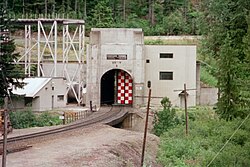
Bill Burgel will give a presentation on the Synergy between the development of the science of Geology with the growth of the railroad industry with a short description of how it impacted BNSF’s Cascade Tunnel’s ventilation system. The advent of the Industrial Revolution accelerated the development of the science of geology, and the growth of the railroad industry closely followed. A quick look at both of these disciplines over the past 200 years reveals a fascinating back and forth which resulted in amazing advances for both. For instance, geologists found the coal and then the railroads transported this coal to locations where people worked and lived. And coal mines virtually dictated where the rail line should be built. Comparisons between the two efforts continue to the present day and Bill will outline some of the current challenges. In 1995, Bill was heavily involved in the installation of a new ventilation system for BNSF’s Cascade Tunnel. Ventilation of the tunnel has been an issue since the first Cascade Tunnel opened in 1900. Bill will describe how BNSF ensures safe operations in the current (second) Cascade Tunnel, the longest railroad tunnel in the United States. Bill Burgel is a Professional Geologist Registered in Oregon and Idaho. He retired in 2015 after a successful 45-year career in the railroad industry. He worked for several railroads nationwide in both the engineering and operating departments. While working for the railroad, his interest and training in geology was often called upon to resolve landslide issues and rerouting studies, implement early earthquake warning strategies, and conduct numerous long railroad tunnel analyses. Bill has given numerous presentations on rail issues as well as earthquake preparedness and topics pertaining to regional geology to local audiences throughout the Pacific Northwest and on cruise ships.
Join Wenatchee Valley Erratics for our Meeting on Tuesday, October 13, 6:30 Meet & Greet, 7:00 Presentaion, at the The Wells House: Mapping Dry Falls: A Bird’s-Eye View of Washington’s Iconic Floodscape featuring Daniel Coe via Zoom. Dry Falls is one of the Pacific Northwest’s most geologically significant landscapes. Its dramatic, deeply eroded terrain preserves evidence of catastrophic glacial outburst floods on a scale that is almost impossible to imagine. In 2025, the Washington Geological Survey published an interpretive map which provides a bird’s eye view of the huge landforms at Dry Falls. Dan will discuss how he and his colleague, Dr. Joel Gombiner, constructed this terrain-based map, and will review the challenges in portraying and interpreting this vast landscape. He will also show several new lidar-based landform visualizations from around our state. Daniel Coe has been making maps of the Pacific Northwest for the past two decades. He is the graphics editor at the Washington Geological Survey in Olympia where his work explores the geomorphology and natural hazards of Washington State. When not making maps, he is usually out enjoying the forests and waters of our region. You can see his work at dancoecarto.com Daniel Coe – Works for Washington State DNR and specializes in: Visual communication of geologic and geomorphic processes, natural hazards, and lidar-based landform visualization. Click here for more information about Daniel Coe The presentation will be broadcast live at the The Wells House, 625 Nelson Ave, Wenatchee, WA 98801. If you can’t make it to the Wells House, no worries… Join Our Zoom Meeting Live October 13, 2026 https://us02web.zoom.us/j/81855547958 Meeting ID: 818 5554 7958