
2022 IAFI Year-in-Review

This is our 6th year preparing a Year-in-Review report for you, our members. We appreciate your continued support, friendship and membership. IAFI is a non-profit organization whose main sources of income are membership dues, donations, profit from field trips and Institute Store sales. For 2022, our total income was $16,675. Our main expenses were contract labor (our membership manager) and liability insurance. For 2021, our total expenses were $9,730. At the end of 2022 we have reserves of $38,938 to cover unplanned expenses, printing informational brochures and to pursue new opportunities related to telling the floods story. Our members provide most of our support and much of the reason for the various materials, activities and events we provide. In 1996, we started with 11 members, and by the end of 2022, as we continue to recover from the pandemic, we have 592 members (427 memberships) from 17 states and British Columbia. While we have several hundred members, most of the work is done by a small group of volunteers, including all your institute and chapter leaders. We welcome anyone interested in helping develop and conduct our programs., so if you are interested please contact us at IAFInstitute@gmail.com or reach out to your chapter president or one of our board of directors. INSTITUTE PROGRAMS This year, while continuing to host zoom presentations, we started to have more in-person activities, although compared to a normal year, we had relatively few activities in community social settings, such as county fairs, school programs, working with other organizations, etc. We have continued our outreach to inform and educate the public about the Ice Age Floods and their long-lasting impact on our area is a key part of the IAFI mission. We have significantly increased our online outreach, typically garnering thousands of views each week through interesting articles and features on our Facebook, website and newsletters, while our local chapter programs are possibly the most effective way we meet this challenge with lectures, field trips, hikes and presentations. LECTURES During 2022 we had both on-line Zoom presentations and in-person lectures. Over 500 people attended 18 on-line lectures and hundreds more viewed them when they were posted on YouTube. We had 27 in-person lectures which were attended by over 1200 people. FIELD TRIPS Ellensburg chapter hosted two field trips: 1) Glacier Lake Foster on the Waterville Plateau and 2) Landforms and Landscapes of the Swauk Watershed. Lake Missoula chapter hosted a field trip to the Bison Range. Coeur du Deluge chapter conducted a walking field trip with Farragut State Park Docents to increase their knowledge of local Ice Age Floods features, emphasizing the location of these features within Farragut Park, how these features were formed, and how they influenced land use, transportation and recreational use. Palouse Falls Chapter hosted a field trip to Palouse Falls. Wenatchee Valley Erratics Chapter hosted several field trips: 1) Talk and field trip for the Tobacco Root Geological Society, 2) Field trip focusing on the Geology of the Wenatchee Valley, 3) Geology of the Leavenworth/Lake Wenatchee area. HIKES Palouse Falls chapter hosted a hike/lecture on the Age of Quartzite Buttes in the Palouse Region. Lake Lewis chapter hosted a hike/lecture to Twin Sisters in Wallula Junction. Quite cold and windy but a cool experience. Cheney-Spokane chapter hosted 3 hikes: 1) Dishman Hills Area, 2) along a proposed trail that the Spokane conservation District would like to develop, and 3) a geologic hike that explored the new Waikiki Springs Conservation Area on the Little Spokane River in conjunction with the Inland Northwest Land Conservancy. Glacial Lake Missoula Chapter hosted a hike/talk to Dean Stone Mountain. PRESENTATIONS FOR SCHOOLS AND COMMUNITY EVENTS To help people learn about the floods we are continually developing new ways of communicating information to people. Some examples from 2022: Our Board of Directors Education Committee has been working on developing a 4th grade curriculum about the Ice Age Floods. Lake Lewis Chapter and The Coyote Canyon Mammoth Site near Kennewick – Approximately 3000 people, mostly elementary school kids on school field trips, including quite a few homeschoolers, visited the mammoth site that we are excavating. The mammoth is buried in Ice Age Floods graded beds, so as we study the mammoth’s burial, we also study the floods. The stories are intertwined; hence each talk must include the Floods story. Many other kids came to the site on youth group field trips or accompanied their parents at community events. About 1000 adults and some kids also visited with us at various community events such as Heritage Days at Sacajawea State Park, The SandHill Crane Festival in Othello, The Richland Library, The Reach Interpretive Center, River Fest at Columbia Park in Kennewick and more. Cheney-Spokane Chapter – Presented the floods story in 20-minute segments to three fourth grade classes with the Science Coordinator for Jefferson Elementary School, and exhibited at the Blue Waters Bluegrass Festival at Medical Lake, WA, visiting with 147 people. Glacial Lake Missoula Chapter – Hosted a booth and tent at the city-wide walk-in Fort Missoula Spring Event for many passersby, and continued preparations to install glacial Lake Missoula high water indicator rocks throughout the area. Coeur du Deluge Chapter – Led a four-hour tour in conjunction with the Idaho Master Naturalist Program on the Shawnodese tour boat along the north shore of Lake Pend Oreille and into the Clark Fork River delta viewing the Purcell trench, the location of the ice dam and the steep wall carved by the glaciation. Columbia River Gorge Chapter – Worked to redesign and rebuild the IAFI.org website, andcreated new Conference displays for IAFI. Lower Grand Coulee Chapter – Hosted a booth at the Ice Age Floods Fest at the Dry Falls Visitor Center, and one at the Quincy Farmer Consumer Awareness Day with IAFI talks and tours, videos and info displays. Palouse Falls Chapter – Hosted an information booth at STEAM night at Lacrosse School and at the Grand Opening of remodeled Connell branch for Mid-Columbia Libraries, participated in Neighbor meeting Neighbor booth in Washtucna, a booth at Wheatland Fair, and a chapter appreciation picnic
Othello Sandhill Crane Festival -March 24-26, 2023

The Othello Sandhill Crane Festival announced the 2023 theme as “Silver Anniversary, Celebrating Our Annual Visitors.” The 25 th annual festival will be held March 24-26, 2023 in Othello Washington. We are excited to be celebrating our 25th year! The festival celebration of the spring migration of the Sandhill cranes offers a variety of events for the whole family to enjoy and learn. The festival will be in the same locations as last year. The lectures will be held at the Othello Nazarene Church, 835 S 10 th Ave, Othello, WA. The Church is next door to McFarland Middle School where we will have the children’s art projects, the vendors, the photo booth, the Rotary breakfast, and the art contest. We will be utilizing both facilities. Food trucks will be available for lunches. Online registration opens on February 6, 2023. Visit the Othello Sandhill Crane Festival website for more information on the events at Website: othellosandhillcranefestival.org. Follow us for updates on Facebook: www.facebook.com/Othello-Sandhill-Crane-Festival Cathy Nowak will be one of the featured speakers on Saturday, March 25, at 7:30pm. Cathy will be speaking about Sandhill Crane nests and how experience matters, with both words and photos. Dr. Kaeli Swift will be the other featured speaker on Friday, March 24, at 7:30 pm. This lecture will require masks. Swift will explore commonly asked questions about crows, how crows have co-evolved with people, and what crows and other corvids can teach us about the nature of intelligence. Saturday, March 25, the lectures will cover cranes, birds, Ice Age Floods, the Drumheller Channel, and much more. We are planning tours by bus, bike, boat, car and self-directed, crane viewing tours will be back. Some tours will be set up over two weekends. The Children Activities Committee will have fun activities for kids such as binoculars made of toilet paper rolls to use for “birding” in the gym by finding pictures of various birds, origami folded crane mobiles, mask making and many other activities. We will again have the free photo booth to take your picture with a digitized Sandhill crane in the background to take home as a memento.
Bering Land Bridge Formed Surprisingly Late During Last Ice Age
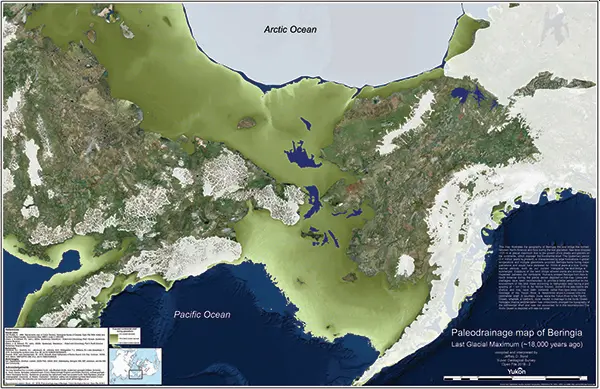
By reconstructing the sea level history of the Bering Strait, scientists found that the strait remained flooded and the Bering Land Bridge connecting Asia to North America did not emerge until around 35,700 years ago, less than 10,000 years before the height of the last ice age (known as the Last Glacial Maximum), and not long before humans are thought to have begun migrating into the Americas. The new findings indicate that the growth of the ice sheets—and the resulting drop in sea level—occurred surprisingly quickly and much later in the glacial cycle than previous studies had suggested. “It means that more than 50 percent of the global ice volume at the Last Glacial Maximum grew after 46,000 years ago,” said Tamara Pico, assistant professor of Earth and planetary sciences at UC Santa Cruz and a corresponding author of the paper. “This is important for understanding the feedbacks between climate and ice sheets, because it implies that there was a substantial delay in the development of ice sheets after global temperatures dropped.” Global sea levels drop during ice ages as more and more of Earth’s water gets locked up in massive ice sheets, but the timing of these processes has been hard to pin down. During the Last Glacial Maximum, which lasted from about 26,500 to 19,000 years ago, ice sheets covered large areas of North America. Dramatically lower sea levels uncovered a vast land area known as Beringia that extended from Siberia to Alaska and supported herds of horses, mammoths, and other Pleistocene fauna. As the ice sheets melted, the Bering Strait became flooded again around 13,000 to 11,000 years ago. The new findings are interesting in relation to human migration because they shorten the time between the opening of the land bridge and the arrival of humans in the Americas. The timing of human migration into North America remains unresolved, but some studies suggest people may have lived in Beringia throughout the height of the ice age. “People may have started going across as soon as the land bridge formed,” Pico said. The new study used an analysis of nitrogen isotopes in seafloor sediments to determine when the Bering Strait was flooded during the past 46,000 years, allowing Pacific Ocean water to flow into the Arctic Ocean. First author Jesse Farmer at Princeton University led the isotope analysis, measuring nitrogen isotope ratios in the remains of marine plankton preserved in sediment cores collected from the seafloor at three locations in the western Arctic Ocean. Because of differences in the nitrogen composition of Pacific and Arctic waters, Farmer was able to identify a nitrogen isotope signature indicating when Pacific water flowed into the Arctic. Pico, whose expertise is in sea level modeling, then compared Farmer’s results with sea level models based on different scenarios for the growth of the ice sheets. “The exciting thing to me is that this provides a completely independent constraint on global sea level during this time period,” Pico said. “Some of the ice sheet histories that have been proposed differ by quite a lot, and we were able to look at what the predicted sea level would be at the Bering Strait and see which ones are consistent with the nitrogen data.” The results support recent studies indicating that global sea levels were much higher prior to the Last Glacial Maximum than previous estimates had suggested, she said. Average global sea level during the Last Glacial Maximum was about 130 meters (425 feet) lower than today. The actual sea level at a particular site such as the Bering Strait, however, depends on factors such as the deformation of the Earth’s crust by the weight of the ice sheets. “It’s like punching down on bread dough—the crust sinks under the ice and rises up around the edges,” Pico said. “Also, the ice sheets are so massive they have gravitational effects on the water. I model those processes to see how sea level would vary around the world and, in this case, to look at the Bering Strait.” The findings imply a complicated relationship between climate and global ice volume and suggest new avenues for investigating the mechanisms underlying glacial cycles. In addition to Pico and Farmer, the coauthors include Ona Underwood and Daniel Sigman at Princeton University; Rebecca Cleveland-Stout at the University of Washington; Julie Granger at the University of Connecticut; Thomas Cronin at the U.S. Geological Survey; and François Fripiat, Alfredo Martinez-Garcia, and Gerald Haug at the Max Planck Institute for Chemistry in Germany. This work was supported by the National Science Foundation. Published in Proceedings of the National Academy of Sciences. Reprinted from UC Santa Cruz Newsletter, By Tim Stephens
OSU Archaeologists Find Oldest Known Projectile Points in the Americas

Oregon State University archaeologists have uncovered projectile points in Idaho that are thousands of years older than any previously found in the Americas, helping to fill in the history of how early humans crafted and used stone weapons. The 13 full and fragmentary projectile points, razor sharp and ranging from about half an inch to 2 inches long, are from roughly 15,700 years ago, according to carbon-14 dating. That’s about 3,000 years older than the Clovis fluted points found throughout North America, and 2,300 years older than the points previously found at the same Cooper’s Ferry site along the Salmon River in present-day Idaho. “From a scientific point of view, these discoveries add very important details about what the archaeologic al record of the earliest peoples of the Americas looks like,” said Loren Davis, an anthropology professor at OSU and head of the group that found the points. “It’s one thing to say, ‘We think that people were here in the Americas 16,000 years ago;’ it’s another thing to measure it by finding well-made artifacts they left behind.” Previously, Davis and other researchers working the Cooper’s Ferry site had found simple flakes and pieces of bone that indicated human presence about 16,000 years ago. But the discovery of projectile points reveals new insights into the way the first Americans expressed complex thoughts through technology at that time, Davis said. The Salmon River site where the points were found is on traditional Nez Perce land, known to the tribe as the ancient village of Nipéhe. The land is currently held in public ownership by the federal Bureau of Land Management. The points are revelatory not just in their age, but in their similarity to projectile points found in Hokkaido, Japan, dating to 16,000-20,000 years ago, Davis said. Their presence in Idaho adds more detail to the hypothesis that there are early genetic and cultural connections between the ice age peoples of Northeast Asia and North America. “The earliest peoples of North America possessed cultural knowledge that they used to survive and thrive over time. Some of this knowledge can be seen in the way people made stone tools, such as the projectile points found at the Cooper’s Ferry site,” Davis said. “By comparing these points with other sites of the same age and older, we can infer the spatial extents of social networks where this technological knowledge was shared between peoples.” These slender projectile points are characterized by two distinct ends, one sharpened and one stemmed, as well as a symmetrical beveled shape if looked at head-on. They were likely attached to darts, rather than arrows or spears, and despite the small size, they were deadly weapons, Davis said. “There’s an assumption that early projectile points had to be big to kill large game; however, smaller projectile points mounted on darts will penetrate deeply and cause tremendous internal damage,” he said. “You can hunt any animal we know about with weapons like these.” These discoveries add to the emerging picture of early human life in the Pacific Northwest, Davis said. “Finding a site where people made pits and stored complete and broken projectile points nearly 16,000 years ago gives us valuable details about the lives of our region’s earliest inhabitants.” The newly discovered pits are part of the larger Cooper’s Ferry record, where Davis and colleagues have previously reported a 14,200-year-old fire pit and a food-processing area containing the remains of an extinct horse. All told, they found and mapped more than 65,000 items, recording their locations to the millimeter for precise documentation. The projectile points were uncovered over multiple summers between 2012 and 2017, with work supported by a funding partnership held between OSU and the BLM. All excavation work has been completed and the site is now covered. The BLM installed interpretive panels and a kiosk at the site to describe the work. Davis has been studying the Cooper’s Ferry site since the 1990s when he was an archaeologist with the BLM. Now, he partners with the BLM to bring undergraduate and graduate students from OSU to work the site in the summer. The team also works closely with the Nez Perce tribe to provide field opportunities for tribal youth and to communicate all findings. The findings were published in the journal Science Advances. Reprinted from Oregon State University Newsroom, STORY BY: Molly Rosbach, SOURCE: Loren Davis
IAFI Booth at WSTA-CSTA Conference in Wenatchee

Ken Lacy of the IAFI Wenatchee Chapter hosted an information booth at the 2022 Washington Science Teachers Association Conference on Oct. 14-15 in Wenatchee, WA. His was the first use of a new table-top display that we recently developed for conferences, meetings and conventions. Ken felt the display,with its impressive graphics, showing maps and images of Ice Age Floods features, attracted a lot of interest and attention and fostered great opportunities to further engage with the conference goers as they came in for a closer look. He felt there was a high level of interest in the Ice Age Floods topic and people were keen to learn more about the floods, which led to many good conversations. It also gave Ken and opportunity to talk to as many as 10 ESD Science Coordinators about our project to provide 4th Grade level education materials about the Ice Age Floods. Their response was uniformly that this idea would not be well received because there was no time available for additional non-formulary classes. One of these Science Coordinators suggested it might be possible to combine our Floods program with an existing program, such as Language Arts, by presenting Floods information and having the students “prove” the existence of the floods by listing facts that supported this hypothesis. In another discussion with a retired school administrator about the issue of available time for our 4th Grade Floods program, she cited two examples of havin had to turn down outside offers of valuable educational programs because there was just not enough class time available for those programs. However, when Science Coordinators and teachers were asked about the idea of having IAFI people either conduct classes themselves or help the teachers develop such a class, the response was quite positive. The different response to the idea of our 4th Grade Floods program and the proposal for individual classes is significant in terms of class-time and preparation required. A single class session can often be fit into the schedule, but a multi-class program may cut too deeply into the time needed for required cirricula. Still, there are several sections in the Washington State Fourth Grade Curriculum that can support the inclusion of our proposed Ice Age Floods program. It will therefore be necessary for IAFI to work with the ESD Science Coordinators in each school district to get their support for the inclusion of our project.
Ancient British Isles Ice Sheet Time-Lapse Animation

The rapid decline of the British-Irish Ice Sheet thousands of years ago may hold lessons for how melting ice sheets in Greenland and Antarctica will influence sea-level rise in the future. In an animation that spans tens of thousands of years, an ancient ice sheet grows to envelope land masses that would one day be known as Great Britain and Ireland. After thousands of years elapse, the ice then retreats to expose the land once more. Known as the British-Irish ice sheet, the frozen mass began its relentless march about 33,000 years ago. Around 10,000 years later, the land was covered in ice half a mile thick. But just 5,000 years after that, the glacier had melted away, vanishing in a mere blink of geological time. Human populations that had fled a millennia-long winter returned to settle the thawing land just as the last ice age drew to a close. Representing years of research, this animation highlights how quickly the British-Irish Ice Sheet declined. And the data driving the animation may help scientists to better understand how modern ice loss due to climate change contributes to sea-level rise.Scottish geologist Archibald Geikie first mapped the British-Irish Ice Sheet’s shape in 1894 and, over the past century, scientists have slowly carved out details of its formation and decline, publishing their findings in more than 1,000 scientific publications, according to the website of BRITICE-CHRONO(opens in new tab) a five-year, $4.2 million endeavor to map the British-Irish Ice Sheet. Ultimately it was the specter of human-caused climate change that drove one team of BRITICE-CHRONO researchers to bring together existing data and collect more; they published their findings Sept. 7 in the journal Boreas(opens in new tab). In creating the new animation, the scientists visualized the most complete picture to date of the ancient ice sheet’s rise and fall. The BRITICE-CHRONO team scoured prior studies and compiled data on more than 20,000 landforms that currently exist along the path of the ice sheet — from hill-like drumlins, or small ridges, to masses of soil and rock left behind by the moving glacier. The scientists then visited locations on land and sea, collecting data from 914 sites — some of which were only accessible via submarine, they reported in the study. They calculated the geometric contours of the ice sheet from features in the terrain, estimating the timing of the glacier’s retreat from carbon-dated sediment, including animal remains. Their efforts produced three times more data than any prior simulation of the British-Irish ice sheet; the team then fed the data into a computer model that assessed how the ice would have interacted with its environment over tens of thousands of years. Their animation presented the resulting maps as a time-lapse of the glacier’s expansion and eventual demise. Although this particular ice sheet melted thousands of years ago, the details of its growth and collapse may hold lessons for climate scientists studying the alarming decline of two modern ice sheets: one in Antarctica and the other in Greenland. Since 1901, these two ice sheets have lost 49,000 gigatonnes of ice — enough to coat the United States in 22 feet (6.7 meters) of ice, or enough to cover the entire surface of the moon in an ice sheet five feet (1.5 m) tall, according to NASA(opens in new tab). That melted ice ended up in the ocean, where it has been the single largest contributor to sea-level rise in the past few decades, according to the United Nations’ International Panel on Climate Change(opens in new tab). Even if humans were to cut all fossil fuel emissions tomorrow, a 2022 study in Nature Climate Change(opens in new tab) suggests that ice lost from the Greenland ice sheet would still cause a 10-inch (25-centimeter) sea level rise. Rising sea levels, in turn, will likely mean more punishing storms with worse flooding; the disruption of fragile ecosystems; and the mass displacement of millions of people who live along the coast. Projects such as BRITICE-CHRONO, which look back at the lifespans of long-gone ice sheets, may help scientists predict the decline of modern ice sheets and plan for the future, the researchers reported. Article by Joshua A. Krisch, taken from Live Science
Dry Falls and Channeled Scabland included in top 100 Geological Heritage Sites Worldwide

Bruce Bjornstad is honored to have his photo of Dry Falls from “Ice Age Floodscapes of the Pacific NW” featured in a just-released international publication coauthored by Susan Schnur and Ryan Karlson. “Dry Falls and the Channeled Scabland” is included as one of the “First 100 IUGS Geological Heritage Sites”, chosen by more than 200 experts and 10 international organizations from more than 40 countries. According to the International Commission of Geoheritage (IUGS) the 100 Geological Heritage Sites are “key places with geological elements and/or processes of scientific international relevance with a substantial contribution of geological sciences through history”. Here’s link to the free .pdf file of the publication that features all 100 sites, Dry Falls is #87: https://iugs-geoheritage.org/videos-pdfs/iugs_first_100_book_v2.pdf. Print copy to be available later. More info: https://iugs-geoheritage.org/geoheritage_sites/dry-falls-and-the-channeled-scabland/
Oct. 2022 Update from the National Geologic Trail

I’d like to start by thanking the Ice Age Floods Institute for letting the National Park Service share regular updates on Ice Age Floods National Geologic Trail. I’m Justin Radford the Trail’s program manager and I look forward to sharing some of the work we are doing. This summer I had the chance to travel much of the “Trail” from Missoula to Cape Disappointment. Having the opportunity to engage firsthand with the visitor experiences offered by our many partners and the amazing landscapes was certainly the highlight of the summer. Photos and stories from these site visits will bring enhancements to both the NPS App and our website in the future. This summer we also had our second annual Teacher training in Spokane, WA. 43 K-12 Teachers earned credit towards their teaching certificates by learning how to instruct with the story of the Missoula Floods in mind. We are currently working on the calendar for next year with hopes that we will be able to bring our traveling Ice Age Floods NGT and Lake Roosevelt NRA visitor center trailer to more events. Coming up this fall we will engage with the National Park Service’s Service-Wide Comprehensive Call seeking funding and support for future project activities. We will also be working to grow our cultural connections with more groups across trail. Thank you for your support as we continue to grow Ice Age Floods National Geologic Trail. More good news to come as we work with the Ice Age Floods Institute and other partners to move the Trail programs forward. Justin P. Radford Program Manager Ice Age Floods National Geologic Trail Address: Lake Roosevelt National Recreation Area 1008 Crest Drive Coulee Dam WA 99116 Phone: 509-237-9722
Redesigned IAFI.org Website
It’s been several years since our IAFI.org website first appeared and website design standards have changed a lot since then. This summer we undertook to completely redesign the website, hoping to make it more useful, interesting and dynamic. Unfortunately when we tried to go “LIVE” the server company messed up the launch and had the website down for a week. That problem is now fixed and the website is LIVE at the same URL (website address) you are used to – https://IAFI.org, though there are still some server problems to be ironed out. If you see something that appears to be broken, or you feel we’ve missed something important, or there’s something we can improve, please email our webmaster at Webmaster@IAFI.org or leave a comment below. In particular, if you have expertise in building and maintaining websites and would like to help with ours, please get in touch with us. Our webmaster is strictly a volunteer who has spent many, many hours developing and maintaining our website for years, learning as he worked at it, and he wouldn’t mind some help.
Hairy Buddies call for Bear Awareness

A near failure of berries and upland food sources has brought the bears into much of the lowlands of the mountainous Pacific NW, including towns and campgrounds. All the area of Lake Missoula is established grizzly habitat now with good numbers outside the parks. Black bears are also doing well now. When you visit the Lake Missoula area this glorious fall keep this in mind. Google Bear Awareness pages from Fish, Wildlife and Parks or National Forests and follow the food and camping instructions. This year is on par for setting new records for encounters and new and unexpected places to find them including downtown in all western Montana. Bearproof coolers and hard side storage are good ideas. Safety Around Bears Mountain bikers, trail runners, and other recreationists take note and read this detailed information on recreating in bear country! When you are on the trails and even in campgrounds, expect bears to be present or nearby. Moving quickly on a trail increases your chance of surprising a bear. Expect bears to be present Carry bear spray attached to you and readily accessible Make noise and slow down Avoid evening/early morning Avoid going alone During a grizzly bear encounter: Stop. Do not run. If on a bike, get off, keeping your bike between you and the bear. If the bear charges—stand your ground, use your bear spray. If the bear makes physical contact—protect your head and neck, play dead, use your bear spray. Visit Interagency Grizzly Bear Committee Bear Safety page for more on recreating in grizzly country.