
Thank You from Ice Age Floods Institute
Thank you for your Ice Age Floods Institute membership registration and or donation. Your membership dues are used to support public education, research, and public policy advocacy about Ice Age Floods related subjects and issues. Donations are used to support public education, research, and public policy advocacy about Ice Age Floods related subjects and issues unless you have specified a specific purpose for its use. NOTE: Ice Age Floods Institute is a registered 501(c)(3) non-profit organization (EIN 91-1658221), and as such 100% of your membership fees and donations may be tax deductible. This notice confirms that your registration/donation has been submitted, but the transaction is NOT complete until you’ve completed the payment process and you receive a payment confirmation. Please keep confirmation notices as needed for your records.
Explore Historical Ice Age Floods Field Research with Google Maps and Google Earth
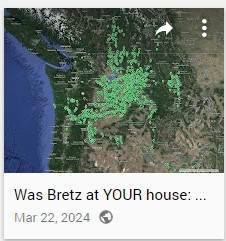
Explore Historical Field Research with Google Maps Did J harlan Bretz (and Others) Do Field Work near You? Ice Age Floods Institute is now a repository for interactive Google Maps that show the travels and field locations/notes of J Harlan Bretz and other field researchers that led to, and continue to refine, Bretz’s of theories of massive floods having created the unique Ice Age Floods landscapes of the Pacific NW. These detailed Google MyMaps (geospatial database files), created by Glenn Cruickshank, are valuable contributions to the Ice Age Floods story in the PacNW. They enable users to locate individual field sites and associated field notes, and to intimately delve into the research, observations and speculations of adherents and detractors of the Ice Age Floods. These interactive maps can be used to zoom in and explore hundreds of Bretz’s and others field locations and notes throughout the area. Links below to a number of other similar maps can help you open a dizzying realm of opportunities to more deeply explore the elements and thoughts behind the discoveries and historic research into the Ice Age Floods. Use your scroll wheel to zoom the map, click a marker for detailed information about a field site. These maps are part of a Google Earth project created by Glenn Cruickshank, supported by Nick Zentner and by the Ice Age Floods Institute through the efforts of webmasters Lloyd DeKay and Chris Sheeran. Glenn Cruickshank has approved the hosting of his MyMaps and Google Earth KML/KMZ files on the IAFI.org website. Glenn is a member of the “IAF Historical Locations on Google Earth” Working Group. The Google Earth KML/KMZ data files and copies of Bretz’s field notes can also be downloaded free of charge and without restriction at NickZentner.com. More Maps Even More Maps J Harlan Bretz – His Personal Memories Glenn Cruickshank recently met with Dean Kiefer. who shared a copy of J Harlan Bretz’s 4-volume memoirs in scanned .pdf format. Glenn converted them to text that also made them searchable. They are a very interesting read, though a bit stream-of-Bretz-consciousness in some sections. Still historically interesting, and a good add to our repository. Click the links below and enjoy! J Harlan Bretz Memories – Part 1 – 1972J Harlan Bretz Memories – Part 2J Harlan Bretz Memories – Part 3J Harlan Bretz Memories – Part 4 – 1975 create a personal tour Map in google earth How to load the Google Earth Geospatial Database Files into Google Earth You can create your own personal Google Earth map to view and use to explore selected field sites from the KMZ files for various researchers. First, download the KMZ files (listed on the right) into your local computer. Or download files from Nick Zentner’s website where they are named “GOOGLE EARTH Bretz Field Sites (yyyy)”. There will be one (or two) field notes for each corresponding KMZ, named FIELD NOTES or FIELD BOOK. Glenn suggests also downloading the field notes as .PDF’s for easier reading. The most complete directions for downloading KML/KMZ files are on the Google Help website Older version of Google Earth on Android:1. On your Android phone or tablet, open the Google Earth app2. Tap Menu Projects3. At the top, tap Open …4. Tap the file you want to add.5. To return to the map and open the file, tap Back New version of Google Earth for Chrome:On chrome go to https://www.google.com/earth/1. Click Launch Earth in Chrome2. Click the Menu button on the left side navigation bar3. Click Settings. Scroll to the bottom of the settings and where it says Enable KML File Import turn it on then click save4. Click New Google Earth Pro on the desktop:1. Launch the Google Earth Pro application2. Select File Open3. GE will place each file in the “Temporary Places” area on the left hand side of the frame. Makesure to move them ABOVE the Temporary Folder into the My Places folder (click and drag) before you exit GE, or else you will have to reload them every time.4. Repeat the process for each Bretz KML file you want to load. Click Here to download a printable PDF of these instructions download KMZ files
National Park Service Volunteer Gigs

National Volunteer Week is an annual celebration established in the U.S. in 1974. The National Park Service marked the occasion by recognizing those who already choose to spend their time volunteering in parks and urging others to consider doing so. Join Volunteers-In-Parks (VIP) to support the National Park Service in its mission to preserve and protect our national parks. You can volunteer for a day or year-round; on your own or with friends and family; close to home or at a dream destination. Volunteer opportunities are available nationwide including in U.S. Territories. What Can Volunteers Do? The possibilities are as diverse as the national parks themselves. Here are some example volunteer activities: Lead or support education and public-facing programs Maintain or rebuild trails or historic buildings Conduct research or monitor wildlife to preserve our natural resources Help families make memories happen as a campground host Teach others about the park and swear in new Junior Rangers in the visitor center Support libraries, archives, and museums in parks to preserve our cultural resources Produce art while staying in a park as an Artist-In-Residence Educate train travelers on the natural and cultural heritage of a region through the Trails & Rails program You can check out some of the National Park Service’s volunteering opportunities here. Alternatively, if the prospect of making the country a greener and cleaner place sounds like an intriguing full-time gig for you, learn how you can apply to be one of the inaugural members of the newly formed American Climate Corps.
Museum of Natural History, University of Oregon
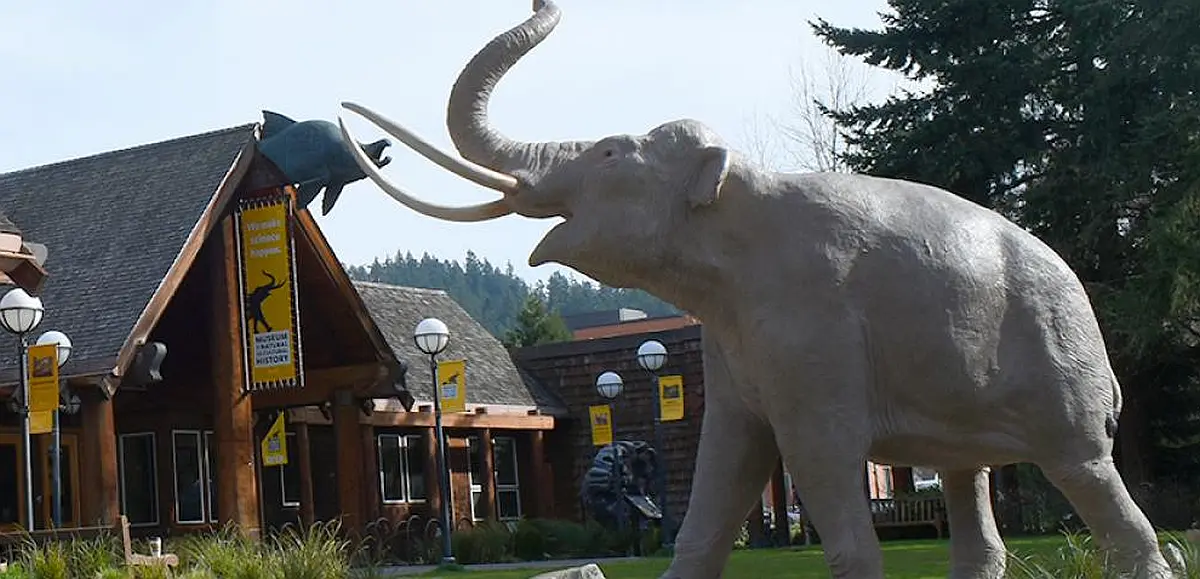
Museum of Natural and Cultural History, University of Oregon The museum offers a variety of seasonal and year-round programs for science and culture enthusiasts of every age. Delve into Oregon’s story, from the archaeology of the First Americans to the dynamic cultures of today’s Tribes. Experience the dynamic forces that shape Oregon’s landscapes, climate, and ecosystems. Meet giant salmon, Ice Age sloths, and other amazing animals from across the millennia. Museum initiatives steward Oregon’s past, present, and future. The museum is home to an invaluable record of Earth’s environments and cultures. As the state’s official repository for Oregon cultural and paleontological materials, our vaults house hundreds of thousands of objects ranging from archaeological and ethnographic items to fossils and geological specimens. The museum also curates extensive zoological and zooarchaeological collections used for comparison and identification of specimens from paleontological and cultural sites. Together, the collections inspire wonder, stewardship, and scholarship in Oregon and beyond. New discoveries constantly reshape our shared understanding of Earth’s natural and cultural histories. Explore the museum’s ongoing research in paleontology and archaeology, and learn how scholars from around the world are using our collections in their research. Website: https://mnch.uoregon.edu/ Hours: Wednesdays through Sundays 10:00 a.m. to 5:00 p.m., Thursdays until 8:00 p.m Entry Fees:•General: $6•Seniors (62+) & Youths (3-18): $12•Families (up to 2 adults and 4 youths): $12•Children (2 and under), UO students, LCC students, faculty, staff*, MNCH members: FreeVeterans and active-duty military*: Free Location:1680 East 15th AvenueEugene, OR 97403
Mike Doran
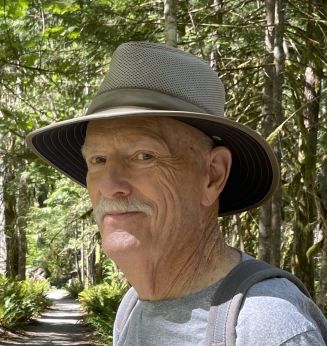
Ellensburg Chapter President My family history is rooted in the Columbia Basin, the Okanogan country and the Yakima Valley. So, I very much identify with central Washington. I was born in Ephrata and raised in Soap Lake. Growing up in the lower Grand Coulee, I often wondered about those large cliff walls on the west side of the coulee. What are they about? How did they get there? And why are they located here and not over there? Upon graduating from Central Washington State College I put in a career teaching high school Special Education and Alternative Education in Tacoma. That was interrupted with a few years serving in the US Army. As I was approaching retirement from teaching I wanted to learn more about the history and geology of the Pacific Northwest and our state of Washington. It wasn’t long before I came across the videos, speakers and field trips being offered out of Ellensburg and Central Washington University. I started attending those events and I was hooked. Fast forward to the present day and I have found it extremely satisfying to be learning answers to those boyhood questions—and ones I hadn’t even thought about asking. I’m looking forward to learning and discovering even more.
Scabland – The Movie, A Google Earth Odyssey

“Scabland” – the Movie, A Google Earth Odyssey “Scabland” is a media complement to CWU Professor Nick Zentner’s 2023-2024 A-Z YouTube geology series that re-treads the ice age floods and the work of Professor J Harlen Bretz and others. In this short animation, viewers virtually fly to a selection of locations visited by geologist Dr J Harlen Bretz, with quotes from his original field notes, geolocated in Google Earth and animated with Google Earth Studio. To see more of these locations, visit https://www.geology.cwu.edu/facstaff/nick/gBRETZ/ This video was done as an experiment/prototype by the authors, Glenn Cruickshank and Eric Larson, to showcase Google Earth, virtual special effects techniques, some of the spectacular landforms caused by the floods, the impacts of ice and water during the Last Glacial Maximum and the field locations of J Harlen Bretz. Eric Larson in Billings MT runs Shashin Studio, a VFX video production company (contact@shashin.studio). Google Earth Glenn is a retired photojournalist and consultant in Liberty Lake WA. Credits: Glenn Cruickshank Eric Larson Two Steps From Hell Made with Google Earth and Google Earth Studio. Thanks to The Families of J Harlen Bretz and Thomas Large, Nick Zentner, Glenn Cruickshank, Bruce Bjornstad, The Ice Age Floods Institute, and many others.
New Membership/Donation Form Test
Dan Foster and the Ice Age Floods story

In my “Tales from the Trail” I usually highlight a place important to our story. This time, I would like to highlight someone important to our story. On December 31st of 2023, Dan Foster, long-time Superintendent of Lake Roosevelt National Recreation Area, and Ice Age Floods National Geologic Trail retired after over four decades of public service. While he worked on many efforts over the years with multiple state and federal natural resources programs, Dan’s time supporting Ice Age Floods National Geologic Trail is something we should all be grateful for. Since 1992, Dan has worked for the National Park Service in various resource management positions, including Superintendent at Niobrara National Scenic River. In 2013, he became the Superintendent of both Lake Roosevelt National Recreation Area and Ice Age Floods National Geologic Trail. In 2014, Dan’s leadership led to the development of the Trail’s Foundation Statement, which is still instrumental today in directing the focus and daily activities of the Trail. It solidified the notion of this public-private partnership we all call Ice Age Floods National Geologic Trail today. Working in collaboration with partners across four states, Dan also led the development of the 2016 Long Range Interpretive Plan and, the following year, the Trail’s first Junior Ranger book. Dan was instrumental in influencing the City of Tualatin to develop an Ice Age Floods theme for many city attractions, including city parks, hiking trails, the library, and local businesses. Dan’s commitment to securing additional resources for the Trail led directly to the National Park Service creating the Program Manager position which I am grateful to occupy today. For over a decade of his career, Dan led the Nation’s only National Geologic Trail. It’s not easy being the first, and Dan’s years of experience and leadership have given our Nation Trail a solid foundation to build upon. Dan still lives in Grand Coulee, Washington, right on the Trail in the middle of Grand Coulee, and you just might see him paddling away out there on Banks Lake. Dan, we are truly grateful for everything you have done for the Ice Age Floods National Geologic Trail! Article by Justin Radford, Program Manager – Ice Age Floods National Geologic Trail, Acting Park Manager – Lake Roosevelt National Recreation Area
Moses Coulee: Unveiling the Mystery of a Colossal Ice Age Scar
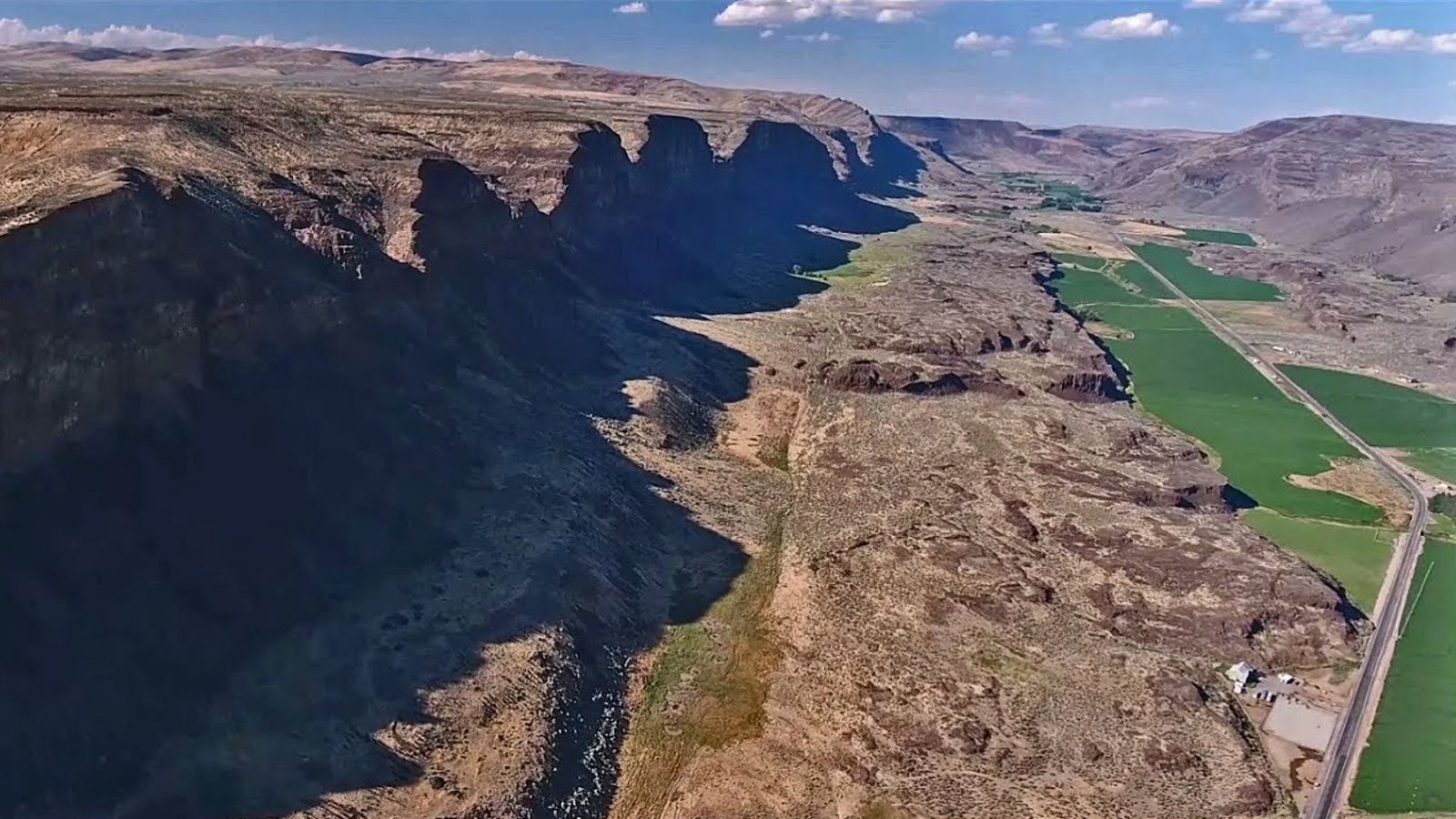
Moses Coulee, a Washington state wonder, has puzzled geologists for over a century. This massive canyon, carved into solid basalt, stands as a testament to some powerful force. The culprit? The Ice Age Floods, a series of catastrophic deluges that reshaped the landscape. If you’ve ever visited, or even just passed through Moses Coulee, you may not have been aware that this awe-inspiring coulee has been an Ice Age Floods conundrum since the time geologist J Harlen Bretz first noted it in 1922. The problem? Moses Coulee doesn’t quite fit the picture. As Bretz described it, “The head of Moses Coulee is just north of Grimes Lake. It is an abrupt termination, walled by 100 foot cliffs, identical with the features of channeled scabland which are called abandoned cataracts.” The head of the coulee ends abruptly, lacking any clear connection to the known flood paths. Theorists proposed a missing link, a path obliterated by the Okanagan Ice Lobe, but no evidence of such a grand passage has ever been found. The mystery has persisted and become more enigmatic as Ice Age Floods research has flourished over the years: what colossal force carved this immense coulee? A new study by Gombiner and Lesemann (Geology, 2024) offers a radical new hypothesis. They propose a surprising source for flood waters: meltwater trapped beneath the massive Okanagan Ice Lobe glacier. Imagine the giant Okanagan ice sheet pressing down on the Waterville Plateau. Meltwater pooled in valleys beneath the ice, trapped and pressurized. This water, according to the theory, found a surprising escape route. Flowing through a network of hidden channels, it carved its way across intervening ridges and valleys, eventually funneling into Moses Coulee. This “tunnel channel network,” as the researchers describe it, explains the unusual path of the water. The channels themselves, carved in basalt, climb slopes and defy normal drainage patterns. These features, along with glacial landforms like eskers, suggest a watery escape route beneath the ice sheet. The study doesn’t rule out the role of traditional Ice Age Floods. Water from massive glacial lakes might have also contributed to Moses Coulee’s formation by flowing along the eastern edge of the glacier. This new hypothesis could be a game-changer. It suggests a hidden world of pressurized meltwater sculpting the landscape beneath the ice. While the debate continues, one thing is certain: Moses Coulee remains a captivating enigma, a place where the power of water and ice continues to unfold its secrets.
First Grader Fascinated By Floods Story
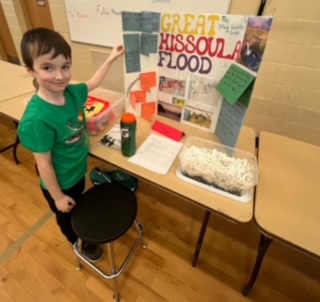
Max Vuletich, a first grader at Jefferson Elementary in Spokane, Washington, exhibited at a STEM Event in March 2024. He prepared a display and shared the Floods story to the many attendees that stopped by his table. He became interested in the Great Missoula Floods when he saw a Public Television video in Kindergarten. He went to a Library and began reading about The Floods and googling topics. His mother, Mariah, reported that he loves the Floods story and continues to be passionate about learning all he can. Perhaps he is destined to be a geologist!