
We came across an interesting article in IFLScience that pertains to our own Washington and Oregon backyard and might be of interest to our fans. Here’s a short excerpt from the article that goes much more in depth about the ramifications of past LIPs and the potential comparable effects of our current contributors to global climate change.
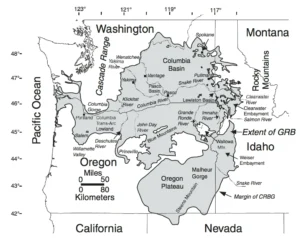
Siberia, India, Southwest China, Ethiopia, and Yemen – dotted around the globe, there are areas that stand out, geologically speaking, from the rest of the world. Why? Because they’re large igneous provinces (LIPs): massive, sprawling regions of igneous rocks, formed tens or even hundreds of millions of years ago in volcanic eruptions so huge that they changed the face of the planet itself.
“You have the potential for truly enormous eruptions, possibly up to 10,000 cubic kilometers erupted in a single event,” Leif Karlstrom, an Earth scientist at the University of Oregon, told PBS. “And that will happen repeatedly over the course of a large igneous province event.”
“These lava flows blanket the earth, and they travel for hundreds of kilometers,” he explained. “The flow rate is so high that they are not cooling – [they’re] flooding the landscape, filling in topography, and forming a stack of basaltic rocks that can be kilometers thick.”So, what would an LIP eruption look like? Well, think of the biggest volcanic eruption you know. Krakatoa, maybe, which, when it erupted in 1883, was responsible for more than 35,000 deaths and could be heard as far away as Australia; perhaps Mount Tambora, whose eruption in 1815 was the largest in recorded history, sending ash raining down over thousands of kilometers in every direction and producing the so-called “Year Without a Summer” in 1816. Anything like that will do.
Now scale that up by a factor of, oh, let’s say 10,000, and you have an idea of what a large igneous province event might look like. “A LIP is not a single dramatic event like Mount Pinatubo, or the explosive Mount Tambora eruption in 1815,” explained Stephen Grasby and David Bond, geologists at the Geological Survey of Canada and the University of Hull respectively, in a 2023 article for Elements magazine.
Instead, radiometric dating “indicates that LIPs extruded lava flows over tens if not hundreds of thousands of years,” the pair wrote. “As such, LIP events are better thought of as a long series of many thousands of seemingly mild Laki-like eruptions, rather than a single massive explosive eruption.”
“Mild” may be understating it. Laki, they acknowledge, is a volcanic fissure in Iceland which, when it erupted in 1783 and 1784, “decimated Iceland’s livestock and crops, leading to a famine that killed approximately a quarter of the island’s human population,” as well as “cool[ing] the Northern Hemisphere so much that crops failed and livestock across Europe was poisoned, leading to – according to some historians – the French Revolution.”
In other words: an LIP event is akin to some of the biggest, most impactful volcanic eruptions – but if they simply never stopped erupting.
And after a while, the world just can’t cope with such an onslaught.