
If you drive up the Klickitat River Canyon, you might pass a strange, colorful rock outcrop without realizing you’re looking at the scene of an ancient volcanic explosion.
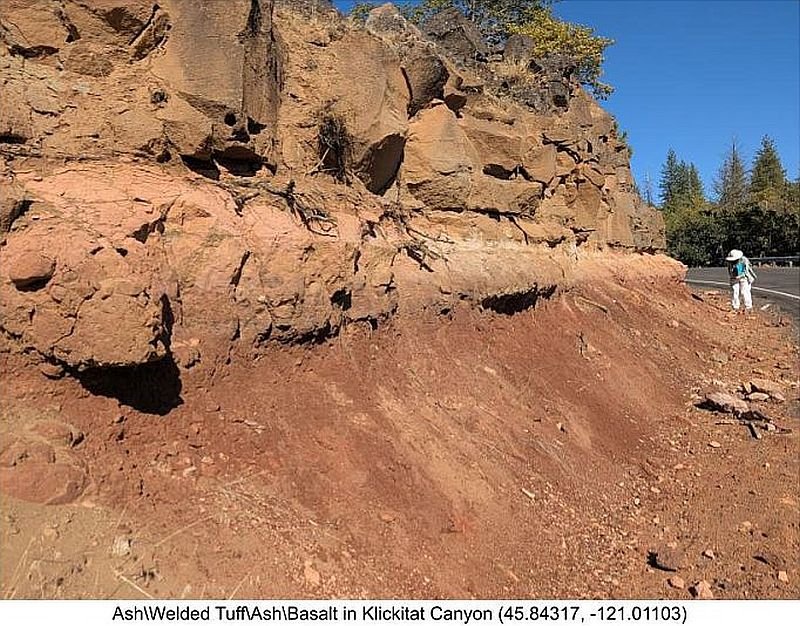 At first glance, it looks like a stacked sandwich of different rocks: a soft red layer on the bottom, a hard, overhanging brown to buff-colored middle layer, another soft, buff to pink-colored layer above that, and a thick cap of weathered basalt covering it all. But if you know how to read the rocks, this outcrop reveals a dramatic, step-by-step saga of fire, ash, and lava.
The story begins with a large volcanic eruption—likely from the nearby Mt. Adams area. As the eruption blasted into the sky, a scorching, high-speed cloud of gas and incandescent ash—known as an ignimbrite or pyroclastic flow—came racing downslope along a shallow channel on the surface of a thick air-fall ash deposit from an earlier eruption.
This avalanche of glowing ash was so hot that, as it roared down the shallow channel, it literally baked the soft ash layer underneath it, scorching it into a deep, rich red color. And as it finally settled, the flow was so hot that it fused its own ash particles into a tough, solid rock layer called welded tuff.
As the fiery tuff hardened, lighter ash from the eruption drifted down from the sky, forming a softer, buff-colored layer of air-fall ash on top of the welded tuff. Finally, a thick stream of molten basalt lava from the eruption slowly crept downslope and poured over the upper layer of air-fall ash, capping the entire pile with a heavy layer of dark, solid rock that slightly baked the air-fall ash directly beneath it.
This outcrop is special because it’s rare to find a single hillside outcrop that preserves every stage of an eruption so perfectly. In just one glance, this roadside outcrop captures the full timeline: from the initial superheated pyroclastic flow, to the gently falling air-fall ash, to the final cooling lava field. And the outcrop is a striking example of how the rocks can tell a story if you take the time to read it.
By Lloyd DeKay (editing assist by Gemini)