 Thousands of K-12 students across the Pacific Northwest are becoming Ice Age Floods detectives—investigating ancient catastrophic flooding, conducting hands-on experiments, and sharing geological discoveries with their communities. Some may be inspired to become scientists who will ask new questions and conduct research that will advance our understanding of these ancient megafloods.
This transformation is happening through Ice Age Floods Detectives, a new grade school science curriculum funded by the Ice Age Floods Institute (IAFI) and developed through partnership with the Ice Age Floods National Geologic Trail (NPS), and Engaging Every Student.
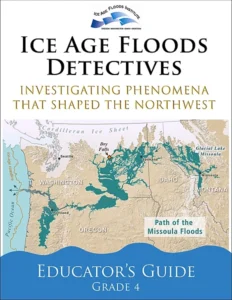
The Ice Age Floods Detectives program is comprised of four phenomena-based ~1-hour lessons, targeted to grade 4 but adaptable for grades 3–8, to be taught in order over a week or more.
Lesson 1: Modeling Ice Age Floods Erosion. Students create watershed models to visualize how water flows and reshapes the landscape.
Lesson 2: Investigating Deposition. Students observe how different rocks and landforms are created by deposition, connecting these small-scale experiments to the massive scale of the Ice Age Floods.
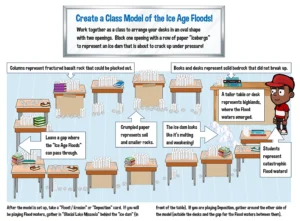
Lesson 3: Creating Kinesthetic Classroom Models. Students use physical movement and simple materials to model incredible scale of Ice Age flooding, weathering and erosion.
Lesson 4: Exploring the Erosion Energy of Moving Water. Students experiment with water speed and volume to understand its erosive forces and to practice designing scientific experiments.
Students will explore the scientific processes geologists use to make discoveries, and how the fascinating area of science—like most other disciplines—is dynamic and constantly changing. The lessons help students explore phenomena and investigate how they relate to observable geologic features. Students are gradually introduced to concepts, processes, and theories that will assist them in forming and revising their own explanations and hypotheses about the Ice Age Floods. These adaptable lessons help train students to be good scientists and critical thinkers, with a unifying theme of exploration and investigation.
When the lesson plans are delivered in sequence, a storyline develops, using the creation of our NW landforms as a compelling framework to help cover core concepts and improve student skills. Numerous studies have identified the need for improved STEAM (Science, Technology, Engineering, Arts, Mathematics) education that connects to students’ lives and communities. Research indicates that grades 4-6 are particularly critical for engaging students and encouraging them to pursue STEAM fields. Those grades are a particular focus of the program, which will help us address the critical need for more scientists and engineers. The curriculum complies with Next Generation Science Standards + Common Core State Standards, and should not compete with other curricular goals for classroom time. This program updates and complements the earlier NPS Investigating Ice Age Floods K-12 curriculum.
We’re bringing this curriculum to educators throughout Washington, Oregon, Idaho, and Montana through regional workshops. Ice Age Floods Institute has also established an IAFI K-12 Education Grant Program to help educators offset attendance costs and classroom implementation expenses. You can also help support the program and play a significant part in inspiring the next generation of scientists:
- Donate fee-free through our Zeffy Fundraiser or IAFI Gorge Chapter’s PayPal Giving Fund
- Share information and leads about potential funding sources— contact us at IAFIGrants@gmail.com
- Share this flyer with educators in your community to help spread the word