
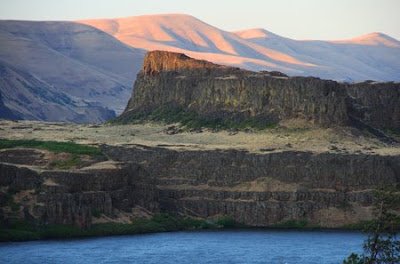
Jon Goodwin for KGW8
Horsethief Butte, part of Columbia Hills Historical State Park, is a rocky labyrinth of towering basalt formations, winding trails and unexpected views. It’s a place where the landscape tells a story millions of years in the making. The butte was formed by ancient lava flows and later shaped by the massive Ice Age floods that swept through the Columbia River Gorge. Today, its unusual rock formations make it a popular destination for hikers, photographers and rock climbers.
As I was arriving, I crossed paths with Susan Sieglein, visiting from Annapolis, Maryland. She was just finishing her exploration of the butte. “I love geology. I love the rock formations,” she said. And there’s certainly no shortage of those here. “You get little glimpses of Mount Hood and the Columbia River, as you go around different turns,” Sieglein said. “It’s like a labyrinth inside.”
The trails around Horsethief Butte are relatively short, but they offer plenty of opportunities to explore. Visitors can wind between imposing rock walls, navigate narrow passages and scramble over rocks for a different perspective of the surrounding landscape. A closer look at some of those rocks reveals another piece of the area’s geological history. Vesicular basalt, commonly found throughout the Gorge, is dotted with small holes created by gas bubbles trapped in molten lava as it cooled and hardened. Millions of years later, those bubbles remain preserved in solid stone. It’s a small reminder of the Gorge’s more turbulent times.
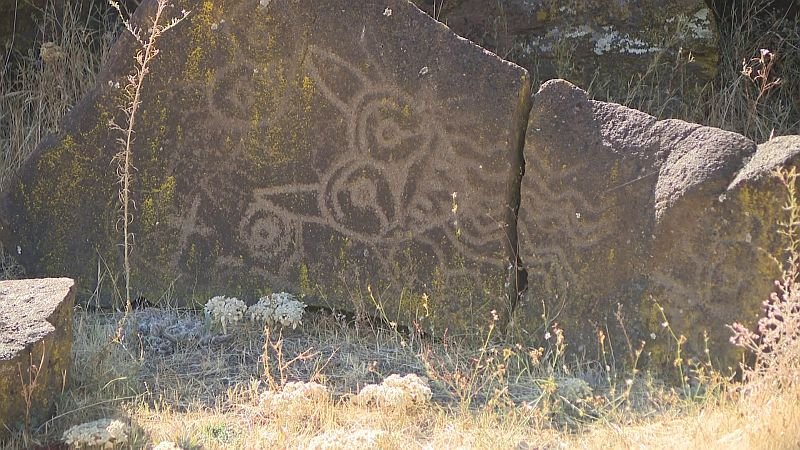
While Horsethief Butte’s geology is impressive, the surrounding landscape also holds deep cultural significance. For generations, Indigenous communities gathered along this stretch of the Columbia River to fish, trade and build connections. The river was an important center of life and commerce for Native peoples long before modern highways crossed the region. Nearby, at the Horsethief Lake section of Columbia Hills Historical State Park, visitors can see preserved examples of Indigenous rock art. The Temani Pesh-Wa display features petroglyphs and pictographs that were removed from their original locations in the 1950s, before rising waters behind The Dalles Dam submerged those sites. The rock art was eventually placed on public display in 2003, preserving an important connection to the people who lived along the Columbia River. Visitors can explore the relocated rock art display on their own during daylight hours from April through October. The park also offers guided tours to Tsagaglalal, commonly known as “She Who Watches,” one of the region’s most significant Indigenous rock images. Those tours are available by advance reservation on Fridays and Saturdays at 9 a.m. from April through October. Access to the site is restricted to guided tours to help protect the culturally significant artwork.
Back at the butte, the experience is a little more hands-on. Although the hiking distances are short, the terrain can be uneven, with loose rocks and sections that require careful footing. “Wear shoes that have a good grip. Take a walking stick if you can,” Sieglein advised. “Be careful on the loose rocks, but it’s nothing too crazy.”
The scenery here is a dramatic departure from the evergreen forests and lush landscapes farther west in the Gorge. Instead, visitors are surrounded by open skies, dry hillsides and rugged basalt cliffs. It’s a different kind of Pacific Northwest beauty, and one that Sieglein says shouldn’t be overlooked. For her, the appeal goes beyond the geology or the views. “It renews your soul. It really does,” she said. Sometimes, a change of scenery is all you need.
Reprinted, with respect, from KGW8