
Ice Age Floods in Western WA

The Mossback’s Northwest production team met in Thurston County last week to research some geological history. We learned that the Missoula Floods that scoured Eastern Washington weren’t the only massive, earth-shaping floods at the end of the last Ice Age some 15,000 years ago. The retreating Puget Lobe — the last ice sheet’s southern extension, which stopped just south of Olympia — sent massive flows south and west as it melted. But while retreating, the ice also blocked rivers flowing from Mount Rainier, like the Carbon and Puyallup. This created a series of glacial lakes which, when unblocked, periodically let loose with floods and debris flows, shaping the valleys and prairies of the region. We talked at length with geologist Patrick Pringle who has, with his research partner Barry Goldstein, studied this phenomenon. As a result of the floods, Pringle says, there is a lot of volcanic rock — from gravel to massive boulders — in the valleys of South Puget Sound that washed down from Tahoma. More on this is coming in Season 11 this fall. Reprinted from the Cascade PBS ‘The Mossback Den’ newsletter
Where (and When) Will Yellowstone Erupt Next?
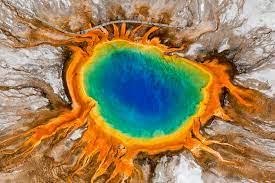
New research indicates it likely won’t blow today, but one region on Yellowstone’s northeastern side is likely to host liquid magma in the long term, possibly fueling future eruptions hundreds of thousands of years from now. Yellowstone’s melted magma lurks in four separate reservoirs within the crust of the caldera. The western reservoirs do not touch the deep mantle rocks that would heat them from below so they will likely start to cool and solidify. But to the northeast, mantle rocks are heating the magma trapped in the crust keeping them liquid and eruptable. Using measurements of earthquake waves and magnetotellurics (measurements of subterranean magma magnetic fields) researchers mapped four main hidden pockets of magma that together contain more liquid magma than was present during large, caldera-forming eruptions at Yellowstone in the past (2.8 MYA, 1.3 MYA and 640,000 years ago). These magma pockets rest as deep as about 6 or 7 miles below the surface, but only in the northeastern region of the caldera is the magma in touch with hot mantle rock that will keep the magma liquid in the long term. Despite the large volume of magma pooling below Yellowstone, the caldera isn’t likely to erupt anytime soon. The magma sits in pore spaces in solid rock, much like water in a sponge. The estimated fraction of magma filled pores is 20% or less, but only when more than 40% of pore spaces are filled can the magma link up, get mobile and start erupting. But that could change over tens of thousands of years as mantle rock warms the northeastern magma pools. Exactly how long that will take, or if it will happen before the mantle rocks in the northeastern region of Yellowstone lose contact with its magma reservoir, remains unknown. Condensed from a Live Science article by Stephanie Pappas
IAFI 2024 BRIEF YEAR-IN-REVIEW

This is a very short summary of our 2024 Year-in-Review report prepared for you, our members, who provide most of our support and much of the reason for the various materials, activities and events we provide. You can read the entire detailed report on our website. In 1996, we started with 11 members. At the end of 2024, we have 587 members in 20 US states, Canada and Germany. While we have over six hundred members, most of the work is done by a small number of people. All of your institute and chapter leaders are volunteers. We are always looking for people willing to work with us to help develop and conduct chapter programs. If you think you might be interested, please contact your chapter president or board members. All help is appreciated, both small and large. Our eleven local chapter’s lectures, field trips and hikes are possibly the most effective way we fulfill our mission to inform and educate the public about the Ice Age Floods and their long-lasting impact. IAFI projects at the Institute board level generally benefit more than one chapter or do work that all chapters might not be able to do by themselves. In 2024 we had 37 in-person lectures attended by over 1425 people with many more viewers on YouTube. In addition, our chapters conducted 22 field trips with 735 attendees and 7 hikes with 106 attendees. IAFI also shares resources and knowledge in collaborations and partnerships with over 30 other professional organizations, universities and state/federal agencies to present up-to-date information to our members and communities. IAFI is a non-profit organization supported by membership dues, donations, profit from field trips and store sales. Our funds are used for new and existing educational and informative materials and programs related to the Floods story, insurance, contract labor and to cover unplanned expenses. We appreciate your continued support, friendship and membership. Prepared January 4, 2025, by Gary Ford, IAFI President
Discovering the Telford Tract: A Hidden Gem in the Channeled Scablands

Traveling east along Lake Roosevelt from the Grand Coulee brings you closer to an area steeped in geological and historical intrigue. This journey not only unveils the legacy of ancient Glacial Lake Columbia but also leads to one of the most captivating sections of the Channeled Scablands: the Telford Tract. A critical player in the narrative of Ice Age floods, the Telford Tract offers a striking example of the power and scope of these ancient cataclysmic events. The Role of Glacial Lake Columbia The current Lake Roosevelt occupies much of the previous western Glacial Lake Columbia area, a massive lake formed when glacial ice blocked the Columbia River’s southwestward flow. The lake’s height and timing had a dramatic influence on the routes taken by the incoming Glacial Lake Missoula floodwaters. A portion of these immense floods, among the largest known in Earth’s history, surged south through the Telford region, carving canyons, depositing sediments, and shaping the land into what we now call the Channeled Scablands. J Harlen Bretz, the geologist who first described the scablands in detail, outlined these pathways or “tracts” in his seminal 1928 paper, The Channeled Scabland of Eastern Washington. Among the four major scabland tracts Bretz identified, the Telford-Crab Creek Tract is particularly significant for its geological features and historical context: “The Telford-Crab Creek scabland tract…heads in the vicinity of Telford station…as wide as the Cheney-Palouse River tract…convergence of all these (and of all but one of the Cheney-Palouse River divergences) occurs in a wide shallow structural sag (Quincy Basin) in the western part of the plateau. In this basin is the largest single area of gravel left by the glacial waters…There is continuous scabland northward from all channel heads of this tract across the plateau divide to the limits reached by the ice sheet.” Exploring the Telford Tract Today The Telford Tract, adjacent to the Lake Roosevelt National Recreation Area, provides an unparalleled opportunity to witness the scars of Ice Age floods. Once a 900-acre homestead, the tract’s eroded flood channels and gravel deposits serve as a testament to the massive forces that shaped this region. Managed by the Bureau of Land Management, the Telford Recreation Area invites visitors to explore this geological marvel. Hiking trails weave through remnants of these ancient waterways, offering a chance to immerse yourself in one of the major routes of the Missoula Floodwaters. Check out these resources to help plan your visit: BLM Telford Recreation Area and Washington Trails Association: Telford Recreation Area Beyond Telford: Exploring Upper Crab Creek For those looking to expand their journey through this region, the Telford Tract’s channels eventually connect to Crab Creek, another iconic feature shaped by glacial waters. The Upper Crab Creek Field Trip offers a deeper dive into this fascinating landscape, combining geological exploration with breathtaking scenery. In 2013 Karl Lillquist and Jack Powell created an Upper Crab Creek Field Trip guide for the Ellensburg Chapter of the Ice Age Floods Institute. A Landscape Worth Protecting The Telford Tract exemplifies the dynamic history of the Channeled Scablands and the profound environmental changes brought about by Ice Age floods. As part of the Ice Age Floods National Geologic Trail, this area’s preservation ensures that future generations can continue to learn from and appreciate its unique geological story. Whether you are a geology enthusiast, history buff, or outdoor adventurer, the Telford Tract promises an unforgettable experience. This landscape, shaped by forces beyond imagination, stands as a humbling reminder of nature’s power and its enduring impact on the Earth’s surface.
Geologists predict an Undersea volcano off the Oregon coast could erupt this year

Scientists say Axial, an undersea volcano off the coast of Oregon is probably going to erupt in 2025. The volcano, known as Axial, is a seamount 300 miles (480 kilometers) west of Cannon Beach, Oregon. The Axial seamount erupts regularly — it rumbled to life in 1998, 2011 and 2015, according to a blog by scientists monitoring the seamount — and it doesn’t pose a threat to people. But because of the seamount’s regular activity and its relative proximity to land, researchers made it the site of the world’s first underwater volcano observatory, known as the New Millennium Observatory. Now, the monitors at Axial are showing that the surface of the seamount is inflating — a sign of moving magma that likely presages an eruption, William Chadwick, a geologist at Oregon State University who studies the volcano and its nearby hydrothermal vents, reported at the annual meeting of the American Geophysical Union in December 2024. The volcano’s surface has now risen to 95% of what it was before the 2015 eruption, Chadwick reported. The activity follows a period of quiet between 2015 to 2023, during which the seamount barely budged. The new rise began in the fall of 2023 and increased in January 2024, with the ground moving upward at a rate of about 10 inches (25 centimeters) per year as of mid-2024. This inflation was accompanied by swarms of hundreds of small earthquakes. Since then, the inflation rate has stabilized, Chadwick reported in his blog. “The rate of inflation at Axial has been steady for the last 6 months and the rate of seismicity has moderated,” he wrote. “An eruption does not seem imminent, but it can’t do this forever.” He and his co-author Scott Nooner, a geophysicist at the University of North Carolina Wilmington suspect that the volcano will erupt before the end of 2025. The scientists are hopeful that their prediction is correct, because the well-monitored Axial is a promising location to work out the patterns a volcano experiences before eruption. The fact that the volcano has recently erupted several times over two decades – rather than once in centuries, like many volcanoes – makes discerning patterns easier. Researchers are also more comfortable offering tentative predictions for a volcano that doesn’t threaten life or property, because there are no downsides to being wrong. Volcanologists can currently make accurate short-term predictions of eruptions, but according to the Smithsonian Global Volcanism Program, predictions are rarely reliable more than a few days in advance. Reprinted from Live Science News, article By Stephanie Pappas
Ancient ‘land bridge’ that connected Siberia to US wasn’t what it seems
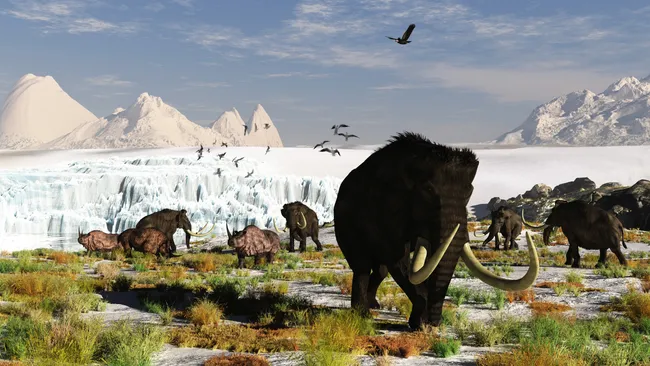
The boggy landscape of the Bering land bridge may have allowed some ice age animals to cross easily, while others stayed in Asia. The Bering land bridge that spanned between Siberia and Alaska during the Ice Age was more of a Bering land bog, new research finds. The discovery could help explain why some animals, such as birds, easily crossed the land bridge, while others, like woolly rhinos (Coelodonta antiquitatis), didn’t make the migration. The land bridge, now submerged under the Bering Strait between Alaska and Russia, was above water from about 36,000 years ago to 11,000 years ago. Scientists thought it might have looked a lot like the grassy, arid steppe landscape in Siberia and Alaska at the time — but no one had ever investigated the ocean floor where the “bridge” once stood. Last year, researchers led by University of Alaska Fairbanks geologist Sarah Fowell set out on the research vessel Sikuliaq to extract cores of sediment from the floor of the Bering Sea. It was the first attempt to reconstruct the ancient landscape and climate of the land bridge. The researchers presented their results today (Dec. 10) at the annual meeting of the American Geophysical Union in Washington, D.C. Instead of a grassy steppe, they found a marshy landscape crisscrossed by rivers and dotted with little lakes. “We were looking for several large lakes,” Fowell said. “What we actually found was evidence of lots of small lakes and river channels.” Lake sediments were apparent in the ocean floor cores, as were pollen, small fossils, ancient DNA and organic matter. The pollen and fossils revealed that the landscape hosted trees and mosses. The researchers also found egg cases from water fleas (Daphnia), a freshwater crustacean. This marshy environment may have been particularly welcoming for some species such as birds, but there were also spots where there was evidence of larger mammals making the migration. One site hosted mammoth DNA. Bison are also known to have crossed from Eurasia to North America during the time that the land bridge existed, and horses are known to have made it from North America to Eurasia. “Even if it was mostly floodplains and ponds, the grazers were around, just uphill following higher, drier areas,” Fowell said. However, the environment may have been less conducive for species that did not make the move between continents, such as the woolly rhino (a Eurasian native), American camel (native to north and central America), and the short-faced bear (native to North America). “The watery, wet landscape could have been a barrier for some species,” said Jenna Hill, a geologist with the U.S. Geological Survey who is also presenting research on the Bering Sea core data at the AGU meeting, “or a pathway for species that actually travel by water.” Further research will be needed to understand the full impact of the environment on migration. Republished from an article by Stephanie Pappas in Live Science
Explore Lake Roosevelt National Recreation Area

The Lake Roosevelt National Recreation Area serves as a striking landmark that narrates a dramatic geological history shaped by colossal natural forces. Greatly influenced by the Missoula Floods, this area, part of the Ice Age Floods National Geologic Trail, reveals not only stunning landscapes but also insights into the Earth’s geological story. Understanding this region offers a glimpse into the powerful events that occurred between 13,500 and 18,500 years ago, as well as the enduring environmental significance of these features. Lake Roosevelt and Grand Coulee Dam Lake Roosevelt, created by the Grand Coulee Dam in the 1930s, serves multiple purposes: from water storage and hydroelectric power generation to recreation and wildlife preservation. The lake provides a crucial habitat for various species and supports a vibrant ecosystem and is home to a range of fish species, including walleye, rainbow trout, and Kokanee salmon. The surrounding lands offer habitats for birds and other wildlife, contributing to ecological balance. With over 400 miles of scenic shoreline, the 150 mile long goes from Grand Coulee nearly to the Canadian board and is a haven for outdoor enthusiasts. The lake offers expansive waters perfect for various forms of boating. Anglers can enjoy abundant fishing opportunities year-round. 32 different campgrounds such as Spring Canyon close to Grand Coulee, WA offer numerous places to extend your overnight stays with these stunning landscapes. Historical Heritage The Lake Roosevelt area holds historical significance for the Confederated Tribes of the Colville Reservation and the Spokane Tribe of Indians, highlighting the intertwined relationship between Native heritage and the natural landscape. The National Park Service (NPS) supports Bureau of Reclamation management of Bakes Lake, Coulee Dam, and Lake Roosevelt. NPS works with Washington State Parks throughout the Grand Coulee Corridor and along with the Tribes and Washington Department of Natural Resources, oversees recreation on the water and lands of Lake Roosevelt NRA. Our collective efforts work to ensure that these natural treasures are preserved for future generations. Visitors to the area can engage with a variety of programs and informational resources that enhance their understanding and respect for the environment. Power in Nature The Grand Coulee and Lake Roosevelt National Recreation Area stand as remarkable examples of nature’s power and the intricate tapestry of geological history. From the cataclysmic Missoula Floods that sculpted the landscape to the thriving ecosystems supported by Lake Roosevelt, this region offers an unparalleled opportunity for exploration and discovery. Whether you are an avid hiker, a passionate angler, or a curious geology enthusiast, this area provides not only recreational activities but also a deeper connection to the Earth’s history. As we delve into the breathtaking scenery and rich cultural heritage of this national recreation area, we are reminded of the dynamic forces that shape our world. The Grand Coulee and Lake Roosevelt invite each visitor to engage with the past while understanding the importance of stewardship for future generations. This stunning landscape not only captivates the eye; it expands our knowledge of nature and our place within Ice Age Floods National Geologic Trail.
Coyote Canyon Mammoth Dig

The Coyote Canyon Mammoth Dig is an active paleontological excavation site in the Horse Heaven Hills near Kennewick, Washington. It’s a significant project that sheds light on the history of the Ice Age floods in the Tri-Cities area. The dig focuses on the unearthed remains of a Columbian mammoth that lived approximately 17,500 years ago. The mammoth’s carcass was buried in Touchet beds, a geological formation laid down by ancient floods. The site sits at an elevation of 1040 feet above sea level, which is considerably higher than the current elevation of the Columbia River, which is only 350 feet above sea level about 7 miles north. Scientists estimate that Lake Lewis, a massive glacial lake that existed during the Ice Age, reached a maximum surface elevation of over 1200 feet above sea level at the time the mammoth perished. This substantial difference in elevation hints at the immense power of the Ice Age floods that swept across the region. Another fascinating aspect of the Coyote Canyon Mammoth Dig is the discovery of a vast pile of erratic rocks. Initially thought to be a small cluster, the collection of these displaced rocks has grown to extend into several adjacent dig units. A dig unit, for those unfamiliar with archaeological and paleontological fieldwork, is a standardized square measuring 2 meters by 2 meters that archaeologists and paleontologists use to meticulously excavate and collect data. The MCBones Research Center, a non-profit organization, spearheads the Coyote Canyon Mammoth Dig. They offer educational tours for schools and other groups, providing a firsthand look at this significant paleontological excavation. These tours are a great opportunity to learn more about the Ice Age floods, mammoths, and the meticulous work of paleontologists. For more information about the Coyote Canyon Mammoth Dig, including details about tours, visit the MCBones Research Center website at www.mcbones.org.
Volunteers Help Shape the IAFI!

We’re reaching out to ask for your help. As we work toward our mission of promoting public awareness and education about the Ice Age Floods, our chapters have been facing a significant challenge: a shortage of active member volunteers willing to step into leadership roles or assist with essential chapter functions. Many of our current leaders are in their 70s and 80s, and the demands of their roles are becoming challenging. While our dedicated leaders works to maintain our organization’s momentum, we need support to ensure our continued growth and success. Your involvement will be crucial in helping to: Organize events: Assist with planning field trips, chapter functions, and speaker series. Provide administrative support: Help with recordkeeping, website updates, and newsletter contributions. Engage with the community: Connect with local schools and media outlets to spread awareness about our mission. Contribute fresh perspectives: Share your ideas and expertise to help us adapt to a changing world. Here are some ways you can get involved: Volunteer for events: Help plan and execute field trips, workshops, and conferences. Join a committee: Contribute to our leadership team and help make important decisions. Share your expertise: Offer your skills in areas like marketing, communications, or technology. By becoming more involved, you can: Strengthen your chapter: Contribute your time and skills to make your local chapter more vibrant and effective. Share your knowledge: Bring new ideas and contemporary skills to our organization. Support the organization: Help IAFI achieve its goals and become the foremost provider of Ice Age Floods information. No matter your level of experience or commitment, we welcome your participation. Whether you can volunteer a few hours a month or are interested in taking on a leadership role, your involvement will make a significant difference. The involvement of many will lighten the load on the few, and also bring a much-needed infusion of energy and fresh perspectives. We believe that by working together, we can strengthen our organization and better serve our mission of promoting public awareness and education about the Ice Age Floods. Your participation is essential. To get involved, please contact your local chapter through the IAFI.org website
Bitterroot Valley Glacial Erratics
Two glacial erratics in the Bitterroot Valley, the Lone Rock School erratic and the Rome Lane erratic, were deposited during the last high stand of Lake Missoula about 13,000 years ago. Both these glacial erratics are easy to visit. At the extreme Southern end of the Bitterroot Valley is beautiful Lake Como named after its Italian alpine counter part by Father Ravalli a Jesuit Black Robe tasked with bringing literacy and Jesus to the native Salish people in 1845 via St Mary’s Mission in nearby Stevensville. Lake Como is a beautiful place for lunch and a hike/bike on the trail around lake including a beautiful waterfall a the head of the lake. Several mountain glaciers coalesced here and neighboring drainage to make the largest mass of ice calving into the lake south of the Flathead lobe of the Cordilleran ice sheet at Polson. This mass exited the mountains, floated into and calved into Glacial Lake Missoula. This was the primary iceberg generator for the Bitterroot Valley. As they floated out into the lake and melted they dropped large rocks called erratic onto the lake floor, which is now the surface of the valley. Lone Rock School Erratic The easiest one to find is the Lone Rock School erratic. From Stevensville, proceed north on the Eastside Highway, county road 269, to the junction with county road 268, turn right. Follow county road 268 until you reach the Lone Rock School on your left; the erratic is the large boulder in front of the south side of the school, and behind the fence (see map below). The Lone Rock School erratic is 69” tall, 58” wide, 85” long, and weighs in at about 8.5 metric tons or about 18,700 lbs. This large erratic is a type of granite called quartz monzonite. The minerals that make up this rock type are, in order of abundance, plagioclase (calcium and/or sodium rich) feldspar, orthoclase (potassium rich) feldspar, biotite (dark mica), and quartz. If you look closely you will see that the quartz typically stands out in relief with respect to the other minerals and that its surface has been polished to a smooth finish. This is the result of dense glacial ice grinding over the surface of the rock. Rome Lane Erratic The Rome Lane erratic measures 47” tall, 117” long, 96” wide, and weighs in at about 13 metric tons or about 28,600 lbs. The Rome Lane erratic is almost identical to the Lone Rock School erratic; it to is quartz monzonite granite with approximately the same minerals and mineral proportions. The observation that both erratics are of similar rock type suggests that they came from a similar source region. There are sources of quartz monzonite granite in both the Sapphire and Bitterroot Mountains, which is the source of these erratics? Since we know that the erratics were carried to the shores of glacial Lake Missoula by glaciers, we can rule out the Sapphires as a possible source because we know that no glaciers in the Sapphire Mountains ever reached the shores of Lake Missoula. So, the erratics had to come from the Bitterroot Mountains where the quartz monzonite granite lies anywhere between 5 and 20 miles from the ancient shoreline of Lake Missoula. That means glaciers carried the erratics for distances of up to 20 miles (32.2 km) before reaching the shores of glacial Lake Missoula. Which at an average velocity of 5 meters per day (normal for most valley glaciers with the exception of rare bursts in velocity up to 75 meters per day) would take about 18 years. Which Erratic is Oldest? The quartz grains on the surfaces of the Rome Lane erratic are polished to a smooth shine and stand out in relief above the other minerals, similar to the Lone Rock School erratic. However, the quartz grains exposed on the top surface of the Rome Lane erratic seem to exhibit higher relief than the quartz grains exposed on any other side of the Rome Lane erratic and/or the top surface of the Lone Rock School erratic. Why is this? Rainwater is slightly acidic and acidic fluids can break down some minerals, such as feldspar, and turn them into clay. Quartz, however, is very resistant to acidic fluids and as a result takes longer to break down or weather. It is this difference in weathering rates between feldspar and quartz that causes the quartz grains to stand higher than the feldspar grains. So, based on this relationship we can say that the greater the relief between quartz and feldspar on a rock surface, the longer that surface has been exposed to the elements i.e. rain and wind. With that in mind, which erratic’s top surface has been exposed longer? If you answered Lone Rock, you are correct. As it turns out the Lone Rock School erratic was dug up and moved from its original location, about ¾ of a mile to the south of where it sits today, to commemorate the Lone Rock Schools’ centennial in 1985, in fact upon its excavation portions of the erratic broke off and remain buried. So what is the top surface of the Lone Rock School erratic today may well not have been the top surface before 1985, and our mineral weathering hypothesis fits the facts.