Woolly Mammoths’s Steps Retraced Based on Chemistry of 14,000-year-old Tusk
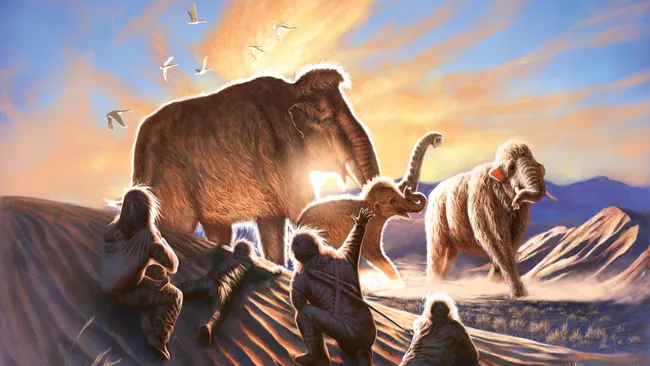
New analysis of a 14,000-year-old woolly mammoth tusk has pieced together the life of a female mammoth that likely died at the hands of hunters close to Alaska’s oldest archaeological site. Scientists have retraced the journey of a female woolly mammoth from her birthplace in present-day Canada to eastern central Alaska, where she met her end around 14,000 years ago at the hands of hunter-gatherers. The mammoth, whose name Élmayuujey’eh translates to “hella lookin” in the aboriginal Kaska language, was likely killed by early Beringian hunter-gatherers when she was 20 years old. Her existence is known thanks to a complete tusk discovered at Swan Point, one of the oldest archaeological sites in the Americas. Élmayuujey’eh, or Elma for short, was born toward the end of the last ice age in what is now the Canadian province of the Yukon, where she likely stayed for the first decade of her life. A new analysis of the mammoth’s tusk suggests she then set off across the frozen landscape, covering roughly 620 miles (1,000 kilometers) in under three years. “That’s a huge amount of movement for a single mammoth,” study co-author Hendrik Poinar, a professor of anthropology at McMaster University in Canada and the director of the McMaster Ancient DNA Center, said in a video released by the university. Elma trekked all the way into Alaska and eventually slowed down, Poinar said. Her remains indicate she was closely related to both a juvenile and a newborn woolly mammoth whose bones were also unearthed at Swan Point. The trio may have belonged to one of two matriarchal herds that roamed an area within 6.2 miles (10 km) of Swan Point, according to the study, published Wednesday (Jan. 17) in the journal Science Advances. To piece Elma’s life together, researchers split her tusk lengthwise and examined thin layers of ivory that formed like the rings of a tree trunk throughout her years. The proportion of different versions of chemical elements, or isotopes, in these layers contained valuable information about the mammoth’s diet and location, enabling the team to retrace her steps. The researchers also analyzed ancient DNA in Elma’s tusk and compared it with the remains of eight other woolly mammoths found in and around Swan Point, including the two youngsters. Their results revealed the mammoths belonged to at least two distinct herds that may have gathered in the region along with other mammoth herds — a congregation that would have attracted humans. “Indigenous hunters clearly saw that the mammoths were using this as a really important location for feeding,” Poinar said in the video. “The data to me suggest that these were Indigenous people that appreciated, looked at, loved these phenomenal beasts walking on this landscape. But it would make sense too, that in times of need, that you would kill them — a mammoth like that could provide food for a huge number of people over a long period of time.” Elma’s remains indicate she was in the prime of early adulthood and well nourished at the time of her death. She likely died in late summer or early autumn, which coincides with when humans would have set up their seasonal hunting camp at Swan Point and suggests she died at the hands of hunters, according to the study. Very little is known about the geographic movements and behaviors of woolly mammoths — or about how these animals interacted with early Americans — but stories like Elma’s can paint us a picture. “This analysis of lifetime movements can really help with our understanding of how people and mammoths lived in these areas,” co-author Tyler Murchie, a postdoctoral researcher and former member of the MacMaster Ancient DNA Center, said in a statement. “We can continue to significantly expand our genetic understanding of the past, and to address more nuanced questions of how mammoths moved, how they were related to one another and how that all connects to ancient people.” Reprinted from a Live Science article by Sascha Pare
IAFI 2023 YEAR-IN-REVIEW

A summary for our members and other interested people By Gary Ford, IAFI President, January 12, 2024 This is our 7th year preparing a Year-in-Review report for you, our members. We appreciate your continued support, friendship and membership. INSTITUTE MEMBERSHIP Our members provide most of our support and much of the reason for the various materials, activities and events we provide. In 1996, we started with 11 members. At the end of 2023, as we continue to recover from the pandemic, we have 648 members (489 memberships) from 20 states, British Columbia, Canada and Germany. INSTITUTE BOARD PROJECTS IAFI work activities occur at both the Institute Board of Director level and at the Chapter level. Projects at the Institute board level generally benefit more than one chapter or do work that all chapters might not be able to do by themselves. Listed below are some of the recent projects the Institute Board of Directors has worked on. The Education Committee is working with a contractor to develop three 20-minute floods videos for a 4th grade audience The Membership Committee is developing a catalog of speakers for the chapters to use for their member programs. A new membership tracking system has been developed which makes it easier to take care of our members. The Trail Advocacy Committee works closely with the National Park Service (NPS) Program Manager for the Ice Age Floods National Geologic Trail. The intent is to help the Trail Manager with projects related to the development of the Trail. We assisted with three NPS Sponsored Teacher Workshops this year: two in the Tri-Cities area and one in Spokane. Website and Newsletter: Our webmaster keeps our website (iafi.org) fresh and stimulating. He also, with support from the chapters, issues the Pleistocene Post Newsletter four times a year. ANNUAL MEMBERSHIP MEETING This year we had our first annual membership meeting and field trip since the pandemic started back in 2020. It was sponsored by the Puget Lobe Chapter with major assistance from the Lower Grand Coulee Chapter and was held in the Sun Lakes State Park area. Click here for a summary. 2023 CHAPTER PROGRAMS Outreach to inform and educate the public about the Ice Age Floods and their long-lasting impact on our area is a key part of the IAFI mission. Our local chapter programs are possibly the most effective way we meet this challenge. Three of the more important ways we help people learn about the Ice Age Floods are with lectures, field trips and hikes. Lectures – As we have moved beyond the pandemic, we have been able to again offer more in-person lectures with some viewed Zoom presentations. We had 50 in-person lectures attended by over 1642 people. Many more people viewed these lectures when they were posted on YouTube. Field Trips – We conducted 21 field trips with 586 attendees. Hikes – Three chapters sponsored 13 hikes with 163 attendees. CHAPTER PRESENTATIONS TO SCHOOL GROUPS AND SCIENTIFIC ORGANIZATIONS Lake Lewis Chapter: A number of people from the Lake Lewis Chapter help with education programs at The Coyote Canyon Mammoth Site (MCBONES) near Kennewick. Between April and October 2023, McBones hosted school classes or home school groups on 58 days, participated in 12 STEM (Science/Technology/Engineering/Math) events at elementary, middle and high schools, conducted 40 group tours, hosted 12 public tours, and did 7 youth group tours. That means that 1853 adults and 2242 kids were exposed to the story of MCBONES’ Coyote Canyon Mammoth Site and the ice age floods in 2023. Each presentation included the story of the floods usually including the IAFI map of the floods region. The connections between the floods and the mammoth are that the mammoth was buried in several layers of floods sediment (Touchet beds). There are erratic pebbles buried among the bones and the elevation of the bone bed is just over 1000 feet above sea level (about 650 feet higher than the Columbia River at the Tri-Cities). The calibrated radiocarbon date of death of the mammoth is approximately 17,449 years before present. We are studying the death and burial of a Columbian mammoth. We can’t tell people about that without including the floods story. This is a “Who Done It” story, and we have a suspect. Cheney-Spokane Chapter gave a talk to 84 sixth graders at Jefferson Elementary School in Spokane, WA. Also, conducted a program at STEM in March with 367 students. Glacial Lake Missoula Chapter helped with a Bozeman Science Camp. Had a day of classroom activities that discussed glaciers, ice ages, landscapes, climate change. Field trip day featuring Lake Missoula impacts to modern landscapes. Palouse Falls Chapter hosted the Geological Society of Oregon Country for three lectures and three days of touring about 600 miles of the channeled scablands. Had an information booth at STEAM (Science/Technology/Engineering/Arts/Math) night at Colton School. Lower Grand Coulee Chapter assisted with a geology presentation at the Ice Age Floods Fest at Dry Falls aimed at educating children on the Ice Age Floods story (350+ attendees) CHAPTER PRESENTATIONS AT COMMUNITY EVENTS Cheney-Spokane Chapter talked with 102 people at Spokane Outdoor Expo. Talked with 128 people at the Blue Waters Bluegrass Festival, Medical Lake, WA. Glacial Lake Missoula Chapter presented program to Five Valleys Land Trust banquet. Took Wildlife Film Festival Film makers on eastern loop. Featured lake Missoula Story at all stops. Featured Glacial country scenery shots. Columbia River Gorge Chapter made presentations to visiting Polish and German Marshall Fund delegations and led donated field trips for Bingen-White Salmon Rotary and Skyline Health Foundation. Lower Grand Coulee Chapter had a booth at the Quincy Farmer Consumer Awareness Day with IAFI talks and tours, videos and information displays. 250+ attendees. Palouse Falls Chapter conducted a tour at the Sandhill Crane Festival, had a booth at both the Wheatland Fair and the Palouse Empire Fair. Wenatchee Chapter participated in FCAD Farmer Consumer Awareness days in Quincy; also made a presentation at a Master Gardener Conference, 89 attendees. CHAPTER MEMBERSHIP APPRECIATION EVENTS Our members
Hello from the Ice Age Floods National Geologic Trail

Hello from the Trail. Congress created Ice Age Floods National Geologic Trail to educate visitors on the story of massive flooding towards the end of the last Ice Age in the Northwest. Its primary function is to grow connections between like-minded organizations and to increase public awareness and understanding across the four-state region. The Trail made progress during 2023, and some of the highlights include the development of our web-based interactive map, including an additional 70 flood site locations in our GIS database. Last year, we also joined fellow floods enthusiasts at multiple events, including the Ice Age Floods Institutes annual member meeting, the US Geological Society of America’s Penrose conference on glacial lake outburst floods, and numerous festivals and trade shows across the region. 2024 is shaping up to be another great year of sharing the story of the floods. We are looking forward to several trade show events in the Spokane area this winter, along with the Sandhill Crane Festival in March. This would be a great time to try out the NPS App. The Columbia Nation Wildlife Refuge includes Drumheller Channels Nation Natural Landmark, and the NPS App can help you navigate this area to features important to the Ice Age floods story. There are many unique places along the Ice Age Floods National Geologic Trail, and the Drumheller Channels are one of my favorites. I’ve had the chance to travel through sections of this magnificent landscape a couple of times and always find something new. Drumheller Channels are, for sure, part of the Channeled Scablands of Central and Eastern Washington State. This butte and basin landscape had as much as 400 feet of sedimentary and volcanic basement rocks torn away by the Missoula Floods, creating nine massive channels. Be sure to think about coming out to the Othello Sandhill Crane Festival March 22-24, 2024, where you can have some fun celebrating the return of 35,000 sandhill cranes and see the landscape that was forever changed by the Ice Age floods. As always, see you out on the Trail.
NORTH AMERICA’S FIRST PEOPLE MAY HAVE ARRIVED BY SEA ICE HIGHWAY

NEW RESEARCH SUGGESTS SOME EARLY AMERICANS MAY HAVE TRAVELED ON WINTER SEA ICE DOWN THE COAST FROM BERINGIA AS LONG AS 24,000 YEARS AGO One of the hottest debates in archeology is how and when humans first arrived in North America. Archaeologists have traditionally argued that people walked through an ice-free corridor that briefly opened between ice sheets an estimated 13,000 years ago. But a growing number of archeological and genetic finds — including human footprints in New Mexico dated to around 23,000 years old — suggests that people made their way onto the continent much earlier. These early Americans likely traveled along the Pacific coastline from Beringia, the land bridge between Asia and North America that emerged during the last glacial maximum when ice sheets bound up large amounts of water, causing sea levels to fall. Now, in research to be presented Friday, 15 December at the American Geophysical Union Annual Meeting (AGU23) in San Franciso, paleoclimate reconstructions of the Pacific Northwest hint that sea ice may have been one way for people to move farther south. The idea that early Americans may have traveled along the Pacific Coast isn’t new. People were likely south of the massive ice sheets that once covered much of the continent by at least 16,000 years ago. Given that the ice-free corridor wouldn’t be open for thousands of years before these early arrivals, scientists instead proposed that people may have moved along a “kelp highway,” where early Americans slowly traveled down into North America in boats, following the bountiful goods found in coastal waters. Archeologists have found evidence of coastal settlements in western Canada dating from as early as 14,000 years ago. But in 2020, researchers noted that freshwater from melting glaciers at the time may have created a strong current that would make it difficult for people to travel along the coast. Ice highway over dangerous waters To get a fuller picture of ocean conditions during these crucial windows of human migration, Summer Praetorius of the US Geological Survey and her colleagues looked at climate proxies in ocean sediment along the coast. Most of the data came from tiny, fossilized plankton. Their abundance and chemistry help scientists reconstruct ocean temperatures, salinity and sea ice cover. Praetorious’ presentation is part of a session on the climate history and geology of Beringia and the North Pacific during the Pleistocene at AGU23. The week-long conference has brought 24,000 experts from across the spectrum of the Earth and space sciences to San Francisco this year and connected 3,000 online attendees. Praetorious’ team used climate models and found that ocean currents were more than twice the strength they are today during the height of the last glacial maximum around 20,000 years ago due to glacial winds and lower sea levels. While not impossible to paddle against, these conditions would have made traveling by boat very difficult, Praetorius said. However, the records also showed that much of the area was home to winter sea ice until around 15,000 years ago. As a cold-adapted people, “rather than having to paddle against this horrible glacial current, maybe they were using the sea ice as a platform,” Praetorius said. Arctic people today travel along sea ice on dog sleds and snow mobiles. Early Americans may also have used the ‘sea ice highway’ to get around and hunt marine mammals, slowly making their way into North America in the process, Praetorius said. The climate data suggest conditions along the coastal route may have been conducive to migration between 24,500-22,000 years ago and 16,400-14,800 years ago, possibly aided by the presence of winter sea ice. While proving that people were using sea ice to travel will be tricky given most of the archeological sites are underwater, the idea provides a new framework for understanding how humans may have arrived in North America without a land bridge or easy ocean travel. And the sea ice highway isn’t mutually exclusive with other human migrations further down the line, Praetorius said. The team’s models show the Alaskan current had calmed down by 14,000 years ago, making it easier for people to travel by boat along the coast. “Nothing is off the table,” she said. “We will always be surprised by ancient human ingenuity.” Reprinted from American Geophysical Union web article
Geographia: An Ancient Blueprint for Mapmaking

Many of history’s major breakthroughs were made by great thinkers standing on the shoulders of other intellectual giants, and Ptolemy’s Geographia, which builds on the scientific advancements of ancient Greek scholars, is no exception. The ancient Greeks were particularly skilled at understanding the world around them. By the fifth century BCE, the famous mathematician Pythagoras understood that the Earth was round, and it wasn’t long before Eratosthenes, another Greek scholar, accurately calculated the planet’s circumference. Centuries later, the Egyptian Greek scholar Ptolemy channeled all these scientific advancements into his masterwork, a collection of maps known as Geographia. Created around the year 150 CE, the eight-volume atlas served as a blueprint for mapmaking during the time of the Roman Empire. Ptolemy detailed the process of projecting a globe-shaped object onto a two-dimensional map, and pinpointed some 8,000 locations throughout Eurasia and northern Africa. He borrowed the concept of longitude and latitude from his mapmaking contemporary Marinus of Tyre, and built on it to make his own lasting contributions to cartography. Ptolemy’s work fueled many of the maps to come during the Islamic Golden Age and Europe’s Renaissance era. Reprinted from HistoryFacts.com article
The Bretz Journals and Google Earth

If you have been following Professor Nick Zentner (CWU) on YouTube, you may know that one of the treasures he has uncovered with the help of collaborators are the Bretz journals from field research done from 1919 through 1929. After Bretz’s death in 1981, his family donated his papers to the University of Chicago Library and though they were available to the public, access was very limited. Just recently Professor Zentner was able to obtain whole-hearted permission from Bretz’s family to share them more widely. Because of this, scans have been made of the journals and PDF’s are now available on Nick’s website for viewing and downloading. In November, 2023 Nick began a new series called “Ice Age Floods A to Z.” (The videos are recorded and can be viewed on YouTube.) During session I, Nick invited viewer Glenn Cruickshank (Liberty Lake, WA) to share about how to use Google Earth to view the travels of J Harlen Bretz based on his field journals. Glenn had the idea that he could transfer Bretz journal locations to Google Earth; in doing so he has created files for each of the Bretz’s years in the Northwest! All of Glenn’s work has been linked on Nick Zentner’s website. Using Google Earth with Glenn’s files, a marker appears on the map for each location that Bretz visited during a particular year and includes a snippet of his notes. The map points are all identified by year and by journal page. Not only can you zoom into the satellite images, but you can also use the ‘Street View’ feature to see various outcrops along roads that still exist today. Google Earth is a free program and can be used on the web, or as an app you can download for a mobile phone, tablet, or your computer (PC, Mac, or Linux). It is similar to Google Maps, but with many more capabilities. If you are just getting started with it, you may want to check out one of the many beginner tutorials on YouTube. Glenn has included step by step instructions on how to load the Bretz Files into Google Earth from Nick’s site. Using the journals and Glenn’s Google Earth files, you can follow along with Bretz’s field travels year by year.
Ice Age Floods A to Z Series

Ice Age Floods A to Z by Nick Zentner Our good friend Professor Nick Zentner (Central Washington University) recently started a new series on his YouTube channel called ICE AGE FLOODS A-Z. It is being live-streamed Thursday at 12:00 pm and every Sunday at 9:00 am Pacific Time. The series is also being recorded so that it can be watched anytime. Sessions A-H (streamed and recorded in November and December) have set the stage leading up to the time of J Harlen Bretz, covering Bretz’s predecessors and mentors (Israel C. Russell, Bailey Willis) and some of Bretz’s journey from starting out as a biology major and later becoming a geologist, and the chance meeting that propelled him to come to the Northwest. Special guests have included Jerome Lesemann, Skye Cooley, Joel Gombiner, and Glenn Cruickshank.
Journey Through Time: Explore Drumheller Channels

Nestled in the heart of Washington state, the Drumheller Channels offer a unique glimpse into earth’s history, carved by the immense power of Ice Age Floods. This National Natural Landmark is a must-visit for anyone seeking breathtaking landscapes, remarkable geological formations, and a chance to understand the power of nature. Witness the Scars of Ancient Floods: Drumheller Channels are a remarkable example of the Channeled Scablands, a vast landscape sculpted by cataclysmic floods that roared across the region millennia ago. Hike or bike through dry riverbeds, past towering basalt cliffs, and over rolling hills, all remnants of these powerful events. Imagining the colossal force of water that once flowed through these channels is an awe-inspiring experience. Explore Diverse Landscapes: The Channels offer a variety of landscapes, each offering its own unique charm. Hike along the McManamon Trail for panoramic vistas of the Scablands, or venture into the Crab Creek Unit to discover hidden waterfalls and basalt columns. For a unique perspective, climb to the top of “Nick’s Columns” and marvel at the vastness of the Channeled Scablands. A Haven for Wildlife: The diverse ecosystem within the Drumheller Channels provides a sanctuary for various wildlife species. Birdwatchers can spot over 23 species of ducks and geese, while sharp-eyed visitors may catch a glimpse of deer, coyotes, and even bald eagles. The Channels are also a vital nesting ground for many birds, making it a crucial habitat for preserving regional biodiversity. Connect with the Past: Explore the fascinating human history of the Drumheller Channels. The region has been inhabited for thousands of years, with evidence of Native American presence found throughout the area. Learn about the early settlers who braved the rugged landscape and contributed to the development of the region. A Place for Recreation and Reflection: Whether you’re an avid hiker, a passionate photographer, or simply seeking a peaceful escape, Drumheller Channels has something for everyone. Hike through scenic trails, enjoy a picnic amidst the breathtaking scenery, or simply relax and soak in the tranquility of nature. Plan Your Visit: The Drumheller Channels are open year-round and offer free access. Several trailheads provide easy access to various sections of the Channels. The Ice Age Floods Institute offers valuable resources, including maps, trail descriptions, and educational information. Be sure to pack sturdy shoes, appropriate clothing for the weather, and plenty of water for your adventure. Come experience the grandeur and wonder of the Drumheller Channels. Witness the power of nature etched into the landscape, explore the diverse ecosystem, and connect with the rich history of this remarkable place. It’s a journey through time that will leave you with a lasting sense of awe and appreciation for the natural world.
Recording of Erratics’ October 10 program, “Reading the Okanogan Lobe Glacial Landscape”

Because of problems with the Zoom broadcast of the Erratics’ October 10th program, Ralph Dawes graciously recorded for us his talk, “Glaciated landscapes that formed beneath the Okanogan Lobe of the Cordilleran Ice Sheet,” so that we could all enjoy it. Or re-enjoy it. He talks through the slide show, with all the illustrations showing up clear and supportive. The video software lets you view the slides full size, or the slides plus a table of contents at the side, if you click in the right places.You can watch at 1.5x speed by clicking on the gear icon lower right, if you want to hurry along to topics of interest (that appear in the side bar). You can also pause the video to study individual figures. The recording is hosted on a server Wenatchee Valley College provides for faculty to store teaching videos that are retained for the foreseeable future. The video is set to be open to anybody, no password needed. https://wvc.hosted.panopto.com/Panopto/Pages/Viewer.aspx?id=5105f23e-e869-4909-b7b8-b0b10002f143 Here is also a link to the YouTube version: https://youtu.be/1A2hkmxTDdo
Lyle Cherry Orchard Interpretive Panels Installed

Last week, Friends of the Columbia Gorge completed installation on their first-ever interpretive trail signs at the Lyle Cherry Orchard Preserve! They’ll be sharing MUCH more on this story in spring 2024 (including guided outings!), but if you’re intrepid enough to hike this trail during the winter, check out the brand new signage with QR-code links to learn more about the preserve and the Gorge. Stay tuned for more in the coming months. And check out the Ice Age Floods geology recording.