
Were Humans Present in the Area During the Ice Age Floods?

During the last ice age, humans ventured into two vast and completely unknown continents: North and South America. For nearly a century, researchers thought they knew how this wild journey occurred: The first people to cross the Bering Land Bridge, a massive swath of land that connected Asia with North America when sea levels were lower, were the Clovis, who made the journey shortly before 13,000 years ago. According to the Clovis First theory, every Indigenous person in the Americas could be traced to this single, inland migration, said Loren Davis, a professor of anthropology at Oregon State University. But in recent decades, several discoveries have revealed that humans first reached the so-called New World thousands of years before we initially thought and probably didn’t get there by an inland route. So who were the first Americans, and how and when did they arrive? Genetic studies suggest that the first people to arrive in the Americas descend from an ancestral group of Ancient North Siberians and East Asians that mingled around 20,000 to 23,000 years ago and crossed the Bering Land Bridge sometime between then and 15,500 years ago. Geneticists studying the first Americans tend to paint a more consistent picture than archaeologists do, mainly because they’re using the same human remains and genetic datasets. Genetic analyses have found that Ancient North Siberians and a group of East Asians paired up around 20,000 to 23,000 years ago. Soon after, the population split into two genetically distinct groups: one that stayed in Siberia, and another, the basal American branch, which emerged around 20,000 to 21,000 years ago. Genetic data suggest the descendants of this basal American branch crossed the Bering Land Bridge and became the first Americans. But some archaeological sites hint that people may have reached the Americas far earlier than that. There are fossilized human footprints in White Sands National Park in New Mexico that may date to 21,000 to 23,000 years ago. That would mean humans arrived in North America during the Last Glacial Maximum (LGM), which occurred between about 26,500 to 19,000 years ago, when ice sheets covered much of what is now Alaska, Canada and the northern U.S. Other, more equivocal data suggest the first people arrived in the Western Hemisphere by 25,000 or even 31,500, years ago. If these dates can be confirmed, they would paint a much more complex picture of how and when humans reached the Americas. Almost all scientists agree, however, that this incredible journey was made possible by the emergence of Beringia — a now-submerged, 1,100-mile-wide (1,800 kilometers) landmass that connected what is now Alaska and the Russian Far East. During the last ice age, much of Earth’s water was frozen in ice sheets, causing ocean levels to fall. Beringia surfaced once waters in the North Pacific dropped roughly 164 feet (50 meters) below today’s levels; it was passable by foot between 30,000 and 12,000 years ago. From there, the archaeological picture gets muddier. The older version of the story originated in the 1920s and 1930s, when Western archaeologists discovered sharp-edged, leaf-shaped stone spear points near Clovis, New Mexico. The people who made them, now dubbed the Clovis people, lived in North America between 13,000 and 12,700 years ago, based on a 2020 analysis of bone, charcoal and plant remains found at Clovis sites. At the time, it was thought that the Clovis traveled across Beringia and then moved through an ice-free corridor, or “a gap between the continental ice sheets,” in what is now part of Alaska and Canada. However, new discoveries have turned back the clock on the first Americans’ arrival. In 1976, researchers learned about the site of Monte Verde II in southern Chile, which radiocarbon dating showed was about 14,550 years old. It took decades for archaeologists to accept the dating of Monte Verde, but soon, other sites also pushed back the date of humans’ arrival in the Americas. The Paisley Caves in Oregon contain human coprolites, or fossilized poop, dating to about 14,500 years ago. Page-Ladson, a pre-Clovis site in Florida with stone tools and mastodon bones, dates to about 14,550 years ago. And Cooper’s Ferry — a site that includes stone tools, animal bones and charcoal — dates to around 16,000 years ago. Then, in 2021, scientists announced much more ancient traces of human occupation: fossilized footprints in White Sands, New Mexico dating to between 21,000 and 23,000 years ago. Sites such as White Sands and Cooper’s Ferry have big implications for how the first people arrived in the Americas. It’s thought that the ice-free corridor through North America didn’t fully open until about 13,800 years ago. So if humans were in the Americas long before then, they likely traveled there along the Pacific coast. That coastal journey could have been made by foot, by watercraft, or both. But no fossil or archaeological evidence of this journey has been unearthed. Ideally, archaeologists would like to find more sites from all of these branches, especially any remains that could explain the genetics behind the people at White Sands between 23,000 and 21,000 years ago. Evidence of these long-lost people can be found in the remains of the animals they butchered, the charcoal they burned, the tools they crafted and the loved ones they buried. Local Indigenous Peoples’ stories strongly suggest humans were in the area during the Ice Age Floods, but tangible scientific evidence is sparse and yet to be found in the area. Eedited from a Live Science article by Laura Geggel
When And Why The Sahara Desert Turned Green
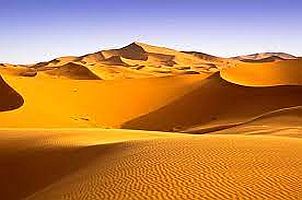
Our planet has changed a lot over billions of years, from the location of the continents to the makeup of the atmosphere, and a new study looks in detail at the history of the Sahara desert – which wasn’t always an arid wilderness. Researchers from Finland and the UK reconstructed the periodic transformations of the Sahara over 800,000 years using a new climate model. “Our study is one of the first climate modeling studies to simulate the African humid periods with comparable magnitude to what the paleoclimate observations indicate, revealing why and when these events occurred.” The researchers focused in particular on what are known as the African humid periods, spans of time when the African continent was much wetter and greener than it is today. The climate model was used to investigate the timing and driving forces behind these periods. The modeling backed up a long-held hypothesis that African humid periods are driven by Earth’s orbital precession: the way it wobbles on its axis across a 21,000-year cycle, which in turn affects variation between the four seasons and the strength of the African Monsoon meteorological system. As backed up by other data and testing, the precessions would’ve meant warmer summers in the Northern Hemisphere, more intense monsoons across West Africa, and thus more rainfall across the Sahara. Another notable finding from the study is that during ice ages – with giant glaciers covering the higher latitudes – the effects of the wobbles in Earth’s orbit were somewhat canceled out, keeping northern regions cooler and restricting the African monsoons. Knowing when the Sahara was wet, green, and inhabited by animals such as hippos can also teach us more about the spread of humankind across the globe. These greening periods may well have provided an opportunity for people (and indeed other species) to move across stretches of the Sahara that were usually very difficult to traverse. “Our ability to model North African humid periods is a major achievement,” says University of Helsinki geoscientist Miikka Tallavaara, “and means we are now also better able to model human distributions and understand the evolution of our genus in Africa.” Excerpted from a Science Alert article by DAVID NIELD
Present-Day Glacial Outburst Floods – WaPo Article
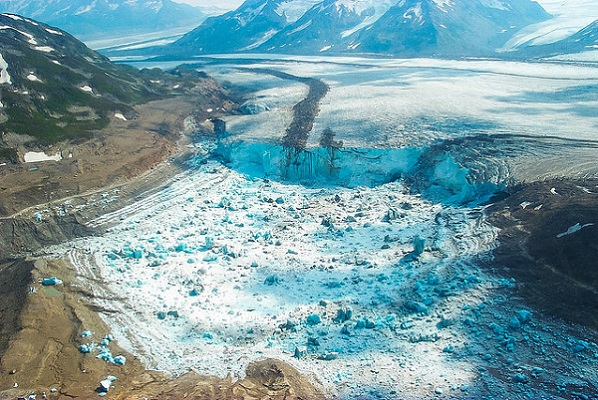
Mendenhall Glacier and other glaciers above Juneau, Alaska, while rapidly receding are trapping meltwaters that are more frequently being released as devastating ‘glacial outburst floods’ in mini-examples of the processes that produced the Ice Age Floods. The Washington Post recently produced a detailed article about the Aug. 5th flood that roared through Juneau on the order of a 500-year flood. Excerpted from Washington Post, Sept. 4th article by Joshua Partlow On the morning of Aug. 4 … “Looks like the basin is going.” The U.S. Geological Survey (USGS) gauge at Mendenhall Lake — at the foot of the glacier — was showing water levels rising sharply. … All summer, a jumble of icebergs and meltwater had been filling Suicide Basin. And when it eventually flushed out, as it had done more than 30 times since 2011, the water would pour into Mendenhall Lake and down the river to Juneau. … The glacier normally served as a dam for that reservoir of ice melt and rainwater, but when enough of it accumulated, the tremendous pressure could lift the glacier and let water escape underneath. This was known as going “subglacial.” When that happened … the passageway within the glacier can rapidly expand, emptying billions of gallons of water downstream in a matter of hours … About a week later,water began overtopping the ice dam and flowing down along the glacier’s flank. When this overtopping had happened in two previous years, the water found its subglacial escape hatch about a week later. But each year the glacier is changing, and the holes made the summer before may be gone. No one knew exactly when it might burst. On Aug. 4, with lake levels rising, the National Weather Service issued a warning predicting that Mendenhall Lake would peak the following evening around 10.7 feet — about five feet above its typical level … the next day … observing the raging river as water levels surpassed that initial projection and then kept going beyond the 12-foot record set in July 2016. Before the night was over, it would rise three feet higher.
Mima/Desert/Biscuit Mounds – An (Possible) Explanation

If you’ve visited the Rowena Crest Viewpoint at Tom McCall Preserve, west of The Dalles in the Columbia River Gorge, you may have noticed the many dome-shaped earthen mounds that cover the Rowena Plateau. These mounds are broadly circular and are surrounded by collections of basalt rock fragments. If you’ve visited the spring wildflower mecca of Catherine Creek on the Washington side of the Gorge, you may have also wondered at what caused the stripes of black rock extending down the slopes above the area. Tens of thousands of similar soil mounds cover large areas of the high desert lands of north-central Oregon, often in swarms that number in the hundreds. These mounds can be round or elongated, can range from a dozen feet to more than 60 feet in diameter atop the rocky Columbia River Basalt bedrock, and are typically surrounded and separated from each other by rings or stripes of basalt rock fragments. The mounds also appear similar to those at Mima Mounds Natural Area Preserve near Olympia, WA. There have been many suggested causes for the creation of these mounds, from burial mounds, to Pleistocene pocket gophers, to plants or glacial sun cups trapping wind-blown sediment, to sorting by earthquake vibrations, to turbulence at the base of ice-age floods flowing over the landscape. Research by two Oregon graduate students, Clark Nelson of Oregon State University and John Baine Pyrch of Portland State University, independently came up with what may be the most likely explanation for the origins of these enigmatic features. Their theses suggest desert mounds and their rock rings formed through a process of natural sorting, where fine soil material is pushed up into mounds and associated rocks are pushed out to the edges to form rings through countless cycles of wetting/drying and freeze/thaw during the wetter and colder period of the late Pleistocene. Clark Nelson cut a trench through a mound that exposed layers of soil and volcanic ash whose lack of mixing discounts the pocket gopher theory. Nelson also found that slope angle less than or greater than 10 degrees determined whether the features would form rounded mounds vs. elongated stripes. Pyrch showed the strips to be distinct from common talus slopes, because no obvious source of rock exists at the head of the talus stripe. He also observed that rocks within these stripes are sorted, unlike talus slopes, suggesting the same ice age freeze-thaw origins as soil mounds and rock rings. You can read more detailed articles about these enigmatic features in these articles: Mystery of the Desert Mounds Great Pyramids of the Gophers: Mima Mound Mystery Solved Similar processes are also thought to be responsible for the “patterned ground” found in periglacial environs. However these various types of features may have formed, we can be certain how the few mounds in the center of the parking circle at Rowena Crest Viewpoint came to be. They were man-made during the construction of the viewpoint and made to look like the mounds that cover the Rowena Plateau. At least one origin has a definitive answer.
Bone Pendants Suggest Humans in South America 25,000 Years Ago
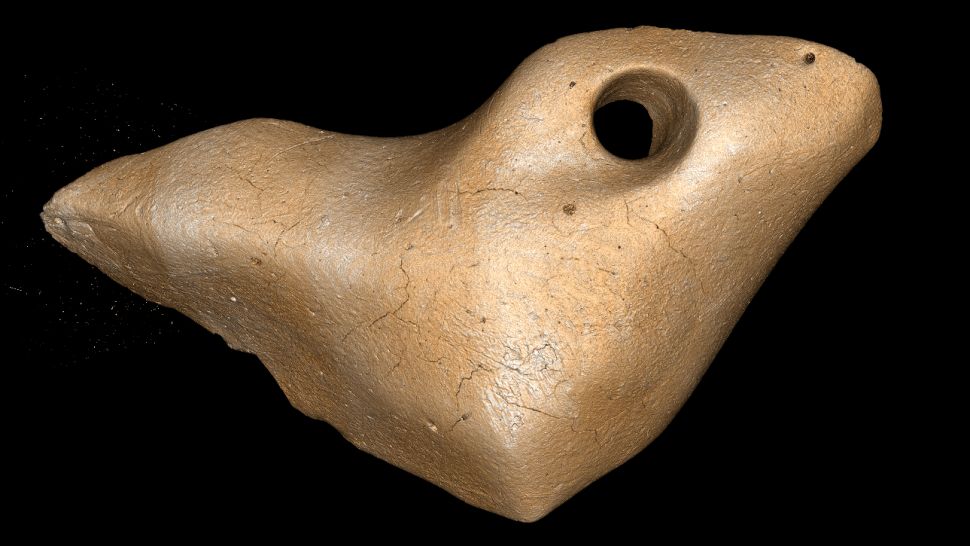
The date that humans arrived in South America has been pushed back to at least 25,000 years ago, based on an unlikely source: bones from an extinct giant ground sloth that were crafted into pendants by ancient people. The presence of human-modified sloth bones in association with stone tools from geological layers that date to 25,000 to 27,000 years ago is strong evidence that people arrived in South America far earlier than previously assumed. Discovered in the Santa Elina rock shelter in central Brazil, three sloth osteoderms — bony deposits that form a kind of protective armor over the skin of animals such as armadillos — found near stone tools sported tiny holes that only humans could have made. The finding is among the earliest evidence for humans in the Americas, according to a paper published July 12 in the journal Proceedings of the Royal Society B. The Santa Elina rock shelter, located in the Mato Grosso state in central Brazil, has been studied by archaeologists since 1985. Previous research at the site noted the presence of more than 1,000 individual figures and signs drawn on the walls, hundreds of stone tool artifacts, and thousands of sloth osteoderms, with three of the osteoderms showing evidence of human-created drill holes. The newly published study documents these sloth osteoderms in exquisite detail to show that it is extremely unlikely that the holes in the bones were made naturally, with the implication that these bones push back the date humans settled in Brazil to 25,000 to 27,000 years ago. These dates are significant because of the growing — but still controversial — evidence for very early human occupation in South America, such as a date of 22,000 years ago for the Toca da Tira Peia rock shelter in eastern Brazil. Using a combination of microscopic and macroscopic visualization techniques, the team discovered that the osteoderms, and even their tiny holes, had been polished, and noted traces of stone tool incisions and scraping marks on the artifacts. Animal-made bite marks on all three osteoderms led them to exclude rodents as the creators of the holes. “These observations show that these three osteoderms were modified by humans into artefacts, probably personal ornaments,” the researchers wrote in their paper. Edited from Live Science article by Kristina Killgrove
Ice Age Floods National Geologic Trail – July 2023 Update

Hello from the trail. A lot has been happening over the past couple of months and I’ll start with our new National Park Service interactive web map (https://www.nps.gov/iafl/planyourvisit/maps.htm). Our new web map will help visitors locate and understand the complexity of various Ice Age flood features throughout Ice Age Floods National Georgic Trail. This new map would not have been possible without the support and collaboration of the Ice Age Floods Institute. The National Park Service has also been out and about with its mobile visitor center for the floods and Lake Roosevelt National Recreational Area. The trailer was at several Spokane conventions earlier this year and made an appearance at the 2023 Sand Hill Crane Festival is Othello, WA. This year’s Ice Age Floods Institute annual member meeting was a smashing success. The Jubilee was a grand time for many to dig deeper into their experiences with this fascinating story. So many floods’ detectives out walking, hiking, and driving Ice Age Floods National Geologic Trail, I was excited to meet and join with members through presentations, walks and tours in the heart of the Missoula Floods there at Dry Falls and the Grand Coulee. Last month the National Park Service was also fortunate enough to participate in the Geologic Society of America 2023 Penrose Conference. This conference focused on Glacial Lake Outburst Floods (GLOFs) and drew presentations from world renowned scientists. Fitting that this conference was also held at Dry Falls on the 100th anniversary of J Harlen Bretz’s first publication about the Channeled Scabland. It was great to see so many people thinking about outburst floods and, of course, several of the presentations focused on the Missoula Floods. Scientists from all over the world are taking various approaches to better understanding the forces at work during massive GOLF events. Efforts like dating giant gravel bars help us better understand when events took place, modeling water flow helps us see where water went based on various terrains, and new Light Detection and Ranging (LiDAR) data is helping us see past vegetation to the hidden landscape below. I was most impressed with the scope of efforts underway. From British Columbia, Alaska, and the Tropical Andes, to China, Antarctica, and Iceland, evidence of events like our Missoula Floods are being closely studied across the globe. Also in attendance were members of the twelve Bands which compose the Confederated Tribes of the Colville Reservation. The Grand Coulee and surrounding flood channels are the historic homelands of the Colville Tribe, and they shared cultural connections with the landscape and floods. In all some 70 participants helped create an atmosphere of reverence for a greater understanding of the forces at work changing our planet: then and now. I would also like to thank our partners at Washington State Parks for not only hosting both events but also for the daily care and respect they show these special places. Don’t forget you are also encouraged to come by the Dry Fall Visitor Center for this year’s Flood Fest, July 22, 11-3pm. See you there!
Must See Floods Features in Northern Idaho

SOME LOCAL NORTHERN IDAHO ICE AGE FLOODS and GLACIAL FEATURES Purcell Trench – This structurally formed valley became the passageway for the Purcell Ice Lobe that divided into five glacial sub-lobes. The east moving sub-lobe blocked the Clark Fork River forming Glacial Lake Missoula, the source of the Ice Age Flood waters. Other sub-lobes modified and deepened the basin now occupied by Lake Pend Oreille or helped define several important N-S transportation routes. The Purcell Trench is visible from City Beach in Sandpoint and Schweitzer Mountain Rd. Hwy 95 follows the Purcell Trench from Sandpoint to beyond Bonners Ferry. Cabinet Gorge – Contact of Pleistocene Ice and Glacial Lake Missoula Water – Although the contact of the Pleistocene Ice and the lapping waters of Glacial Lake Missoula was in flux as the glacier advanced and retreated, the Cabinet Gorge is considered by many to be a likely location of the terminus of the Clark Fork sub-lobe that blocked the drainage of the Clark Fork River. Evidence of glacial erosion and till deposits indicate glaciation; however, flood deposits on the south side of the river attest to Ice Age flooding. Cores taken during the construction of the Cabinet Gorge Dam suggest multiple stages and events of ice damming. An AVISTA maintained viewpoint at the Cabinet Gorge Dam with Ice Age Floods signage provides an excellent location to ponder the formation and disintegration of the ice plug blocking the Clark Fork River. Glacial Striations – Striations can be viewed along Hwy 200 east of Hope and on the south side of Castle Rock east of Clark Fork. Glacial/Flood Related Erratics – Large and small erratics cover the glacial and flood modified landscape. Large erratics can be seen along Hwy 200 east of Clark Fork, in Sandpoint’s City Beach and in Farragut State Park. A large pile of erratics excavated from flood deposits are visible on the west-side of Hwy 95 south of the Hoodoo Channel. A giant ice-rafted flood related erratic weighing over 1,600 tons is located on the east-side of Hwy 41 near Twin Lakes. Lake Pend Oreille – Cross-section morphology, depth, and sediments – This is where it all started! Lake Pend Oreille is the largest lake in Idaho and the deepest lake in the Pacific Northwest and the 5th deepest in the US. The lake level is 2062 ft above sea level with depths over 1,000 feet and an additional layer of over 1,500 feet of glacial-fluvial deposits going to bedrock, with the surrounding terrain as high as 6002 ft. The glacially modified U-shaped bedrock valley, cut to approximately 600 feet below sea level, was formed by the Pend Oreille glacial sub-lobe. This glacial sub-lobe was up to 4,000+ ft. thick and 30+ miles wide. It was the ice plug responsible for blocking the Clark Fork River. It collapsed catastrophically as often as about every 10-60 years, releasing 40-100 Ice Age Floods. The location of the lake is probably related to an old river valley controlled by faults. The Lake Pend Oreille basin was carved by the repeated advances of Pleistocene ice and scoured by ice age floods. With the waning of ice age flood waters, the basin was, and continues to be, filled with glacial outwash and flood deposits. The lake is dammed at the south end by thick glacial and flood deposits the mark the beginning of the “Outburst Deposits”. There is a pullout on Hwy 200 approximately one mile west of Hope with signage already established that provides a great view looking south across Lake Pend Oreille to the Green Monarch Mts. Another view of the former ice plug location along Hwy 200 is the mouth of the Clark Fork River at the Clark Fork Drift Yard. Giant Current Dunes or MegaRipple Marks – One of Bretz’ most important pieces of evidence for catastrophic flooding was the “giant current dunes.” These large-scale bedforms appeared as patterns of parallel ridges and swales on many aerial photographs in the flood channels in the scabland of Washington, but had escaped recognition from the ground because of their size. Giant Current Dunes are visible west of Clark Fork near Castle Rock; however, the most prominent and visible Giant Current Dunes are located several miles east of Spirit Lake along Hwy 54 where the highway cuts through the dunes showing their undulating profile. The location of many of the telephone poles on the crest of these dunes accentuates these landforms. The dunes form transverse to the current direction, and form cusps that are convex upstream, with arms that point downstream. Furthermore, the size of the cusps appears to decrease in the direction of lower velocity. Internally, the dunes consist of gravel and pebble foresets. Giant current dunes exhibit an asymmetrical profile with the downstream (lee) slope steeper than the upstream slope. Crests range from 20 to 200m apart and heights range from 1 to 15m (Baker and Nummedal, 1978) and are among the largest measured throughout the Floods area. The Spirit Lake current dunes can also be easily recognized from the air by their characteristic pattern, accentuated by vegetation. This dune field is immediately in the path of the breakout from Lake Pend Oreille, and experienced some of the highest energy flows. Rhythmites – Rhythmites are glaciolacustrine sediments associated with flood events and are useful in attempting to determine the number of Ice Age Floods. A 112-foot cross-section of rhythmites is located at the junction of East Fork Creek and Lightning Creek approximately 6.5 miles northeast of Clark Fork along Lightning Creek Road (NF-419). Proglacial Deposits – This type of deposit is found associated with most of the drainages on the south side of the Clark Fork Valley and extend from the mouth of the Clark Fork River to nearly Thompson Falls in Montana. These sediments are glacio-fluvial deposits deposited in contact with the ice and therefore provide evidence of glaciation in the Clark Fork River drainage. The associated geomorphic features formed by these deposits are referred to as “kame deltas”. The gravel pit associated with Dry Creek (approximately 8 miles west of Clark Fork
The Oldest Stone Tools Ever Found in the US

Indigenous people have been in the Americas longer than archaeologists once thought. Stone tools unearthed from a rock shelter in Southern Oregon were last used more than 18,000 years ago, radiocarbon dating suggests. That makes the site one of the oldest-known human living spaces in the Americas. Buried deep beneath a layer of volcanic ash, archaeologists excavating Rimrock Draw Rockshelter found two stone scraping tools, which ancient knappers had skillfully shaped from pieces of orange agate. A residue of dried bison blood still clung to the edges of one scraper, a remnant of the last bit of work some ancient person had done with the tool before discarding it. The layer of volcanic ash above the tools had blasted out of Mount St. Helens, a few hundred kilometers north of the rock shelter, 15,000 years ago, long after the fine agate scrapers, and the people who made and used them, had been forgotten. In a layer of dirt below the volcanic ash but above the stone tools, archaeologists found broken teeth from now-extinct relatives of modern camels and bison. Radiocarbon dating on a piece of bison tooth enamel (first in 2012, and confirmed recently by more testing) suggests the teeth belonged to animals that lived about 18,250 years ago. And because those teeth were buried in a layer of dirt above the stone tools, they must have ended up in Rimrock Draw sometime after the tools. That makes the agate scraper, complete with bloody evidence of its use, more than 18,000 years old—and one of the oldest traces of human presence in North America. But the people who lived in Oregon more than 18,000 years ago almost certainly weren’t the first to call the continent home. In Idaho, the Nimiipuu (Nez Perce) know the Cooper’s Ferry archaeological site as the ancient location of a village they call Nipehe. The oldest artifacts unearthed at the site date to at least 16,000 years ago, and it looks like people lived there, at least off and on, for several thousand years after those first arrivals. To have reached Cooper’s Ferry 16,000 years ago, the ancient inhabitants of Nipehe would have had to cross Beringia, a land mass that connected what’s now Russia with what’s now Canada during the last Ice Age, when sea levels were lower. They then had to move south along the Pacific Coast of North America, skirting along the western edge of the great ice sheet, until they reached the southern edge of the ice. The ice-free corridor wouldn’t open until about 15,000 to 14,000 years ago. By then, people were already living far, far south of the ice: Archaeologists found stone tools and butchered mastodon bones submerged in a Florida sinkhole that dated back to 14,500 years ago. And in Chile, someone left behind a single footprint 14,600 years ago. Thanks to footprints on an island off the coast of what’s now British Columbia, we know that at least some people did make their way along the coasts about 13,000 years ago. But some archaeologists, like Bournemouth University’s Matthew Bennett and his colleagues, say that those coastal migrants may have found their way into a continent already home to people who arrived at least 26,000 years ago—long before the ice sheets blocked the way into North America from Asia. In the mountains of north-central Mexico, archaeologists unearthed stone tools from Chiquihuite Cave, which dated back to around 30,000 years ago. And at White Sands National Monument in New Mexico, it appears that someone walked along the ancient shoreline of Lake Otero (now long since dry) between 23,000 and 21,000 years ago, leaving behind a trail of 61 footprints. Archaeologists dated the White Sands footprints thanks to grass seeds trapped in the layers of clay and silt above and below the tracks, which helped bracket their possible age. Some archaeologists are still skeptical, partly because there are so few sites this old south of the ice sheets, but there’s enough evidence to take the claims seriously. Taken from an article by KIONA N. SMITH published in arsTechnica
Modeling Time: Human, Geologic, Cosmologic

It’s difficult for most people to grasp the immensity of time as it’s viewed by archeologists, much less as it’s viewed by geologist or cosmologists. One way often used by those scientists to model time in terms that others can visualize is to compare time to distance along a path, with markers to denote specific events and periods. To Scale: TIME is a YouTube video about a group of friends who built a practical scale model of time: 13.8 billion years of cosmic evolution, and our place within it, on a dry lakebed in the Mojave.
Molten Mush Under Yellowstone Supervolcano

The mantle hotspot now under Yellowstone is thought to have been the source of the voluminous Columbia River Basalts that erupted from 17 to 6 million years ago as the North American continent passed over the hotspot, and that now underlie much of the path of the Ice Age Floods. During and since that time the hotspot cut a long and explosive path from the Oregon/Nevada/California border across the Snake River Plain, but ongoing research appears to show it to be fairly stable for at least our brief geologic time. A new study has found the amount of melted rock beneath Yellowstone’s supervolcano is far higher than previous estimates. Scientists have worked out the consistency of the magma under the Yellowstone caldera using seismic waves — and the reservoir is filled with “mush” that doesn’t pose an imminent eruption threat. While researchers say there is no sign of an imminent eruption, the discovery provides a more detailed view of what’s going on in the enormous magma chamber that sits beneath the national park. Far from a smooth blend of molten rock, magma reservoirs contain a large amount of solid rock, semi-liquid crystals, gasses and other volatile substances. This “magmatic mush” is highly dynamic but tends to burst out from deep underground when the proportion of liquid — or melt — crosses a certain threshold. Previous work suggests that eruptions typically occur when at least 50% of the space in the upper magma reservoir — a layer of flattened pockets of magma stacked on top of each other — is filled with melt. The magma reservoir beneath Yellowstone volcano consists of two chambers — a shallow reservoir near the surface that’s around 55 miles (90 kilometers) long and 25 miles (40 km) wide, and a deeper chamber that is about 4.5 times larger. While the deeper reservoir contains about 2% melt, the upper chamber contains far more: A study published in Science in December 2022 put the proportion of melt between 16% and 20%. Now, Sin-Mei Wu, a geophysicist and postdoctoral researcher with the Swiss Seismological Service at the Federal Institute of Technology (ETH) in Zurich, and colleagues have found the percentage is much higher. The team used seismic wave data to assess the texture and composition of the upper magma reservoir, which is about 3 miles (5 km) deep at Yellowstone. The results, published June 8 in the journal Earth and Planetary Science Letters, indicate the upper chamber consists of 28% melt — 8% to 12% more than the 2022 estimate, which was found with different methods, Wu said. “What we found is that the portion of liquid phase is not enough to have an imminent eruption,” Wu told Live Science. “Although we found a much higher portion of liquid than what was previously found, it’s still only up to 28%. So, to the best of our knowledge, Yellowstone will not have an imminent eruption.” Working out the proportion of liquid in magma reservoirs could help scientists evaluate the risk of volcanic eruptions elsewhere. “It’s important to understand the eruption potential, maybe not for Yellowstone so far, but you can apply the same methods to other magma systems that are more prone to eruption and to some that are already erupting,” Wu said. The methodology used for the study is “revolutionary in the detail and resolution it allowed for,” said Michael Poland, a research geophysicist and scientist-in-charge at the Yellowstone Volcano Observatory. The magma at Yellowstone and in other magmatic systems is like “mush,” Poland told Live Science in an email. “We often refer to ‘magmatic mush’ to convey a sense that it’s not a 100% molten ball, but also contains a lot of solid material — in the case of Yellowstone, way more solid than liquid material,” he added. “Maybe like a really thick lentil soup.” Despite recent breakthroughs, scientists can’t be sure what exactly lurks beneath the supervolcano, Wu said. “We are looking forward to some joint interpretation with other geophysical data to find out, for example, if we only have melt or if there is gas, volatiles, or something else that will help us understand the eruption dynamics.” From an article in Live Science by Sascha Pare