
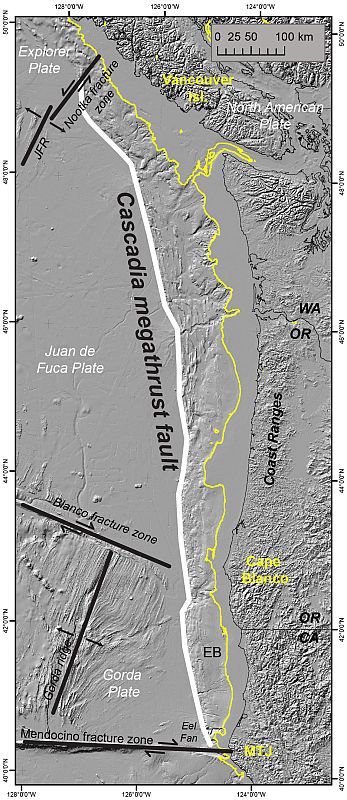
A new study finds a 1954 earthquake that rattled Northern California was likely caused by the infamous Cascadia Subduction Zone. The linking of the magnitude 6.5 quake with this particular seismic zone is important, because the Cascadia Subduction Zone, which stretches from northern California to Vancouver Island in Canada, is not known to give off many small or medium quakes. In seismology parlance, the fault is “locked,” or unmoving. The last known rupture was a massive magnitude 9 earthquake in 1700 that caused landslides and an enormous tsunami that was so powerful that waves over 16 feet high (5 meters) hit Japan, according to the U.S. Geological Survey.
In modern times, though Cascadia “has been eerily quiet,” one of the study’s co-authors said in a statement. “We don’t have smaller earthquakes, and that’s not something you usually see in subduction zones.”
That lack of small earthquakes in the decades since scientists started monitoring faults with seismometers and other instruments means they have a limited sense of Cascadia’s behavior. But the new research suggests that the fault has possibly ruptured on a smaller scale within recent memory. The study re-evaluated a Dec. 21, 1954 quake that shook the Humboldt Bay, California area just before noon. Residents reported strong, rapid ground motion that toppled chimneys.
Researchers had previously proposed 14 different epicenters for the quake. The new study honed in on Fickle Hill, a small forest community along a two-lane road not far from the larger city of Arcata. The researchers also found that the fault that caused the quake likely ruptured between about 6.8 miles and 8.7 miles (11 to 14 kilometers) below the surface.
Arcata sits in a particularly interesting earthquake region. It’s not far from the offshore “triple junction,” where the Pacific oceanic plate meets the Gorda oceanic plate and the North American continental plate. It’s also in the transition zone between the San Andreas fault zone (where the North American plate and the Pacific plate slide past each other) and the Cascadia Subduction Zone (where the oceanic Juan de Fuca plate dives under the North American plate).
Most quakes near Humboldt originate on the Gorda plate. But the Fickle Hill quake didn’t, the researchers found. Based on the depth and the direction of the earthquake waves, the quake instead seems to have come from the Cascadia Subduction Zone. That makes Fickle Hill one of only two known possible Cascadia quakes since 1700. (The magnitude 7.2 Cape Mendocino quake in 1992 might also have been a Cascadia quake, though that is still hotly debated.)
The finding would suggest that Casadia does not have to rupture all at once, causing devastatingly huge quakes, but that it can also break in segments, creating smaller temblors. Though the new research doesn’t yet translate to any predictions of what Cascadia might do in the future, reviewing existing data can help improve scientists’ understanding of the area’s tectonics, ultimately helping improve their estimation of the earthquake hazard for the Pacific Northwest.
Excerpted from a Live Science article by Stephanie Pappas published